I spend a lot of time on tech forums. One type of post keeps showing up: I filed my income tax return using an AI chatbot. Some read like victory laps. Others are cautionary tales. Having spent over a decade building tax technology, I read every single one of them carefully. Together, they show where AI helps taxpayers and where it quietly fails them.
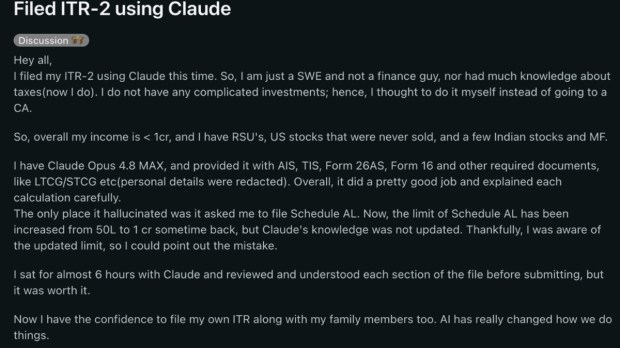
An engineer recently used an AI chatbot to file his ITR-2. He uploaded his Form 16, Form 26AS, AIS and TIS, and the AI did a great job explaining every calculation. I love this part. These government forms are a mystery to most people, and a busy tax professional racing a deadline rarely has time to explain them.
But look at what that convenience actually cost him. The chatbot used an old disclosure limit that had changed months ago. He caught it only because he happened to know the current rule. That one error pushed him into six hours of rechecking every section before he felt safe to submit. Think about that: six hours of expert-level review, done for free, by the customer himself. That is the hidden catch with generic AI: the machine does the quick drafting, and you are stuck with the heavy lifting as the reviewer.
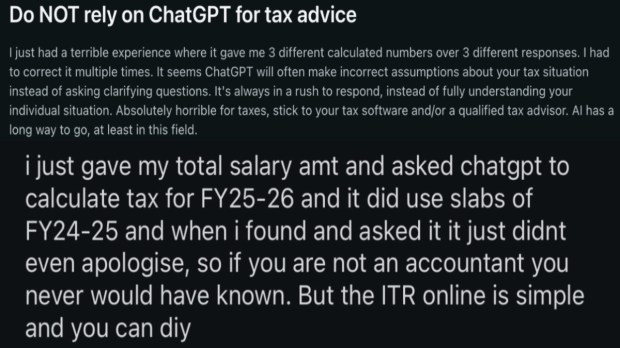
Another taxpayer asked a chatbot to calculate the tax on his salary, and the tool quietly applied the previous year’s slabs. He admitted he would have missed it if he hadn’t known the correct rates. Indian tax law changes constantly. Slabs move, rebates shift, and we are navigating an entirely new Income Tax Act. A single error can trigger penalties and notices, yet the chatbot served outdated law without realising it. A first-time filer has no way to see through that.
This isn’t just an Indian problem. An NRI taxpayer got three different calculations from the same chatbot across three prompts, and finally gave up correcting it.
Notice the larger problem here. These stories exist only because someone caught the mistake. Countless returns have already been filed by people who simply trusted the chatbot’s first answer. That group worries me most. A bad return doesn’t announce itself on filing day. It surfaces months later as a notice or a missing refund.
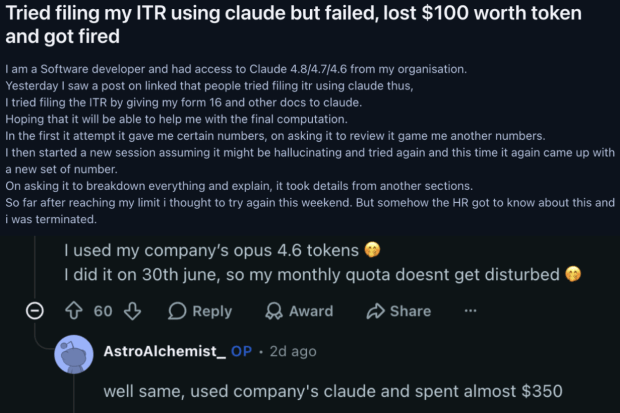
The final story came from a developer who used his company’s paid AI access for his personal return. The chatbot gave him different numbers with each prompt. Later, HR discovered his personal financial data on company resources and he lost his job. This is not an isolated case either. Many others admit to spending up to 350 dollars of employer tokens on a single return. Meanwhile, a straightforward filing on ClearTax takes barely a few minutes and just a few hundred rupees.
This also exposes a risk people overlook. A Form 16 carries your PAN, your salary structure and your employer’s proprietary details. A chat window is a conversational interface, not a secure filing system. This is exactly why government frameworks exist. ClearTax operates as a registered e-Return Intermediary, licensed by the Income Tax Department, bound by strict rules on data security, encryption and audit trails.
These cases arrive at a time when returns aren’t simple anymore. Nearly a third of filers now use ITR-2 or ITR-3, and ITR-3 filings have more than doubled in a year. People are trading stocks, holding mutual funds, trying F&O. This is exactly where a chatbot messes up the math, and the tax department flags every mismatch as defective.
Does this mean platforms like ClearTax are dead because of AI? Not even close. I am an AI maximalist. We use AI to guide millions of users. But the AI doesn’t do the filing and it doesn’t touch the math. The heavy lifting sits with our tax engine – millions of lines of battle-tested code that updates the day a rule changes, pulls data from over 100 brokers, removes duplicates and checks everything against government records in real time. The AI sits on top of that engine to ease the process, not to run it. The engine doesn’t guess; it calculates.
Meanwhile, we let AI do what it is great at: simplifications, answering questions, making the process feel human. The real compliance work, capital gains, loss carry-forwards, regime choice, stays with our core code and our tax experts.
Being fast and easy is great, but getting your return right is what keeps you safe. Every taxpayer deserves both.
(The author is the founder and CEO of ClearTax)
Disclaimer: The views expressed in this article are solely those of the author and do not reflect the official policy, editorial position or views of Financial Express. The article is intended for informational purposes only and should not be construed as tax, legal or financial advice.
Every financial journey has a turning point. What’s yours?
Financial Express is launching a new series highlighting real experiences with money, investments, and the taxman. Did a sudden tax rule catch you off guard? Did a piece of financial advice change your life? Your story could provide invaluable, practical lessons for thousands of fellow taxpayers. Share your experience with us. We respect your privacy: no stories will be featured without a direct conversation and your full consent. Thank you.