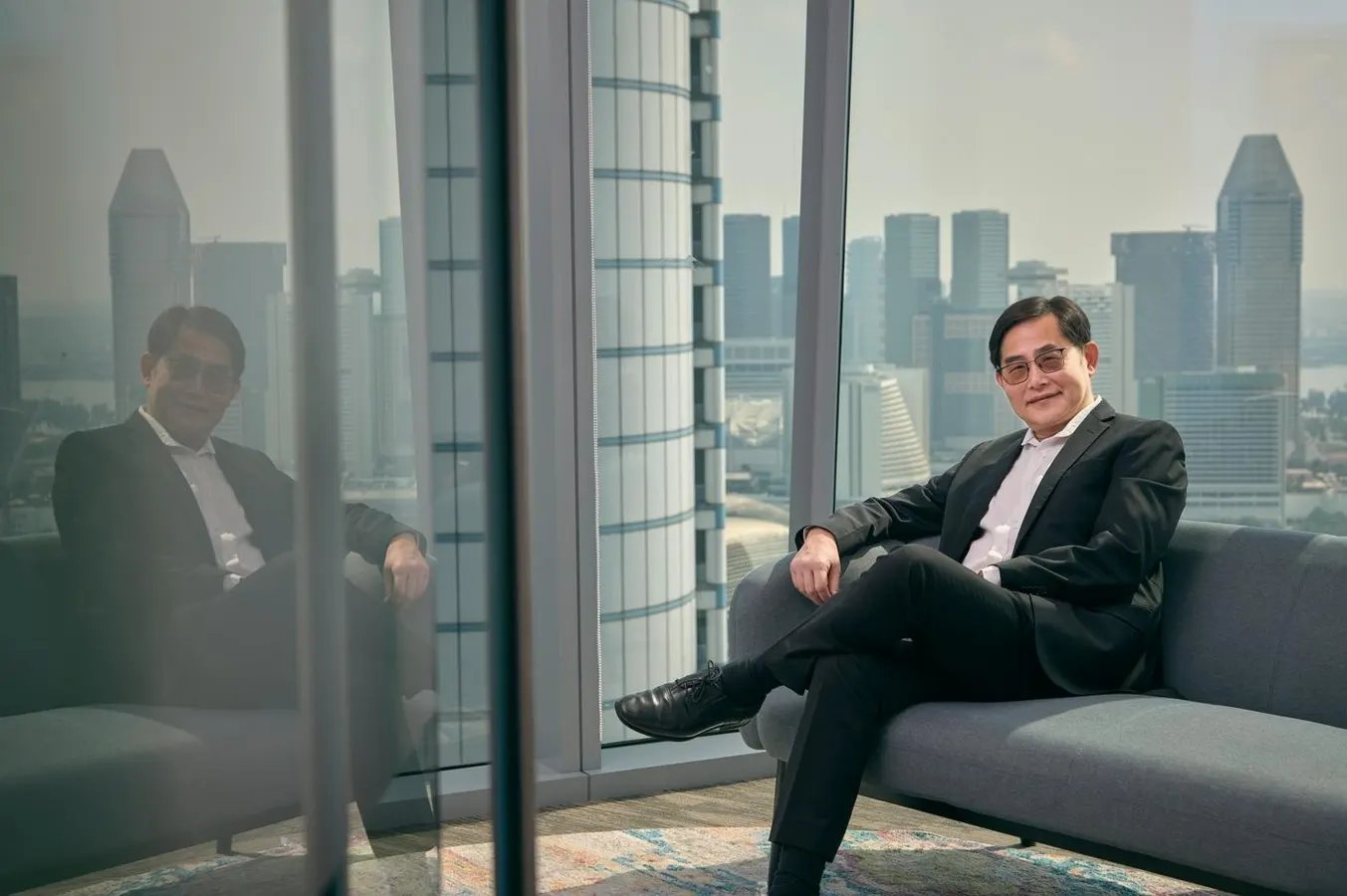
Company founder Lim Chung Chun reshaped retail investing in 2000 by making it easy to buy mutual funds online. Now, with a suite of 29,000 investment products and 1.2 million customer accounts, he’s betting digital banking can take the firm global.
Long before fintech was a buzzword, Lim Chung Chun was bringing retail investors in Singapore online. In 1998, at the peak of the dotcom boom, he left his job as head of equity research at ING Barings Securities and two years later launched Fundsupermart.com, offering low-cost, easy access to a range of mutual funds online. Other fintech firms that followed in its wake focused either on investments or banking, but Lim built for both, naming the company iFAST in 2003.
Today, that first business-to-consumer platform (now called FSM Global) is one of the most comprehensive sites for wealth management in Southeast Asia with 1.2 million customer accounts and offering 29,000 investment products, including over 16,800 funds from over 350 fund houses. It has expanded from mutual funds to bonds, equities, government securities and exchange-traded funds in markets beyond its home base, including Malaysia, Hong Kong, mainland China, the U.K. and the U.S. Lim simultaneously built a business-to-business platform that accounts for over two-thirds of the company’s S$33 billion ($25 billion) in assets under administration (AUA) as of March 31, meaning assets that are not actively managed, serving 14,700 wealth advisers at 850 banks and financial institutions.
These days Lim, 58, is focused on leveraging that breadth for iFAST’s big play: plugging iFAST Global Bank (iGB), a digital bank it owns in the U.K., into its investment platform to widen the customer pool. And he’s targeting the segment he knows, the mass affluent, people with investible assets of up to $1 million. “Private banks serve customers from all over the world, but focus on high-net-worth individuals. We think the big opportunity is mass affluent customers,” says iFAST’s chairman and CEO in an interview at his 26th floor office in Ocean Financial Centre, overlooking Singapore’s Raffles Place central business district.
In February, Lim outlined the company’s plan to clock a compound annual asset growth rate of over 25% to reach S$100 billion in AUA by 2030. “The scale is as big as we want to dream. Where we are at today, with over S$30 billion in AUA, is a tiny drop in the context of where the global banking and wealth management opportunity is,” says Lim.
In 2019, iFAST celebrated five years of being listed on the Singapore Exchange.
COURTESY OF IFAST
Accelerating growth will involve securing more payments licenses, in addition to the couple it already has, to help customers move money seamlessly across borders. iFAST received in-principle approval for a Malaysian payments license in 2025, and plans to launch services later this year. To further beef up its payments connectivity, iGB in April partnered with Alipay, the e-wallet gateway of Ant International, the Singapore-based arm of Chinese fintech giant Ant Group. That enables iGB customers to use the bank’s app to pay over 150 million merchants across 100-plus markets.
With its headquarters in Singapore, iFAST is well-placed. The city-state’s reputation for strong regulation and an investor-friendly tax regime has strengthened its position as a global wealth management center, and it’s poised to remain a magnet for capital, family offices and globally mobile investors, notes Nirguran Tiruchelvam, Singapore-based head of consumer and internet research at investment advisory firm Aletheia Capital. Hyderabad-based market research firm Mordor Intelligence forecasts Asia-Pacific’s wealth management market will surge to $41.8 trillion by 2031 from $27.6 trillion in 2025, thanks to urban growth, rising middle-class affluence and widening use of affordable robo-advisory models, a type of automated financial advisor. Lim’s strategy has already begun to pay off. iFAST’s net profit more than doubled to S$67 million on a 49% jump in revenue to S$383 million in 2024, a growth trajectory that earned it a spot in 2025 on Forbes’ Best Under A Billion list of 200 small and midsized publicly traded companies in Asia-Pacific with sales above $10 million and below $1 billion. In 2025, iFAST kept up the pace with net profit topping S$100 million on S$515 million in revenue.
The company’s shares, up 33% in early July from a year ago, pulled back from their January peak after first-quarter earnings, which came in slightly below expectations despite net profit rising 48% to S$28 million on a 45% increase in revenue to S$155 million. Analysts say the broader growth story remains intact, with momentum likely to improve. Lim is iFAST’s largest individual shareholder with a nearly 20% stake that’s worth S$540 million.
Growth hasn’t always been linear. Like many online investing platforms, iFAST got a powerful boost during the Covid-19 pandemic, when lockdowns kept people at home and retail investors flocked online. Net inflows nearly quadrupled to S$3.8 billion in 2021 from S$976 million in 2019. But the surge also amplified a structural strength in iFAST’s model: a flywheel effect in which an increasingly broad product range attracts more advisors, investors and institutional partners, which in turn draws more suppliers of investment products and deepens the platform’s appeal. That dynamic drove growth in AUA in 2025, with Singapore accounting for 70% of the total.
Marking Milestones
Both top line and bottom line performance are improving steadily.
*Maybank estimates
Source: iFAST
Tiruchelvam of Aletheia Capital notes that Lim’s approach has helped set iFAST apart in an increasingly crowded field at home. While domestic rivals—including StashAway, a robo-advisor that offers automated risk-managed portfolios, and Chocolate Finance, which offers low-cost cash management—have built slick, niche investment products, iFAST is betting that its customers will prefer a full-service platform that lets them hold cash, move money across borders and invest across markets. Lim, adds Tiruchelvam, “has been at the cutting edge of it all.”
“He had a vision and grew the company fast from a very small investment platform to where it is today,” says David Liau, a Singapore-based investor who has been a customer since 2004. “iFAST offers investors a slew of investment products and its multi-advisory team provides insightful research,” adds Liau, who trades about S$1 million worth of stocks every month and says he appreciates being able to access international markets at a very affordable cost versus other international players.
Lim grew up in a small town in Johor, Malaysia, where his father ran a photography studio in a traditional shophouse while the family lived upstairs. His parents were hopeful that their only son among four children would become a doctor, and dispatched him at age 12 to live with an uncle in Singapore to continue his studies. But after missing out on a place in medical school, Lim followed an interest in math into studying electrical engineering at the National University of Singapore. After graduating in 1991, he joined the now defunct ING Barings Securities as an analyst, becoming its head of research.
He left in 1998 to focus on investing his own money and funds from a few private investors with a friend, Moh Hon Meng, a former Procter & Gamble marketing executive. While working to get the venture off the ground, they met with a couple of management consultants, who suggested that online investing, which had taken off in the U.S., was the next big thing for Asia. While Singapore banks at that point charged a front-end load or commission of around 5%, the new breed of online trading platforms in the U.S. charged no sales loads or transaction fees.
Broader Canvas
iFAST’s core wealth management platform has attracted retail investors primarily from local markets. The company is now targeting a global customer base.
As of Dec. 31, 2025
Source: iFAST
Lim and Moh caught on and set up Fundsupermart.com using S$500,000 raised from friends and family, including S$200,000 from Lim’s savings. (The consultants who came up with the idea declined to put in capital.) They applied for a capital markets services license and launched an educational website about investing in mutual funds to build a pipeline of early customers in Singapore. In December 2000 the license came through and the sales platform went live.
One early decision proved to be a crucial differentiator at a later stage. Lim was initially looking to buy a third-party technology platform, but after months of evaluating vendors he scrapped that plan and hired a team of eight software developers to build it in-house. “I realized that if we built our dependence on an external IT vendor, over time we’d be working for them,” he says. Better to keep costs lean, build core functions internally and prioritize sustainable growth, he adds.
In many ways, a raft of regulatory challenges shaped the company’s global expansion strategy, says Lim. In finance, governments tend to award licenses to companies that hold similar licenses elsewhere. Singapore is particularly conservative, he adds. “The analogy I always give is, ‘If you want to build a singing career in Singapore, what do you do? Go to Taiwan and be famous. You get famous in Taiwan, then naturally in Singapore, they assume you’re good.’ We did that with stockbroking.”
“Private banks serve customers from all over the world, but focus on high-net-worth individuals. We think the big opportunity is mass affluent customers.”
A year after its 2014 IPO on the Singapore Exchange, iFAST bought Winfield Securities, a stockbroking firm in Hong Kong, for HK$14.7 million ($1.9 million). After operating there for several years the company successfully applied for a stockbroking license in Singapore. Its presence in Hong Kong also helped iFAST win a seven-year subcontract from Hong Kong-based PCCW Solutions to build and manage the territory’s Mandatory Provident Fund e-pension platform in 2021; two years later, iFAST launched its own ePension services, a one-stop digital administration platform for other employer schemes, which later expanded to Macau.
Lim has long viewed banking as key to the financial ecosystem and a primary entry point for customer acquisition. So when Singapore opened up two new digital wholesale banking licenses in 2019, iFAST applied. Lim thought the company—as one of Singapore’s first fintech players—had a credible shot. When regulators passed over its bid in favor of mainland Chinese firms, Lim recalls feeling “deeply, deeply disappointed,” more so as he had also failed in securing a digital banking license in Hong Kong in 2018. Lim says part of the difficulty is structural: regulators tend to prefer applicants with prior banking experience, making it hard for challengers to break in.Rather than abandon his ambition, Lim turned a regulatory setback into a long-term strategy of cross-border reach. He briefed his team to look for acquisition targets in the U.K., which was liberalizing its financial sector to encourage digital banking. In 2022, iFAST paid £40 million ($54 million) for an 85% stake in London-based BFC Bank from Bahrain-headquartered BFC Group, while its partner, Eagles Peak Holding, acquired the remaining 15%, and renamed it iFAST Global Bank.
A return on investment was far from guaranteed as BFC Bank was losing money at the time. The main customers were migrant workers in Gulf countries using its remittance services, and it did not offer loans. But the bank came with fee income, a clean balance sheet and crucially, a banking license in one of the world’s leading financial centers. Lim says iFAST’s in-house team built digital banking infrastructure from scratch and plumbed that into its wealth management marketplace, allowing users to move seamlessly between the two platforms. It also began marketing the bank to customers outside the U.K. who wanted to open an account without residency. (In 2024, iFAST bought out its partner, making iGB a wholly owned subsidiary.)
Lim went on to introduce multicurrency accounts with interest and no monthly or annual fees to attract more deposits—terms not matched by London-based rivals Revolut and Monzo, says Xuan Hao Toh, an equity research analyst at Maybank Securities in Singapore. The bank’s integration with iFAST’s investment platform also holds big appeal to retail customers, Xuan adds. “With all the global volatility, iFAST could see a surge in interest from investors in the West who want to access new markets. Singapore is seen as a safe haven, and Hong Kong is going through an IPO fever.”
As of March, iGB’s deposit base stood at S$1.6 billion, up 40% year-on-year and a 13-fold increase from 2023. Lim says the bank’s in-house technology means the cost of their platform is about a fifth lower than other digital banks, which accelerated the bank’s return to profitability in late 2024. Word of mouth has also helped drive customer growth: iGB’s marketing team has leaned into referral programs, such as a “Power up your payday” promotion that offers £100 to new customers in the U.K. who set up a salary deposit account plus another £100 if they get three friends to do the same.
Lim Chung Chun at his 26th floor office in Ocean Financial Centre, overlooking Singapore’s Raffles Place central business district.
Munster Cheong for Forbes Asia
But there were other setbacks along the way. The company’s expansion into India, launched in 2008 in partnership with Deutsche Asset Management to create an online platform for mutual fund investors, was hampered by operational missteps. The team initially set up a bank account with a third-party bank to collect fees, only to realize they needed a stockbroking license. The process took two years during which time more competitors cropped up.
In another setback, the platform’s commitment to be transparent about fees backfired; price-sensitive Indian consumers, unaware of the hidden fees and commissions in traditional bundled models offered by competitors, deemed iFAST’s fees too high, says Lim. Ultimately, regulatory changes in 2022 that barred fee collection from pooled accounts made the business untenable. iFAST exited India, but Lim says the experience reinforced an important lesson: building from scratch in every market is costly and inefficient.
“I realized that if we built our dependence on an external IT vendor, over time we’d be working for them.”
“To me, the best example is Netflix and Spotify. You operate from one or two countries, but you have customers from around the world,” says Lim. “When it comes to banking and wealth management, I’ll say there’s no reason that won’t happen.”
Moh, who left the company in 2022 and is now working on a Ph.D. thesis, describes Lim as a mission-driven, long-term thinker whose decisions are anchored in doing the right thing for clients rather than chasing short-term gains. That client-first orientation resulted in Lim rejecting a string of high-fee, fashionable products he considered too risky for ordinary investors, from the kinds of complex structured products that led to the 2008 financial crisis to cryptocurrencies. Says Moh, “He calls them ‘casino products’ —they are for gambling, not investing.”
Lim says iFAST will need to do more to hook a global audience. “Our core strength so far has been more of getting business from Singapore residents,” he notes. “In today’s increasingly borderless world, there’s no reason why we shouldn’t be casting our net much wider. We are no longer targeting six million people—our customer base is potentially a billion people.”