Rutgers event highlights cutting-edge health research in growing field of AI use in healthcare
More than 200 researchers, clinicians, students and industry leaders gathered at Rutgers University on March 23 for the annual Rutgers Health Center for Biomedical Informatics and Health Artificial Intelligence Symposium.

Held at the College Avenue Student Center, the annual symposium brought together Rutgers leadership, members of the Rutgers research community and external industry and community partners to explore how artificial intelligence (AI) is transforming biomedical informatics research, clinical care and population health.
The event, titled “Advancing Rutgers Health AI through Research, Discovery, and Collaboration,” was one of three AI-themed symposia held during the inaugural Rutgers Roadmaps AI Week, which included the Rutgers Artificial Intelligence and Data Science Collaboratory and the Rutgers Institute for Data, Research and Innovation Science symposia, underscoring the university’s increasing momentum in health AI and interdisciplinary innovation.
“By convening experts from across academia, health care and industry, our symposium demonstrated Rutgers’ expanding role at the forefront of biomedical informatics and health AI,” said Leslie Lenert, the director of the Center for Biomedical Informatics and Health Artificial Intelligence at the Rutgers Institute for Health, Health Care Policy and Aging Research and a professor in the Department of Medicine at Rutgers Robert Wood Johnson Medical School.
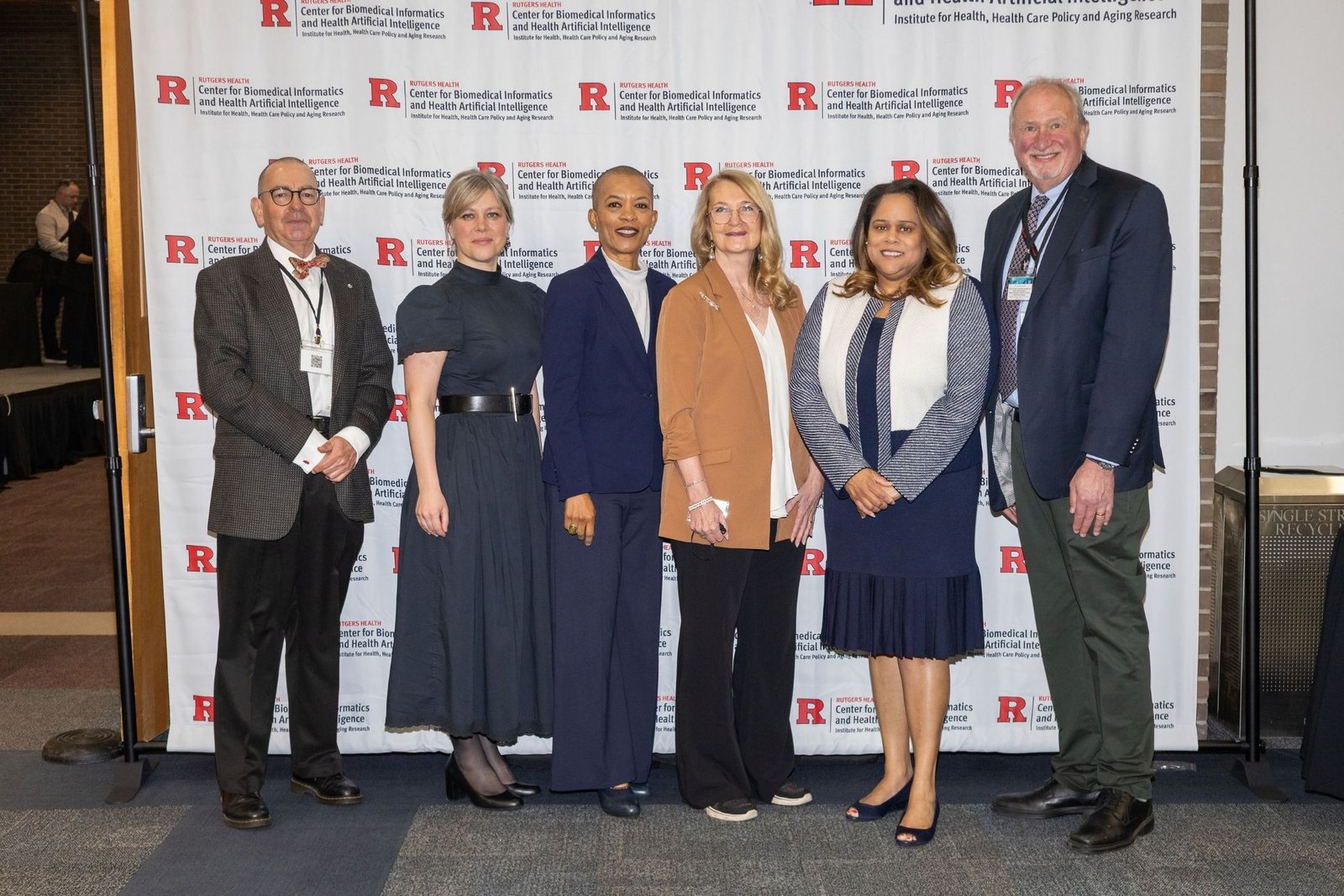
Opening remarks from Rutgers leadership – including Keena Arbuthnot, executive vice president for academic affairs and chief academic officer, Henry Turner, vice president for academic initiatives, and Kathleen Scotto, vice chancellor for research – outlined a forward-looking vision for integrating AI across research, education and clinical practice.
By convening experts from across academia, health care and industry, our symposium demonstrated Rutgers’ expanding role at the forefront of biomedical informatics and health AI.
Leslie Lenert
Director, Center for Biomedical Informatics and Health Artificial Intelligence
Updates from center leadership highlighted recent successes, including a new doctoral degree track in biomedical informatics and health AI that has recruited an eight-student cohort for fall 2026, a new collaborative initiative with Google Health’s Capricorn to assist clinicians in developing personalized treatment plans and the establishment of Living Labs to foster innovation and collaboration.
The keynote address by Rutgers Board of Governors Professor Casimir Kulikowski traced Rutgers’ pioneering role in biomedical AI from the 1970s to today, offering historical context for the field’s evolution and future potential.
The panel discussion that opened the symposium highlighted a first-of-its-kind collaborative initiative that will unite the Center for Biomedical Informatics and Health Artificial Intelligence, the Institute for Data, Research and Innovation Science, the Rutgers Artificial Intelligence and Data Science Collaboratory, ScarletWell and Rutgers–Camden to use AI to promote student wellness, health and retention using the MyRutgers app. The proposed app would help students monitor their health, access on-campus health and wellness resources, participate in online trials of health-based interventions and even build and test their own e-health interventions in student populations.
Other sessions explored infrastructure and data ecosystems needed to advance AI and the use of national data sources for AI training. Industry speakers from Google, Carahsoft, SHI International Corp., Amazon Web Services and Innovation+ shared insights on translating AI innovation into real-world healthcare solutions.

The event included a session on precision medicine in oncology with a lunch trainee career panel and an award for best oncology poster, sponsored by the Rutgers Cancer Institute’s Scholar and Early-Stage Investigator Advancement Initiative.
Presentations at the symposium also highlighted successful center-funded pilot and postdoctoral research projects.
The center’s commitment to student and trainee success was further highlighted with a poster session and networking reception, where attendees engaged with researchers-in-training and learned about their innovative projects.
- First-place best poster was awarded to Kashish Vaish: “Constructing Longitudinal EHR Cohorts for Stroke Prediction in Hypertensive Patients.”
- Second-place best poster was awarded to Phan Nguyen Huong Le: “Uncertainty Quantification for Medical Image Classification: A Comparative Study with Conformal Prediction.”
- Third-place best posters (a tie) were awarded to Changming Li for “Harnessing Vital Sign Vibration Harmonics for Effortless and Inbuilt XR User Authentication” and Yael Bruk for “Using Artificial Intelligence to Combat Bias in Medicine.”
- Best oncology poster was awarded to Vignesh Ravichandran: “Integrating Biological Discovery and Clinical Prediction: A Multi-Omics Framework for Lung Cancer Subtyping.”
“The center is very helpful to Rutgers students,” Branimir Ljubic of the Rutgers Office of Advanced Research Computing said. “It gives them an opportunity to present their work and win awards, which can be helpful for their careers… This is a unique opportunity that students cannot find easily anywhere else.”