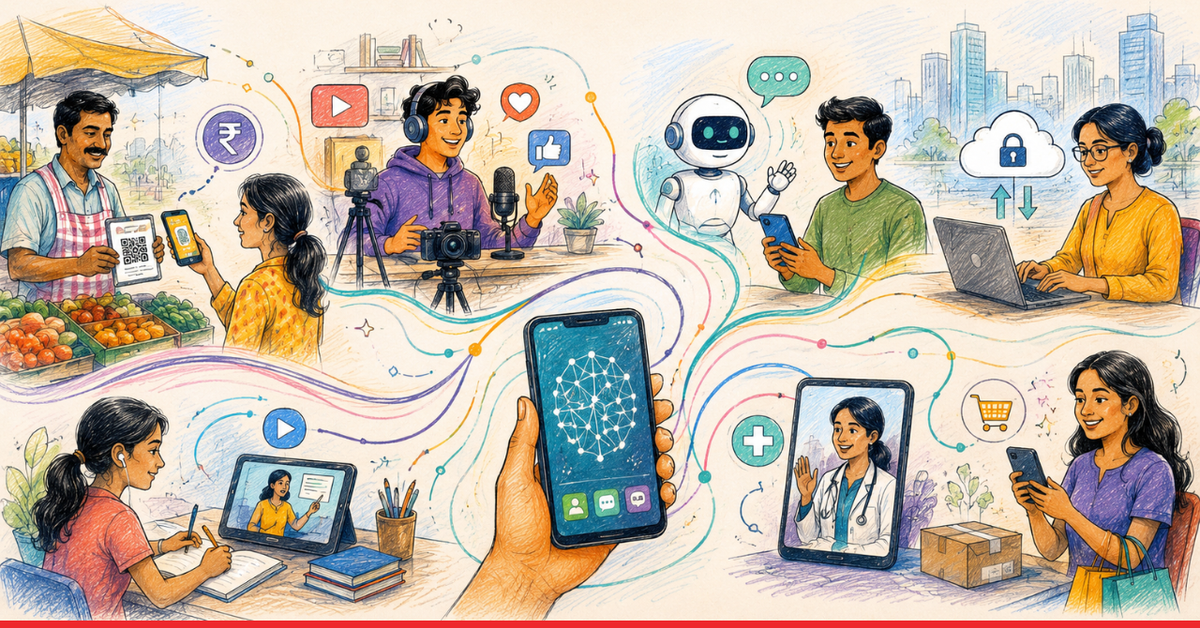
India’s technology story has moved far beyond convenience, where a decade ago, the conversation focused on getting more people online, expanding smartphone access, and bringing digital services to smaller towns. Today, technology is shaping how people trust, work, communicate, consume information, and even make decisions.
The shift is visible everywhere like when a roadside vendor accepts UPI payments without hesitation. A creator from a tier-3 town runs a business fully online. Young professionals begin their day with AI-generated meeting summaries and automated workflows. Technology is no longer sitting in the background but influencing behaviour itself.
Raja Manickam, Founder and CEO of semiconductor company iVP Semi, said India’s technology transformation is also changing the country’s mindset. “In the last 30 to 40 years, as corporates grew, we became a nation of service providers to western countries,” he said. “It is time for us to tap into our own institutions and universities.” He added that India now has an opportunity to move from execution-led growth toward building original products, deep-tech ecosystems, and globally relevant innovation from within the country itself.
Smartphone Changed Everything
India’s digital journey has unfolded differently from most of the global markets. Large sections of the country skipped the desktop internet era and moved directly into a mobile-first ecosystem.
Sid Ugrankar, Co-founder and CEO of AI-native platform Qila.io, said the smartphone became the foundation of India’s digital revolution. “That single device carried in a billion pockets rewired how Indians communicate, transact, and access information. It didn’t just change behaviour. It set India on the trajectory of a full-scale tech revolution,” he said. Ugrankar added that AI is now building on top of that mobile-first foundation, allowing more people to participate in the economy with just a smartphone and the right platform.
That shift has created entirely new forms of economic participation, where millions of Indians now access banking, consume content, run businesses, and interact with government systems primarily through smartphones. Entire industries, including ride-hailing, food delivery, digital lending, and creator-led commerce, have emerged around the same behaviour.
Vybhava Srinivasan, Managing Director and India Head at healthcare technology company Availity India GCC, said technology has become “a great leveller” across India. “A vegetable vendor accepting payment on a QR code, a small shop owner reaching customers through an e-commerce marketplace, an auto driver running his livelihood through a platform app, these are the real markers of change,” he said.
India processed more than 22 billion UPI transactions in March 2026 alone. But executives said the bigger story is not just scale but who now participates in the digital economy and what that access has unlocked for them.
Technology Turned Millions Into Creators
India’s digital transformation also changed who gets to create, influence, and build audiences. A decade ago, content creation was largely concentrated among media companies, film studios, and large urban influencers. Today, anyone with a smartphone, internet connection, and platform access can build an audience, run a business, or create a personal brand online. Executives said that this shift has changed aspiration and economic participation, especially among younger users and creators from smaller towns.
A 2025 Boston Consulting Group (BCG) report estimated that India now has over 2 to 2.5 million monetised digital creators influencing $350 to $400 billion in annual consumer spending, with creator-led commerce expected to cross $1 trillion by 2030. The report also highlighted how smartphones, cheap data, and regional-language platforms are enabling creators from Tier-2 and Tier-3 towns to build businesses, audiences, and careers online at an unprecedented scale.
Sid Ugrankar, added that smartphones and social platforms lowered the barrier to participation in ways traditional industries never could.
Regional creators, independent educators, gamers, podcasters, and small business owners now operate within an economy driven by digital visibility and audience engagement. Entire careers are being built on content ecosystems across video platforms, social commerce, and creator-led communities.
Industry estimates suggest India’s creator economy has grown into a multi-billion-dollar ecosystem, with AI tools now accelerating content production, personalization, and discovery further. But executives also warn that the same platforms shaping opportunity are increasingly shaping attention, identity, and behaviour. Co-founder and CTO of cloud media technology company Amagi, said communities are increasingly being built around algorithm-driven interests rather than geography alone.
That transformation, industry leaders say, is changing not only how people consume media, but also how they form opinions, build careers, and define influence in digital society. Much of this transformation was also accelerated by India’s startup ecosystem, where platforms across creator commerce, fintech, edtech, gaming, and AI tools built products specifically for mobile-first users outside metro cities.
Trust Has Moved Online
Industry leaders said one of the biggest changes over the past decade has been the movement of trust from physical interactions to digital systems.
Ajay Trehan, Founder and CEO of identity verification platform AuthBridge, said people increasingly trust technology for transactions, hiring, verification, and even relationships. “Ten years ago, many Indians were still hesitant to transact, verify, hire, learn or build relationships through digital channels. Today, a large part of daily life runs on digital identity, payments, online discovery and platform-led services,” he said. Trehan added that technology has reshaped how people establish credibility and participate in the economy.
UPI has become a clear example of that behavioural shift. Gagan Sethi, CEO of SaaS-based software provider Ebix Technologies, said digital payments helped Indians become comfortable trusting technology with money.
“Once people became comfortable using technology for money, it opened the door for wider digital adoption across commerce, banking, education, government services, and small business activity,” he said. Sethi added that digital payments made technology feel useful and practical for millions of Indians instead of something limited to urban or tech-savvy users.
Biju Davis, Senior Vice-President and India Site Leader at fintech company InvoiceCloud, called it the “democratisation of financial participation.” “A street vendor in Hyderabad, a farmer in Andhra Pradesh, and a first-time insurance buyer in a tier-3 town are all participants in the same digital financial system,” he said. “That is not a convenience story. It’s a transformation of economic identity.” Davis added that people who previously had little relationship with digital financial systems now expect real-time and frictionless transactions as a standard experience.
The unfinished part of the story, according to Srinivasan, is healthcare accessibility. “Technology is improving healthcare outcomes, but mostly in large urban hospitals. Bringing the same access and quality to rural India is the next frontier,” she said.
From Digital Access to AI Assistance
Executives said the next major shift is already underway. Over the past decade, technology mainly helped people access information and services. AI is now beginning to help people interpret information, compare choices, complete tasks, and make decisions.
A 2026 Deloitte study found that 74% of enterprises globally use AI in at least one key workflow, while a McKinsey survey showed 60% of executives say AI directly influences strategic decisions, from hiring to pricing. Both studies reflect AI’s growing role in shaping business decisions, not just automating tasks.
Dhruv Rastogi, Chief AI Officer at Medi Assist Healthcare Services, said India is moving from a “digital access economy” to a “digital assistance economy.” “AI will become an invisible co-pilot in everyday decision-making,” he said. Rastogi added that the transition is already visible in healthcare and insurance through AI-driven claims processing, predictive support systems, fraud detection, and workflow automation. “The biggest behavioural shift will be the expectation of real-time, hyper-personalized, and proactive services,” he said. “Consumers will no longer tolerate fragmented experiences or long waiting cycles.”
Gagan Sethi said the next phase of AI adoption will focus less on information discovery and more on decision support. “People will increasingly expect AI to guide, recommend, prepare, compare, and act with them,” he said. He added that AI could become especially valuable in areas where millions still lack access to quality advice across healthcare, education, finance, and small business planning.
Enterprises, however, face a foundational challenge before that promise becomes real. Rohit Vyas, Director of Solutions Engineering at Confluent, said legacy systems remain one of the biggest roadblocks for enterprise AI adoption in India. “AI, by design, needs continuous context. It does not work well on yesterday’s data,” he said. Vyas added that organisations are realising modernisation is not just about moving systems to the cloud, but rethinking how data flows across the enterprise in real time.
Indian startups are also building AI-driven platforms across healthcare, education, finance, agriculture, and productivity, bringing AI-powered assistance into sectors where access to expertise traditionally remained limited.
Rise of AI Delegation
Several executives believe the next behavioural shift may be deeper than previous digital transitions. Srividhya Srinivasan, said India is heading toward a world of AI delegation where people increasingly rely on AI to decide what to watch, buy, learn, and even believe.
According to the Kearney “Invisible Gatekeeper” study released in April 2026, 83% of Indian AI users now rely on AI platforms for shopping-related decisions, with users increasingly “asking” AI for recommendations instead of manually searching and comparing products. Another Adobe India report found that 73% of Indian consumers already use AI to guide online purchase decisions, well above the Asia-Pacific average
As AI becomes more contextual, multilingual, and personalized, she said, it will act as an always-on assistant shaping choices at scale, redefining productivity and access, but also reshaping agency and critical thinking in ways the optimistic adoption narrative tends to skip over. She added that communities are no longer defined just by geography, but by shared interests and narratives amplified by algorithms, a transformation already reshaping media consumption and public discourse across India.
Prakash Thekkatte, Senior Vice President of Software Engineering at Salesforce, said the rise of agentic AI demands a new social contract. “When innovation concentrates power, it ceases to be progress and instead deepens inequality,” he said. He added that India’s AI future should focus on inclusion and responsible innovation, ensuring citizens actively shape technological progress rather than passively consume it.
Vybhava Srinivasan warned that younger users are increasingly depending on AI-generated outputs without questioning or improving them. “If we use AI without reviewing what it produces, adding context, and improving on it, we have outsourced our thinking,” he said. He added that companies deploying AI must build stronger governance and privacy frameworks instead of treating regulation as an afterthought.
Biju Davis said the next major challenge will revolve around trust calibration. “Building AI systems that earn trust incrementally, communicate transparently, and fail gracefully will determine whether this shift broadens inclusion or deepens the existing digital divide,” he said. “The technology is ready. The design thinking still needs to catch up.”
Work Is Changing Faster Than Companies Expected
Technology is also reshaping how Indians work, communicate, and build careers.Most industry leaders rejected the idea that AI will simply eliminate jobs. Instead, they said work itself will evolve. Ajay Trehan said companies should avoid treating AI purely as a cost-cutting exercise. “They need to map which roles will change, train people early, and build clear rules on accountability, work boundaries and human review,” he said.
Vybhava Srinivasan said AI will reduce work built around repetitive logic while increasing demand for judgment, creativity, and strategic thinking. “What I see emerging is a hollowing out of the process-heavy middle, with value shifting toward roles built on complex judgment, empathy, and strategic navigation,” he said.
Aditya Singh, Founder of workforce management company Benevolve, warned companies against aggressively cutting entry-level roles without investing in people. “The real threat is not AI. The real threat is organizations that cut costs without making meaningful investments in their people,” he said. He added that companies that strip out younger talent risk weakening their future leadership pipelines without realising it until the damage is done.
Next Phase Will Be About Human Agency
India’s technology story is no longer just about digitization or convenience but it is about influence, behaviour, trust, and human decision-making. The country has already shown how quickly digital systems can reshape payments, commerce, communication, and access to services.
AI may now push that transformation further by embedding itself into everyday choices at a level previous platform never reached. The organisations and policymakers that shape how that happens, not just whether it happens but will determine what kind of digital society India builds next. The next phase of India’s digital transformation will likely be shaped not only by large technology companies, but also by startups building AI-native products for India’s scale, languages, and behavioural realities.
The bigger question is no longer whether Indians will adopt AI-driven systems because that transition is already underway. The real question is how much decision-making people are willing to delegate to technology, and whether the systems being built are designed to enhance human capability or quietly replace human judgment over time.