‘Tax audits are only for large corporations with huge sales or a few wealthy individuals involved in suspicious transactions, right?’
If you think so, you need to be a little careful.
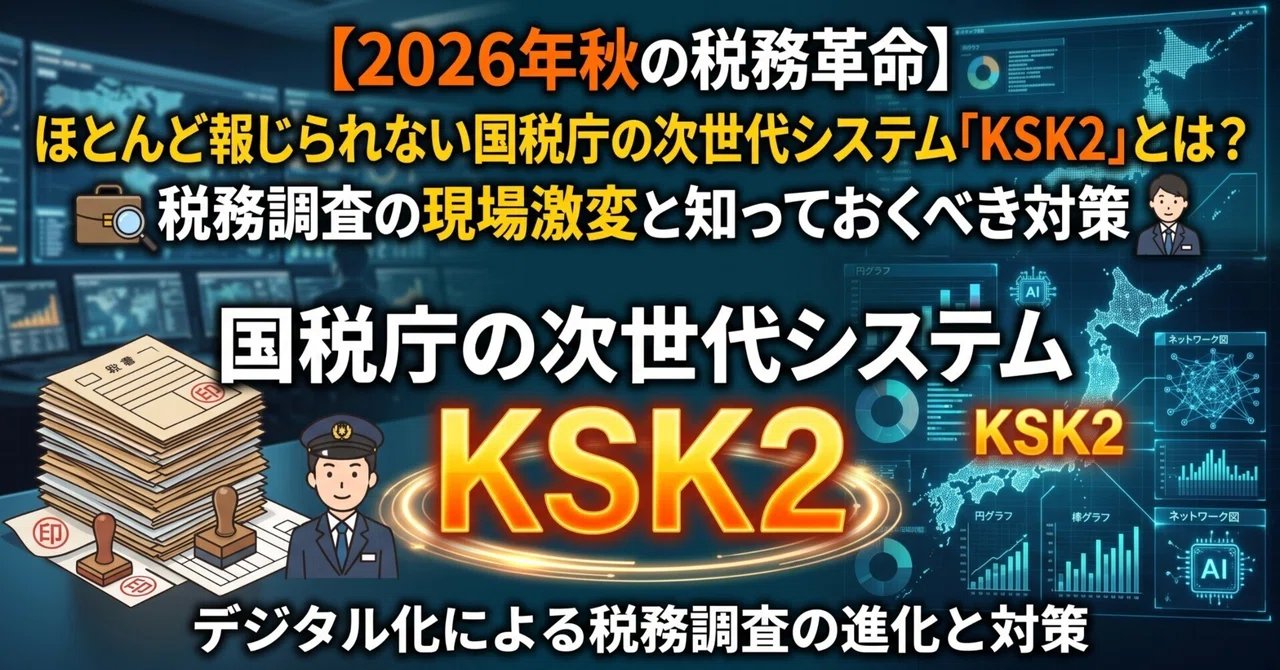
Although it has hardly been covered in major news on television or in newspapers, a historic, massive update, the first in about a quarter-century (25 years), is imminent in Japan’s tax administration.
At its core is the National Tax Agency’s next-generation backbone system, ‘KSK2’ (National Tax Comprehensive Management System 2).
With this overhaul, the way tax offices ‘monitor’ and ‘conduct audits’ is set to change fundamentally, from sole proprietors and small-to-medium enterprises to freelancers and even general inheritance cases.
In this article, I will break down difficult IT and tax terminology as simply as possible to explain for beginners ‘what exactly KSK2 is,’ ‘how tax audits will specifically change,’ and ‘what we should prepare now.’
1. What was ‘KSK’ in the first place?
To understand KSK2, let’s first review the current system, ‘KSK’ (Kei-Esu-Kei).
KSK is an abbreviation for ‘National Tax Comprehensive Management System.’
It connects over 500 tax offices and regional taxation bureaus nationwide via a network, centrally managing vast amounts of data such as the tax returns we file, tax payment records, salary payment reports received from companies, and bank transactions.
The first-generation KSK completed its nationwide deployment in 2001 (Heisei 13). It has supported Japan’s tax administration for over 20 years.
However, because it is a system built over 20 years ago, it had three major ‘limitations (weaknesses)’ in today’s digital society.
-
‘Siloed’ management by tax type
-
Data for ‘corporate tax,’ ‘income tax,’ ‘consumption tax,’ and ‘inheritance tax’ were stored in separate frameworks, making cross-referencing for the same person or company time-consuming.
-
-
Structure based on paper and manual work
-
Within tax offices, many processes still required staff to manually input or handle paper tax returns and documents, putting a strain on operations.
-
-
Usable only within tax office buildings
-
Due to security reasons, it was locked into proprietary OS-based dedicated mainframe computers, meaning it could not be taken outside, and staff could not access the system directly at tax audit sites.
-
‘KSK2’ was developed to fundamentally rebuild this outdated mechanism and complete the DX (digital transformation) of tax administration.
2. From KSK to ‘KSK2.’ What will evolve dramatically?
The major reform points of KSK2, as set forth by the National Tax Agency, can be summarized into the following three main points.

1. “Unified Cross-Check” where tax category barriers disappear
Previously, while investigating a “company (corporate tax),” it was necessary to inquire with other departments or check the system to cross-reference the “president’s personal (income tax)” filing status in detail.
In KSK2, information related to a taxpayer, such as corporate tax, consumption tax, income tax, inheritance tax, and gift tax, will be linked like a single timeline. It is designed to immediately expose “inconsistencies” that arise between a company’s profits and cash flow, and the increase or decrease in an individual’s assets.
2. “AI-OCR” full-document reading that doesn’t miss even paper tax returns
Some might think, “If I file by hand on paper, can I slip through the data analysis net?” but that loophole will be completely closed. In KSK2, tax returns and notifications submitted on paper will also be automatically scanned by high-precision AI-OCR (Optical Character Recognition) and immediately converted into digital data.
3. Real-time access to the field
With the introduction of the government’s secure unified network (GSS: Government Solution Service), tax investigators will be able to safely access KSK2 from the dedicated laptops they carry. An environment will be established where they can check past transaction history and inquiry data on the spot in the conference rooms or stores of the entities being investigated, without having to return to the tax office.
3. How will tax audits change? “3 realistic changes”
So, how will the actual tax audit scene change due to this new system?
Change 1: “Improved selection accuracy” means even small amounts and small-scale businesses will not be overlooked
There are extreme rumors that “AI will decide tax audit targets on its own,” but more accurately, it is a form of “using AI and statistical analysis (analytics) to extremely accurately narrow down targets with a high probability of anomalies or filing omissions.”
Previously, there were limits to comparing with the average values of the same industry and scale, but with KSK2, anomalies such as “cost of sales ratio is abnormally low compared to industry standards,” “the amount of executive compensation does not match the president’s personal consumption and savings balance,” or “there is a discrepancy between invoice purchase tax credits and the counterparty’s sales recording” will be automatically extracted.
The conventional complacency that “the tax office won’t come to see me because my sales are in the range of several million to several tens of millions of yen” will no longer be valid. Regardless of the scale, targets with “unnatural data” will be pinpointed.
Change 2: “Homework time” at the audit site will be drastically reduced
In conventional tax audits, when an investigator raised a question,
“I don’t know about that case without looking at the old ledgers, so I will look into it by next time”
“I will also take this back to the office to check the data”
It was common for such exchanges to occur, creating a grace period (preparation time) of several days to several weeks before an answer was provided.
However, once the auditor’s handheld terminal is constantly connected to KSK2, past years’ tax return data, submitted statutory reports, and information on related business partners will be cross-checked on the spot.
The tactic of ‘taking it back to think of an excuse to make the numbers match’ will become harder to use, and whether you can present books and evidence on the spot and provide a logical, immediate answer will determine the outcome.
Change 3: ‘Comprehensive pursuit’ across individuals and corporations
What will become particularly strict for small and medium-sized enterprises and owner-managed companies is the confusion between ‘company money’ and ‘personal wallets’.
-
Could entertainment expenses or travel expenses recorded by the corporation actually be the president’s personal travel or private dining?
-
Are loans or advance payments from the company to the president actually de facto executive bonuses (salary)?
-
Are there unnatural fund transfers (nominal deposits or undeclared gifts) from the parent’s company to the child’s personal account?
Since information on corporate tax, income tax, gift tax, and inheritance tax will be linked in a single database, it is expected that cases where ‘they came for a corporate audit, but before I knew it, even the president’s personal bankbooks and the flow of inheritance assets were laid bare’ will increase.
4. What should we prepare now?
Just because a sophisticated system is in operation does not mean that ‘some kind of special tax-saving trick’ is required. In fact, it is the opposite. It boils down to ‘thoroughly ensuring that the basics of accounting and tax filing can be explained with data.’
Specifically, let’s review the following three preparations immediately.
1. Do not leave ‘unexplainable transactions’ in your books
What is most suspected in a tax audit is ‘sudden fluctuations in numbers with no known reason’ or ‘expenditures with unknown purposes’.
2. Early adaptation to cloud accounting and the Electronic Book Preservation Act
As the National Tax Agency’s digitization progresses, if the taxpayer’s digitization lags behind, it will take a huge amount of time and effort to cross-check during an audit, and it will also create a bad impression. By utilizing cloud accounting software linked to bank accounts and credit cards, and electronically storing invoices and receipts according to the rules, you will be able to present them in seconds even if you are asked, ‘Please provide evidence for this transaction.’
3. Clearly draw the line between corporation and individual
Owner-managers and sole proprietors should completely separate business accounts from private accounts. Withdrawing living expenses from business accounts or paying for private purchases with corporate cards are factors that will immediately trigger a suspicion flag through KSK2’s cross-check.
Conclusion: There is no need to fear, but do not underestimate it
The arrival of KSK2 is by no means something to be feared for business owners who file and pay taxes honestly. Rather, it can be called a positive evolution that realizes a fair tax environment, as business owners who engage in fraud or sloppy filings will be accurately identified and excluded through data analysis.
However, if you continue to neglect your accounting with the mindset of the Showa or early Heisei eras—thinking ‘it hasn’t been caught before’ or ‘the tax office probably isn’t looking that closely’—you will one day suddenly receive a visit from an investigator based on data analysis that leaves no room for escape.
The greatest weapon for protecting yourself in tax audits of the digital age is not a secret trick, but ‘daily accurate bookkeeping’ and ‘organization of evidence (supporting documents).’ Why not take this opportunity to check your own accounting flow and filing details for any unnatural points?