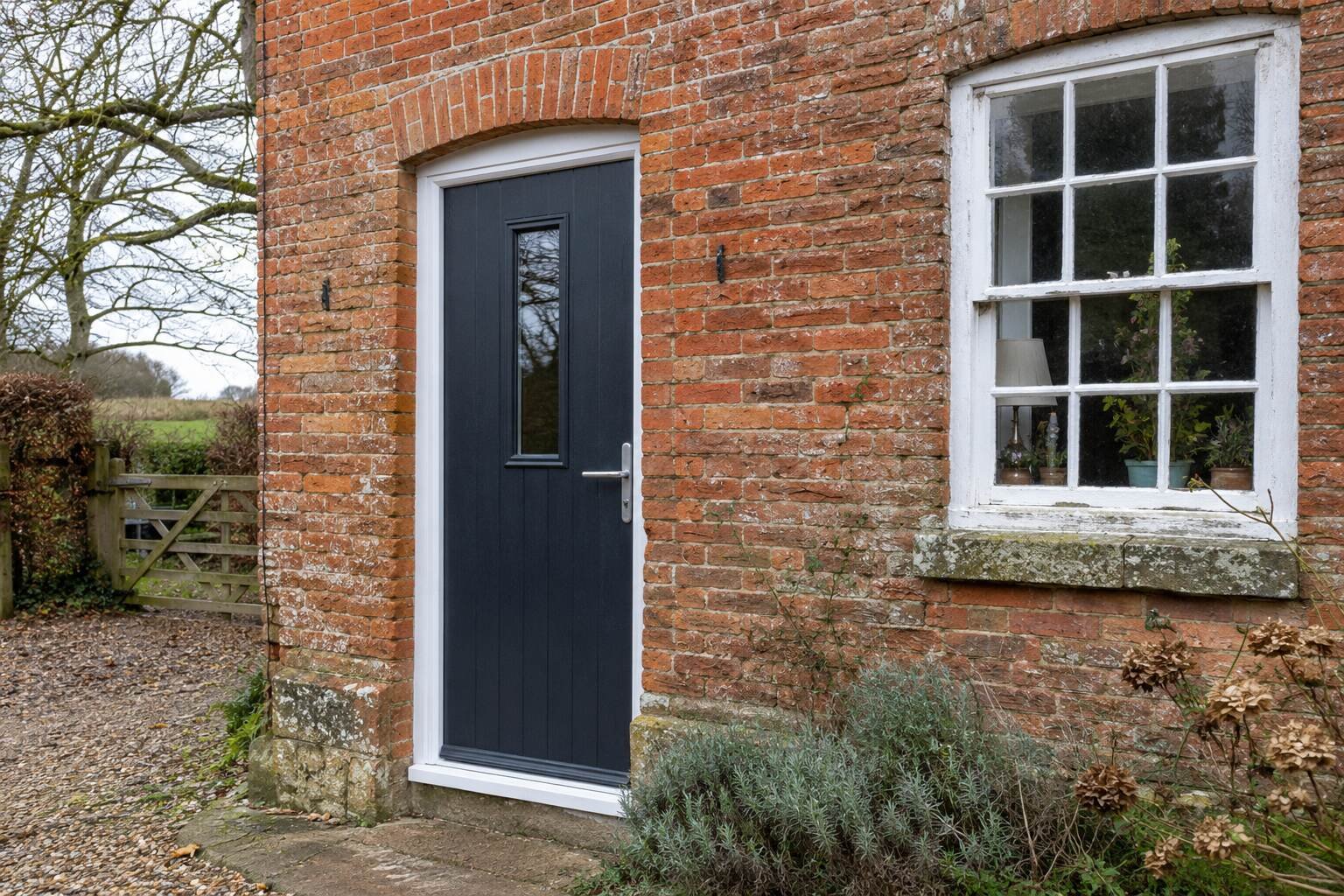
The decision demonstrates why improved insulation alone may not justify modern materials where comparable benefits could potentially be achieved through sympathetic joinery.
Why the listed building door was refused
The late-Georgian building dates from around 1790 and stands within the Throop and Muccleshell Village Conservation Area.
Its traditional materials, surviving fabric and architectural detailing contribute to its special interest, including features on elevations that are less prominent.
The parties disputed whether the former timber door had four or six panels and whether it dated from the original construction.
However, the Inspector found that neither the precise panel arrangement nor the age of the former door was decisive.
The appeal concerned a composite door within a modern uPVC frame, contrasting with the traditional joinery elsewhere on the building.
Although the opening and surrounding brickwork remained intact, the replacement materials and finish harmed the significance of the listed building.
The Inspector identified harm towards the lower end of the spectrum but separately found that the wider conservation area’s character and appearance had been preserved.
Evidence of deterioration and the need for replacement
The appellant argued that the former door was rotten, insecure and beyond reasonable repair, but did not supply a specialist condition report.
The Inspector accepted that intervention might have been justified without finding sufficient evidence that this particular replacement was necessary.
The removal of a cat flap from the former door was accepted as a modest heritage benefit.
As the Inspector explained, the existence of that hierarchy does not render secondary features insignificant
.
Owners considering a listed building door replacement should establish the condition and significance of existing joinery before committing to a particular product.
Energy efficiency is important but not decisive
The Inspector gave substantial weight to improved thermal performance under policies CC2 and HE6 of the revised National Planning Policy Framework.
Weather resistance, security and the occupants’ circumstances also weighed in favour of the proposal.
Nevertheless, there was insufficient evidence that comparable benefits could not be achieved through a solution more sympathetic to the traditional materials.
The combined benefits did not outweigh the weight attached to the harm, having regard to the statutory duty to preserve the listed building.
This contrasts with the recent York sash window appeal, where deteriorated timber windows could be replaced with carefully specified timber double-glazed units.
The Bournemouth decision adds a useful distinction because substantial weight for energy efficiency was expressly acknowledged without making retention of the composite door acceptable.
What owners should establish before ordering joinery
A condition survey from a conservation joiner can help distinguish repairable fabric from elements that genuinely require replacement.
Detailed specifications should explain how the proposed materials, profiles, finish and frame respond to the building’s character alongside the expected improvements in thermal performance.
Our listed building consent guidance explains the separate statutory consent requirements for works affecting special architectural or historic interest.
The decision concerns application P/25/03015/LB and does not determine whether any alternative replacement door would be acceptable.
The appeal decision, reference 6003916, is also available on AppealBase.
Quoted Planning Inspectorate material is reproduced under the Open Government Licence v3.0.