THE energy price rise was dubbed “the nightmare before Christmas” today as US President Donald Trump and the oil and gas industry were blamed for yet another substantial bill hike.
Regulator Ofgem revealed bills are to increase by 26 per cent from January 1 after the US-Israel war on Iran drove a spike in gas prices.
The price cap will rise by £443 per year, or £36.91 per month, to £2,166 for the average household using both electricity and gas.
It is the highest since the second quarter of 2023.
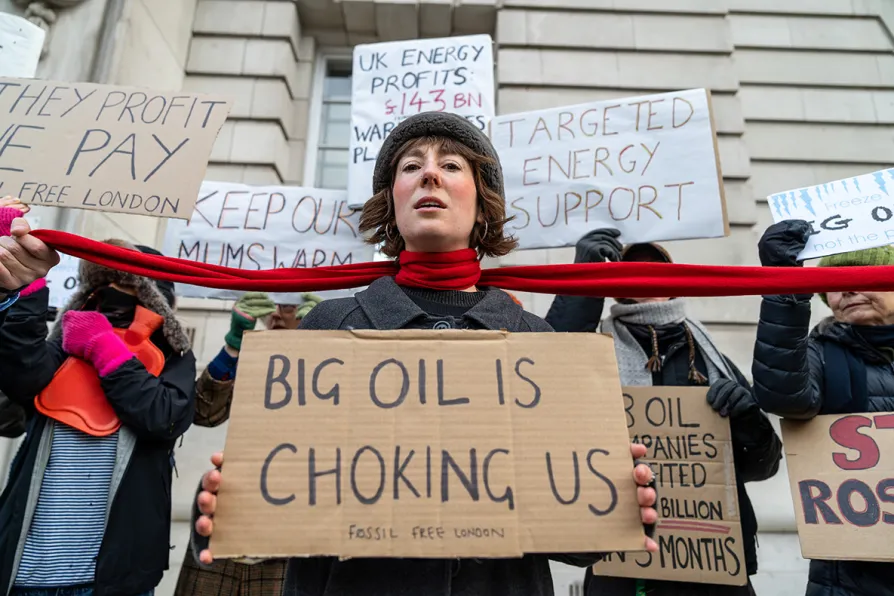
Activists from Fossil Free London gathered in Whitehall as the announcement was made to spotlight the impact of rising energy prices.
Most households are expected to feel the burn even after the support measures announced at the autumn Budget.
Dr Rosie Hampton, of Uplift, said: “This is the nightmare before Christmas and the blame for it lies at the door of Trump, [Russian President Vladimir] Putin and the profiteering oil and gas industry.
“People are right to be angry. For yet another year, fossil-fuel companies are raking in billions while millions of families face the prospect of struggling to keep warm this winter.”
She warned that bills will stay high “as long as we remain hooked on oil and gas, the price of which we don’t control,” adding: “More North Sea drilling won’t bring bills down.
“More drilling isn’t an energy strategy. It’s a licence for oil and gas giants like Shell to make even more money.
“We must break our dependence on oil and gas and switch to homegrown renewable energy, which this country is lucky to have in abundance.”
TUC general secretary Paul Nowak said: “Donald Trump’s reckless warmongering in the Middle East has sent energy costs soaring.
“This has caused an energy bill emergency for families up and down the country, with households cutting back on essentials like heating to save money.”
He called for a Fair Energy Price plan — a social tariff to permanently cut bills for the majority of households, with the worst-off getting around £650 off their annual bills — paid for by raising the tax on bank profits.
“[Banks] can well afford to pay more,” he said.
Unite general secretary Sharon Graham said the rises “are not sustainable,” adding: “As the energy companies made £30 billion profit in just one year, everyday people are literally on their knees.
“While there have been some small moves on assistance, this will not touch the sides. It’s simply not enough.”
Pensioners have said they will have to wrap themselves in blankets this winter, with warnings that the increase could also lead to anxiety for terminally ill people who rely on “vital electrical medical equipment.”
Charities Age UK and Sue Ryder called for targeted energy support for the most vulnerable.
Age UK analysis suggests around a fifth of pensioner households in Britain are likely to be “in fuel stress” this winter, spending more than 10 per cent of their after-tax household income on energy costs.
Among the poorest households, almost half are expected to be in this position.
Roger, who did not give his surname, described the increase as “unbelievable” and said that for many older people, it “will lead to utter despair.”
Independent Age chief executive Joanna Elson urged additional emergency support to “ensure the most vulnerable households are protected from the all-too- frequent price shocks.”
A government spokesperson acknowledged that many pensioners were struggling over winter and could be eligible for up to £550 in support through action already taken.
Which? energy editor Emily Seymour said: “The government missed an opportunity to remove policy levies from bills, which would have helped all households, particularly those with electric heating.
“It is vital that the government delivers on its Energy Independence Bill commitments and ensures support reaches those who need it most, regardless of their council tax band.”
Green MP Hannah Spencer said: “Andy Burnham’s £100 handout was welcome, but hope fades when accompanied by another extortionate hike in energy bills for literally millions of people come January.”
She called on the government to “get serious about affordable bills” by scaling up cheaper renewable energy and “cracking down on obscene profiteering by fossil fuel giants.”
“And it means scaling up efforts to insulate homes, not cutting warm homes funding to pay for defence,” she said.
Scottish First Minister John Swinney has said he was “horrified” by the “staggering” rise, saying: “High energy bills are already causing real hardship across Scotland and confirmation of a £443 increase in January… will be causing understandable anxiety for many people.”
At the protest today, two campaigners dressed as oil executives held either end of a scarf tied around a billpayer’s neck, while others held placards warning “Big Oil Is Choking Us” and declaring “They Profit, We Pay.”
Energy debt has hit a record £6bn, forcing one in five to skip meals or use a foodbank to keep up with costs.
Last winter an estimated eight million adults lived in a cold, damp home, as around 40 per cent of households struggled with their bills.
Energy companies have made over £143bn in profits from their British operations since 2020, including over £10bn in the first nine months of 2026 alone.
Research by Fuel Poverty Action found nearly a quarter of an average bill is taken as pre-tax profits by major firms, while the fossil fuel industry reported combined profits of £71bn in the third quarter of this year.
Fossil Free London director Robin Wells said: “Our dependence on volatile fossil fuels has tied us into an energy system that’s choking us.
“How much higher do bills need to climb before the penny drops with this government?
“We must urgently untangle ourselves from fossil fuels and quickly invest in our renewable energy infrastructure.
“Billpayers are paying millions because energy from renewables is unable to be transmitted around the country.
“Upgrading the national grid so we can utilise the cheap energy on our doorstep must be a priority for our Prime Minister.”
He added that the fossil fuel industry “must not be allowed to pocket windfall profits driven from war while everyone else chooses between heating and eating.”
“Ministers must keep the windfall tax and direct the money to protect ordinary households,” he urged.
Jonathan Bean of Fuel Poverty Action said that with only £100 support compared with the £400 household’s received four years ago, “this government has left vulnerable households facing a terrifying winter.”
Energy Secretary Miatta Fahnbulleh said she knew people were “deeply concerned by another rise,” and that British families had paid the price for conflicts overseas and volatile fossil fuel markets for too long.
She said that while most households would get £100 from January, there was “more to do” to “bring bills down for good.”