Millions of households will see energy bills rise from July but they can still get fixed-rate deals that beat the looming hike, if they act fast.
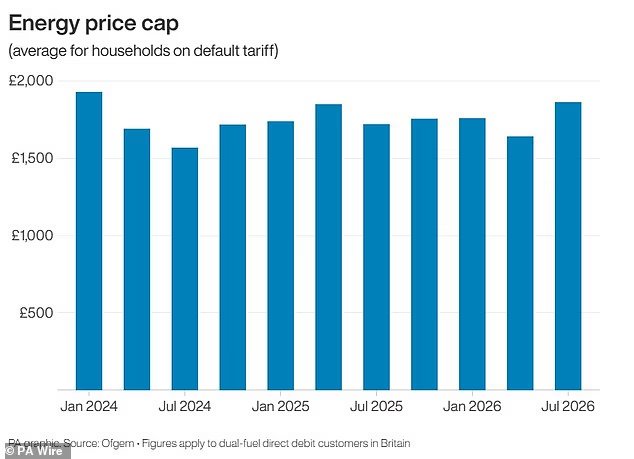
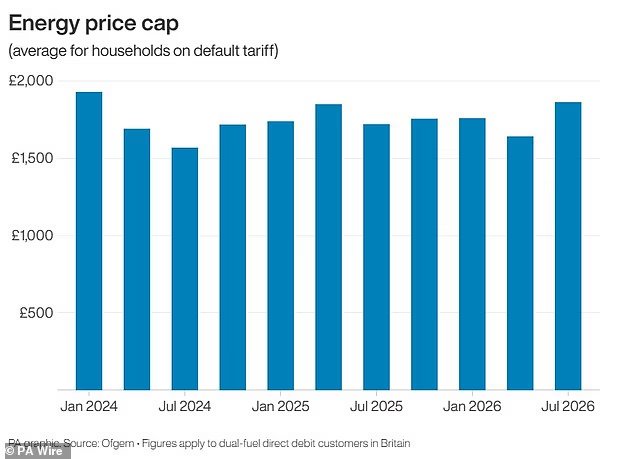
Ofgem has announced a 13 per cent increase in the energy price cap, which will see the bill for an average dual-fuel household jump by £221 to £1,862.
The rise from the current £1,641 energy price cap set in April has been triggered by higher wholesale gas prices, which have surged by about 35 per cent due to conflict with Iran.
July’s hike will be the largest jump in the price cap since January 2023, when rates rose 20.6 per cent but consumers were protected by the Energy Price Guarantee.
Experts say households should seriously consider fixing their bills, as while prices on energy deals have jumped in recent months, it is still possible to lock in at lower rates than the July energy price cap.
‘I would urge everyone to review their current energy contract, the rates they are paying, and whether it is a fixed or variable deal,’ says Gareth Kloet, expert at GoCompare Energy.
We explain what you need to consider about fixing your bills, reveal the best deals currently on the market, and whether a time-of-use tariff can keep bills down.
Energy bills will jump because of the spike in wholesale prices caused by the Iran conflict
What is happening to energy prices?
The energy price cap is what the typical household will pay on a variable rate dual-fuel gas and electricity tariff – those who use more or less energy will see their actual bills differ from this average cost.
The price cap is revised every three months and April’s was set at £1,641. From July, it will rise to £1,862.
Ofgem boss Tim Jarvis said: ‘Today’s price change reflects continued volatility in global energy markets.
‘This means higher wholesale gas prices, driven by ongoing conflict in the Middle East, are impacting the price we pay for energy.’
Customers will see a 5 per cent increase on electricity bills, but that is far less than the hike to gas bills, which are set to jump by 24 per cent from July.
Ofgem said this reflected the ‘increase in the amount of renewable generation on the system and therefore reduced reliance on gas to generate our electricity.’
Households are being warned that the price cap could rise again in autumn and that energy prices are unlikely to suddenly decline.
Dr Craig Lowrey, principal consultant at Cornwall Insight said: ‘A lot of people assume that if the conflict in the Middle East ended tomorrow, prices would return to their pre-conflict levels fairly quickly. However, that may be overly optimistic.
‘The damage to infrastructure, the disruption to supply chains and the erosion of market confidence will not unwind overnight, and the impacts could be felt in bills for longer than many expect.’
Is it still worth fixing your energy bills?
Most households have so far been shielded from the volatility seen in the wholesale gas markets.
Some are on fixed tariffs, where prices will not change for a set period, while others have been protected by the energy price cap.
However, the impending increase in the price cap means it makes sense for households to weigh up fixing their energy bills, because there are plenty of deals that undercut July’s price cap.
Kloet says: ‘While fixed-rate contracts may not always offer you the lowest price available, what they do offer is stability, and the knowledge that your bills will stay the same for the duration of your contract.
‘So, if you are worried about price rises you can’t plan for, a fixed-rate deal might be a good option.’
Over the long-term, prices are expected to stay elevated, and households who stay on a variable tariff are likely to be hit with another increase in October.
Energy expert Cornwall Insight predicts that the cap will increase by two per cent to £1,899 per year, as temperatures fall and energy usage rises.
It says: ‘There remains a lot of time for wholesale market conditions to shift. However, the direction of travel is being shaped by several unknowns that are unlikely to be resolved quickly.’
A further spike could see the government quickly come under pressure to lay out plans for energy bill support. But Labour has already ruled out universal support, which could leave many households in a precarious position.
The 22million households who have already signed up for a fixed tariff will not be affected by the increase in the price cap in July or October. Others may suffer a double whammy as bills jump just as the weather gets cold.
‘With prices forecast to stay high, the real pain will come when the heating goes back on in the autumn and through winter,’ said Richard Neudegg, director of regulation at comparison site Uswitch.
‘No one wants to think about winter during hot weather, but fixing your energy deal now means you can opt out of these rises entirely.’
How you can still beat the energy price cap
There are plenty of fixed price energy tariffs on the market at the moment, however, the majority are more expensive than April’s price cap, which is currently in effect.
But if you want to protect yourself against future price increases you can find plenty of deals that undercut July’s price cap.
Bearing in mind that energy bills tend to be lower over summer as we use less gas for heating, fixing now could pay off.
The current cheapest fixed tariff in the market is from Fuse Energy and is priced at £1,614. That means households will pay £27 less than the April price cap and £248 less than the July price cap.
Outfox Energy is offering a fixed deal with an average annual bill of £1,642, which is £1 above the current cap but £220 below July’s.
Among major suppliers E.ON comes closest to these cheap deals, with a 12-month fix that is £80 above the current price cap but £141 below the July one.
You can see the full list of the cheapest fixed tariffs below. However, deals can be pulled quickly, so if you want one, act quickly:
| Supplier | Tariff | Duration | Average annual bill | Difference vs April price cap (£1,641) | Difference vs July price cap (£1,862) | Exit fees | Availability |
|---|---|---|---|---|---|---|---|
| Fuse Energy | May 2026 Fixed (13m) V19 | 13 months | £1,614 | £27 below cap | £248 below cap | £50 per fuel | Uswitch.com, Confused and Fuse Energy |
| Outfox Energy | Fix’d Dual May26 12m v19 | 12 months | £1,642 | £1 above cap | £220 below cap | £75 per fuel | Direct via Outfox Energy |
| Ecotricity | EcoFixed – 1 year May 26 v2 | 12 months | £1,648 | £7 above cap | £214 below cap | £75 per fuel | Uswitch.com, Confused and Ecotricity |
| Outfox Energy | Fix’d Dual May26 12M v18 – Family Advantage+ | 12 months | £1,683 | £42 above cap | £179 below cap | £75 per fuel | Direct via Outfox Energy |
| E.ON Next | Next Fixed 12m v133 | 12 months | £1,721 | £80 above cap | £141 below cap | £50 per fuel | Uswitch.com, Confused and E.ON Next |
| Good Energy | Good Energy 12m Fix May26 | 12 months | £1,732 | £91 above cap | £130 below cap | £75 per fuel | Uswitch.com, Confused and Good Energy |
| Sainsbury’s Energy | Sainsbury’s Energy Fix and Save 12m v18 | 12 months | £1,738 | £97 above cap | £124 below cap | £50 per fuel | Uswitch.com, Confused and Sainsbury’s Energy |
| British Gas | Fixed Tariff Jun27 v7 | 13 months | £1,740 | £99 above cap | £122 below cap | £50 per fuel | Uswitch.com, Confused and British Gas |
| So Energy | So Capybara 24m | 24 months | £1,743 | £102 above cap | £119 below cap | £95 per fuel | Uswitch.com, Confused and So Energy |
| So Energy | So Capybara 18m | 18 months | £1,748 | £107 above cap | £114 below cap | £95 per fuel | Uswitch.com, Confused and So Energy |
| Source: Uswitch.com. Prices correct as of 8.15am on 27 May 2026. The tariffs included within the table are the cheapest non-bundle fixed tariffs, not variable or tracker. All energy tariffs and prices mentioned are subject to change without notice, and rates vary upon region. These are the cheapest tariffs available based on suppliers who have updated Uswitch with their rates. | |||||||
How much have fixed deals risen since March?
The cheapest fixed energy deal is now more than £100 more expensive than before the start of the conflict in the Middle East, as gas prices continue to surge.
It comes as UK gas futures have soared since the start of the war, from 77.93p per therm to around 111p.
While households on fixed-price tariffs are protected until their deals come to an end, suppliers started to increase the price of new deals when gas prices peaked at around 155p per therm.
Some suppliers pulled them entirely as they work out how best to hedge against surging prices.
The cheapest fixed tariff for a household with typical energy usage was £1,509 when the conflict started. It is now £1,614 – an increase of £105.
Could a time-of-use tariff help you save money?
Time-of-use, also known as agile, tariffs have grown in popularity as households look for innovative ways to save money on their energy bills.
These tariffs charge users a higher price for any electricity used in a peak period – usually between 4pm and 7pm – and a lower price during lower demand, off-peak prices.
In theory, they should save you money if you can move your usage outside of these periods regularly, so you can take advantage of lower rates.
However, if you can’t do so, then a time-of-use tariff is unlikely to save you money.
Not all energy suppliers offer these tariffs and you need to carefully weigh up the costs of different deals. They will usually require you to have a smart meter.
Britain’s largest household energy supplier Octopus has an Octopus Agile tariff, where it says ‘dynamic pricing unlocks the opportunity for customers to make savings by shifting their electricity use to times when it’s cheaper’.
It gives access to half-hourly energy pricing, tied to wholesale prices. Customers have their unit rates for different times over the next 24 hours updated each day between 4 and 8pm. As they use electricity, the half-hourly data from their smart meter is used to calculate charges for that time of day.
The tariff offers some protection against sudden spikes via a cap but also allows households to benefit from plunge pricing and even get paid to use electricity sometimes if there is a lot of excess capacity in the grid.
Agile pricing and EV specific tariffs are beneficial for those who have electric cars and can charge at the cheapest possible time.