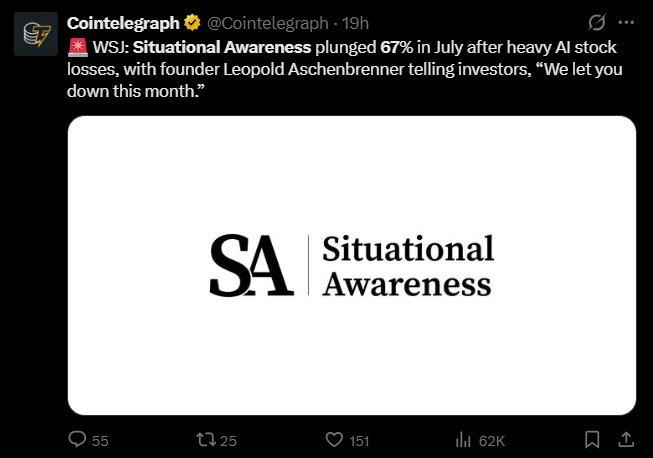
Leopold Aschenbrenner’s Situational Awareness hedge fund lost approximately 67% in July after a sharp decline in AI infrastructure stocks triggered margin calls and forced the firm to sell most of its public portfolio to Citadel.
The fund’s assets reportedly fell from around $45 billion at the beginning of July to roughly $10 billion after the sale. However, Situational Awareness has not shut down completely. It still holds private investments, including a stake in Anthropic reportedly valued at around $5 billion, and remains up roughly 80% for the year after its earlier gains.
The collapse has become one of the clearest examples of how a strong investment thesis can still fail when leverage, concentrated positions and liquidity pressure move against a fund at the same time.

Who Is Leopold Aschenbrenner?
Leopold Aschenbrenner is a former OpenAI researcher who became widely known after publishing his 165-page essay Situational Awareness The Decade Ahead in 2024.
The essay argued that artificial intelligence could advance rapidly toward artificial general intelligence and that the process would require a massive expansion in semiconductors, computing capacity, memory and energy infrastructure.
Aschenbrenner later launched an investment firm with the same name. The fund focused heavily on companies linked to the AI infrastructure trade, including chipmakers, cloud providers, data centre operators and energy companies.
According to TechCrunch, Situational Awareness had returned approximately 439% through June 2026. Its rapid performance attracted significant attention as investors tried to track Aschenbrenner’s AI investment strategy.
That success also encouraged the fund to take larger positions.

What Happened to Situational Awareness?
The immediate problem was a sharp selloff across several AI infrastructure stocks.
Situational Awareness reportedly held large positions in companies such as SK Hynix, SanDisk, CoreWeave, Nebius and Bloom Energy. Many of those stocks fell by more than 30% during July as investors questioned whether massive AI infrastructure spending would translate into near-term revenue and profits.
The fund’s short positions also moved against it. Aschenbrenner had reportedly bet against parts of the software sector on the assumption that AI infrastructure companies would outperform traditional software businesses.
Instead, software stocks rallied while several AI infrastructure holdings declined. The fund therefore lost money on both sides of the trade.
According to Reuters, prime brokers including Goldman Sachs and JPMorgan helped facilitate the sale of most of Situational Awareness’s roughly $16 billion public stock portfolio.
Citadel, the investment firm led by Ken Griffin, bought a large portion of the portfolio after the fund came under pressure to raise capital or sell assets.

How 400% Leverage Amplified the Losses
The fund’s losses became more severe because it used borrowed money to increase its exposure.
Reports described Situational Awareness as operating with roughly four times gross leverage. In simple terms, a fund with $1 of its own capital could control approximately $4 worth of assets through borrowing.
That structure can produce exceptional returns when prices move in the right direction. It also reduces the amount of room available when positions decline.
A 10% fall in the underlying portfolio does not simply create a 10% loss for a fund using four times leverage. The loss is measured against the fund’s smaller equity base, which means the impact on investor capital becomes much larger.
Once asset prices declined, lenders demanded additional collateral. The fund then had to sell positions quickly to meet those requirements.
This creates a difficult feedback loop.
Prices fall, lenders demand more collateral, the fund sells assets, and the forced selling pushes prices lower. Other funds holding similar positions may then face the same problem.
The issue is therefore larger than one bad trade. It is a liquidity problem created by the combination of crowded positions and borrowed money.
Why the Anthropic Stake Was Not Sold
Situational Awareness reportedly sold most of its public stock portfolio but retained its private investments.
The most valuable of those holdings appears to be a stake in Anthropic, the company behind Claude. TechCrunch reported that the stake was valued at approximately $5 billion.
That position was different from the fund’s public stock holdings in several important ways.
Public equities can be marked to market every second and may be pledged as collateral to lenders. Private shares do not face the same daily trading pressure. They are harder to sell quickly, but they are also less exposed to immediate market liquidation.
Situational Awareness reportedly considered selling approximately $3.5 billion of its Anthropic position to a group led by Greenoaks and Sequoia Capital. The firm later withdrew from the transaction, according to The Wall Street Journal.
Keeping the Anthropic stake gives the fund exposure to the same broader AI thesis that supported its public investments. Anthropic was reportedly valued at $965 billion in its latest private funding round and could potentially pursue a public listing.
That creates a sharp contrast within the portfolio. The public positions were exposed to leverage and immediate liquidity demands, while the Anthropic position offered a longer-term opportunity to benefit from the continued expansion of the AI market.
Was Aschenbrenner Wrong About AI?
The collapse does not automatically prove that Aschenbrenner’s AI thesis was wrong.
The fund’s stock picks were concentrated in companies that could benefit if AI spending continues to increase. Memory chips, cloud computing, data centres and energy infrastructure remain important parts of the AI supply chain.
The failure came from the way the thesis was expressed in the market.
A long-term investment view may eventually be correct while still producing devastating short-term losses. A company can have strong fundamentals and still fall sharply if investors reduce exposure, lenders demand collateral or too many funds hold the same position.
The fund also appears to have underestimated the risk of being wrong on both sides of the book. The long positions fell while the software shorts rallied, removing the protection that the pair trade was supposed to provide.
This is why leverage matters. It reduces the amount of time an investor has to wait for a thesis to work.
Aschenbrenner may still be right that AI infrastructure will expand significantly. The fund simply could not remain exposed long enough for that thesis to recover after the July selloff.
What the Collapse Means for the AI Trade
The Situational Awareness crisis does not prove that the AI boom is over. It does show that the financial structure supporting the boom is becoming more fragile.
The AI investment trade has attracted large amounts of capital into a relatively narrow group of companies. Many investors are buying similar themes involving GPUs, memory, cloud capacity, energy and data centres.
When these positions rise together, returns can look exceptional. When sentiment changes, the same concentration can accelerate the decline.
MemeBurn has already examined the broader pressure on AI valuations in its coverage of the AI stock selloff and Anthropic’s $965 billion valuation.
The important distinction is between a fundamental slowdown and a forced liquidation.
If AI companies continue generating revenue and securing infrastructure contracts, the sector could recover after the selloff. If the decline exposes weak demand, excessive capacity or unsustainable valuations, more funds could face similar pressure.
Citadel’s decision to buy the discounted portfolio also highlights how these events redistribute capital. A forced seller may be forced to exit at the worst moment, while a larger and less leveraged buyer can acquire the same assets at a lower price.
What Happens Next?
Situational Awareness is expected to continue operating, but its strategy will likely change.
The fund has reportedly removed leverage from its public-market positions and indicated that it will stop relying on bank borrowing to amplify its stock bets. That would reduce the risk of another margin-driven liquidation, although it would also limit the upside available from the same positions.
The Anthropic stake could become especially important. If the company continues to grow or eventually goes public, the investment may provide Situational Awareness with a major source of liquidity and help rebuild the firm’s capital base.
For investors, the broader lesson is straightforward. A strong AI thesis does not protect a portfolio from poor position sizing, excessive leverage or a lack of liquidity.
Situational Awareness did not disappear because AI suddenly stopped mattering. It unravelled because the fund was forced to become a seller before its long-term thesis had time to play out.
FAQs
What happened to the Situational Awareness hedge fund?
Situational Awareness lost approximately 67% in July 2026 after AI infrastructure stocks fell sharply and the fund faced margin calls. It sold most of its public stock portfolio to Citadel but continues to hold private investments.
How much money did Situational Awareness lose?
The fund’s assets reportedly declined from approximately $45 billion to around $10 billion. That figure represents the fall in assets and portfolio value, not necessarily $35 billion in realised trading losses.
What is 400% leverage?
Four hundred percent leverage means a fund controls roughly four times more assets than its own capital through borrowed money. It can increase returns, but it can also make a relatively modest decline create severe losses.
Did Situational Awareness sell its Anthropic stake?
Reports indicate that Situational Awareness retained its Anthropic stake, which was valued at approximately $5 billion. The fund reportedly considered selling part of the position before withdrawing from the proposed transaction.
Is Situational Awareness shutting down?
No. The fund’s public equity strategy was largely unwound, but Situational Awareness remains active as a private investment vehicle and still holds private company investments.
Who bought Situational Awareness’s stock portfolio?
Ken Griffin’s Citadel bought most of Situational Awareness’s public stock portfolio after the fund faced losses and margin pressure.