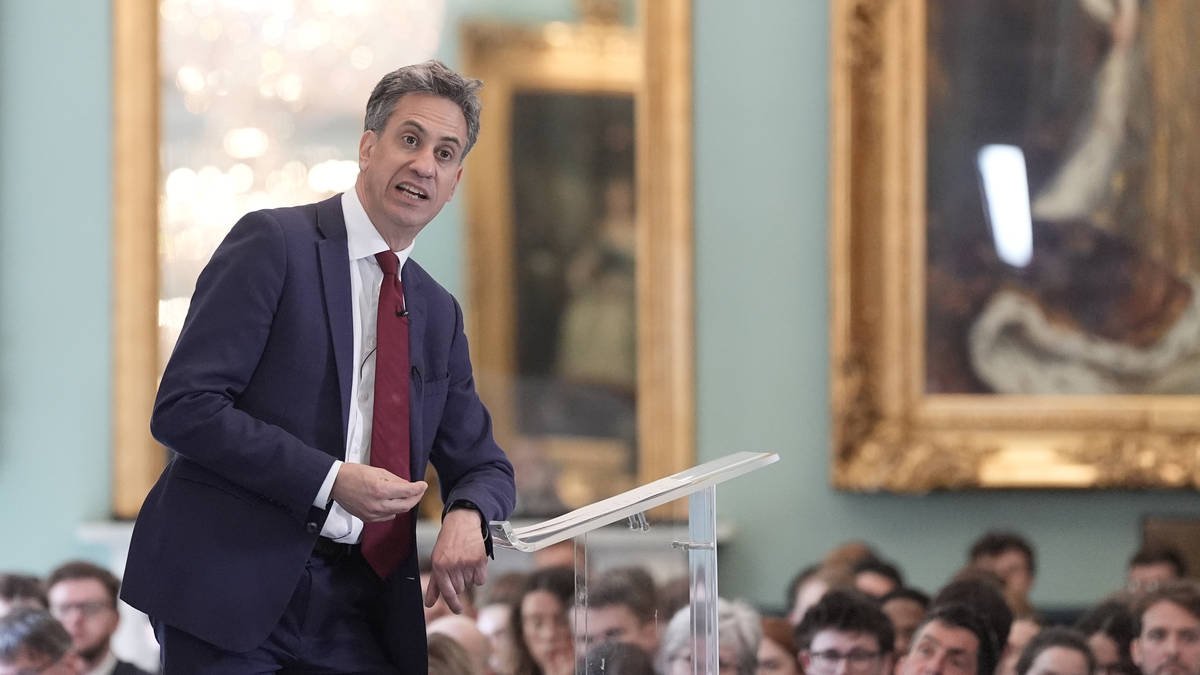
The Energy Security and Net Zero Secretary vowed to ‘double down, not back down’ on the transition to clean energy.
Picture:
PA
The Government has unveiled measures aimed at weakening the link between global gas market prices and the cost of UK electricity as the Middle East crisis drives up energy bills.
Energy Security and Net Zero Secretary Ed Miliband announced the plan as he claimed the “era of fossil fuel security is over”, and said current measures aimed at breaking the link gradually were not enough on their own.
Chancellor Rachel Reeves will hike the Government’s windfall tax on low-carbon electricity generators from 45% to 55% to raise Treasury funds that will be used to support consumers and businesses with the rising costs in the short term.
The so-called electricity generator levy was introduced in 2022 to target the excess profits being made by nuclear, biomass and renewable energy projects built before 2017 as electricity prices soared after Russia’s invasion of Ukraine.
The Government is also proposing a voluntary move by these “legacy” clean power generators, which supply around a third of Britain’s power, onto fixed-price contracts to help protect consumers from volatile prices.
It is hoped the contracts will deliver benefits on consumers’ bills over the next 12 months, though officials are not yet able to say what savings could be delivered.
Read more: Government preparing ‘for all eventualities’ if they need to act on energy prices, says Miliband
Read more: Ed Miliband calls for fairness in business energy contracts amid Iran crisis
And ministers will also increase support available for households on heating oil and liquified petroleum gas to transition to lower-carbon alternatives by increasing the boiler upgrade scheme grants to a total of £9,000.
Mr Miliband outlined the measures as he spoke at the National Growth Debate in Westminster on Tuesday, and vowed to “double down, not back down” on the transition to clean energy.
He said the lesson of the “second fossil fuel shock in less than five years” is “clear”, adding: “The era of fossil fuel security is over.”
“For Britain and so many other countries, clean energy is now the only route to financial security, energy security and indeed national security,” he said.
The Government has been “relentless” in pursuing a clean power agenda since coming to power, he said, adding: “While some have said we have gone too far and too fast, I profoundly disagree.
“Actually, I believe the opposite is true. In response to recent events, our actions must now be faster, deeper and more wide-ranging.”
The Energy Secretary hit out at opponents of the clean energy transition, telling the gathering that solar panels were “not woke, or a left-wing conspiracy or even a Marxist plot”.
Picture:
Alamy
He added: “They’re actually common sense and those opposing clean energy want to stand in the way of what the British public want.”
Mr Miliband said the Government’s actions meant the UK had already moved from gas setting the prices of electricity “around 90% of the time in the early 2020s to around 60% today”.
“And thanks to our clean power mission, we estimate gas will set the wholesale price around half the time by 2030,” he said.But “evolution in breaking the link is not enough”, he insisted, as he explained why the new measures were being introduced.
The announcement comes as consumers face high prices at the petrol pumps and looming energy bill rises in the next price cap period from July.
This is because gas plays an outsized role in the cost of electricity in Britain, setting the wholesale price of power around 60% of the time despite supplying a much smaller and decreasing share of power.
Prime Minister Sir Keir Starmer said: “We need to get off the fossil fuel roller coaster – this will make energy bills more stable and take the pressure off family budgets.
“When global gas prices spike, people here shouldn’t be picking up the tab.“Our focus is simple: easing pressure on household budgets now, while building a homegrown energy system that protects families from global instability in the years ahead.”
The Chancellor said: “Hard-working British families and businesses should not bear the brunt of global gas price shocks while electricity generators are making exceptional profits.”
Ms Reeves said moving legacy generators onto set-price contracts will “help to break the link between high gas prices and high electricity prices – offering households and businesses stronger protection against future energy shocks”.
Picture:
Getty
Other measures the Energy Secretary set out on Tuesday to help cut bills include:
- Further details on so-called transitional energy certificates, which will provide industry looking to invest in North Sea drilling with greater clarity over already explored areas near existing licensed fields.
- Providing an additional £100 million, on top of the £1.2 billion pledged to deliver energy upgrades to 100,000 social homes, to boost the delivery of solar installations.
- Backing efforts to install solar panels on a further 100 schools and colleges this year.
- Driving forward plans to expand renewables across the Public Estate – including using brownfield land, industrial sites and railway sites to host solar panels and wind turbines.
- Streamlining outdated rules to unblock the electricity grid queue and speed up clean power.– And plans to make EV chargers, solar panels and heat pumps easier to install for renters, flat-dwellers and households without a driveway.
The UK has a marginal pricing system, in which the most expensive source of energy brought on to the grid to meet demand sets the price for all generators, apart from those on other types of contract.
That price-setting source is often gas, leaving British consumers at the mercy of volatile wholesale gas prices, while delivering a windfall for generators such as nuclear and older renewables that are not on fixed contracts.
Britain has already moved from gas setting the price of electricity to around 60% as clean power continues to roll out across the country.