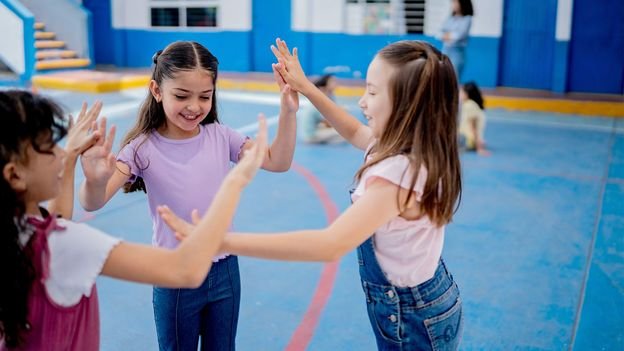
Given that physical activity often decreases among adolescents, especially for girls, parental support can also increase participation. In one US survey of both children and their parents, girls whose parents encouraged them and helped them find opportunities to participate in sports, were more likely to persist.
Similarly, as children often learn from the adults around them, research has shown that children are more likely to be physically active if their parents are active too – as well as if parents exercise with their children. This could be as simple as a bike ride in the local park or a short jog together.
Increased confidence
Another way to increase physical activity is to consider how children feel when they are moving.
Michaela James from Swansea University’s medical school in the UK has found that when children feel confident and competent around movement, it increases their wellbeing. She has found that many schools focus heavily on structured physical activities, which can leave some children to feel excluded and can affect their confidence.
More like this:
• The benefits of five minutes’ exercise per day
• The surprising benefits of standing on one leg
• What to do now to stay healthy into your 70s
Giving children more choice over what activities they do could be life-changing she says. “It could be quite chaotic to hand over power to young people and say, ‘just go with it’ but I think that plays a massive part in raising kind and compassionate humans.”
Increasing unstructured play should be simple to enact too, by encouraging active movement breaks and ensuring that break times are not removed as punishment, which has been used by some schools as a behavioural intervention.
In line with this, designing playgrounds more creatively to encourage free play, using objects like crates, tyres or wooden pallets could help increase activity levels too.
And crucially, we need to recognise that all movement is valuable, say James, whether climbing a tree, running around a playground or playing tag. “It’s all about valuing what children want to be able to do,” she says.
* Melissa Hogenboom is a senior health correspondent at the BBC and author of Breadwinners (2025) and The Motherhood Complex. She is melissa_hogenboom on Instagram.
—
For trusted insights on health and wellbeing, sign up to the Health Fix newsletter by senior health correspondent Melissa Hogenboom who also writes the Live Well For Longer and Six Steps to Calm courses.
For more science, technology, environment and health stories from the BBC, follow us on Facebook and Instagram.