India’s retail investing story is no longer just about getting more people into mutual funds. As SIPs become a routine part of household financial planning, the bigger challenge is whether investors understand what they own, how much risk they are taking, and whether their investments remain aligned with their actual goals.
That is shifting the wealth management conversation from simply getting investors into products to helping them manage their entire financial position.
CashRich, a wealth-tech management platform that says it has over 3.5 lakh users, is taking that approach through what it calls a Family CFO model. The framework brings together a family’s assets, liabilities, income, expenses, investments and long-term goals rather than looking at individual investment products in isolation.
The company is also pushing a different approach to SIP investing through its Dynamic SIP, which adjusts the allocation between equity and debt based on market valuations. The premise is to respond to valuation levels rather than attempt to predict the direction of the market.
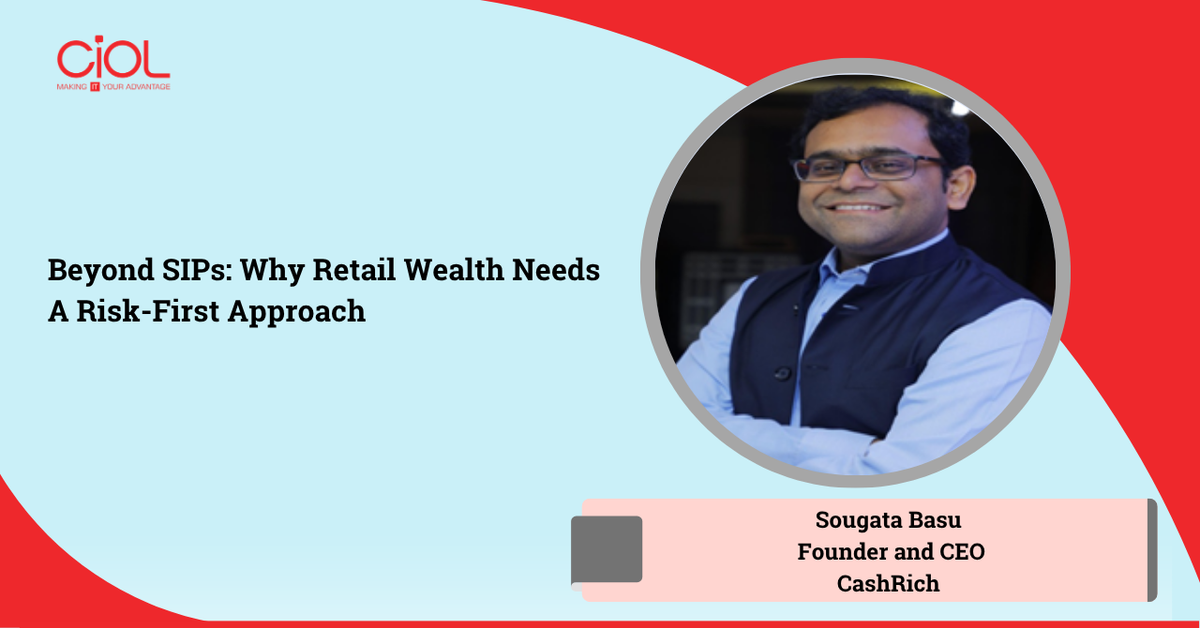
In this conversation with CIOL, Sougata Basu, Founder and CEO, CashRich, discusses why SIP growth does not necessarily translate into better investor outcomes, what retail investors can learn from institutional portfolio management, how AI should be used in wealth management, and why liquidity and portfolio risk could matter more than short-term volatility during the next market disruption.
The Problem With Measuring Investment Success
Basu argues that the wealth management industry needs to look beyond SIP volumes and assets under management and pay greater attention to whether investors are actually reaching the financial goals for which they started investing.
He also points to the gap between investor expectations and the risks they are taking, particularly among investors who entered equity markets during a strong market cycle. One example he cites is a school principal from Nashik who had investments across multiple apps but lacked a consolidated view of the portfolio.
That raises a broader question for wealth-tech platforms: can technology help investors make better decisions without simply giving them more products and more information? Basu’s answer centres on the idea of a family CFO, where the household’s investments are considered alongside cash flow, taxes, liabilities, emergency funds and long-term goals.
Interview Excerpts
The Indian mutual fund industry has seen record SIP inflows over the past year, but critics argue that investors are confusing disciplined investing with guaranteed wealth creation. Has the industry’s focus shifted too much toward maximising inflows rather than improving investment outcomes? Where do you think the wealth management ecosystem is failing retail investors today?
Look at two numbers from AMFI side by side. Monthly SIP inflows touched a record ₹32,087 crore in March 2026. In the same month, the SIP stoppage ratio crossed 100%. More SIP accounts closed than opened.
Money is flowing in, but investors are quietly walking out the back door. The reason is simple. We are generally more focused on overall AUM, SIP growth, etc. Whether investors actually achieve the financial goal for which they started the SIP is rarely measured.
Last year a school principal from Nashik showed me 11 funds across 3 apps, all small caps and thematic funds purchased during NFOs. He believed his SIPs would generate 15-20% every year because that is what he heard from a finfluencer on social media. After 2-3 years, they are facing negative returns, with no one to guide them through the situation.
That is the gap CashRich exists to close. A family gets product sellers, platforms, and apps. Nobody plays the role a CFO plays inside a company, watching cash flow, asset allocation, risk management, and taxes together. We call that missing role the family CFO.
The second failure is risk education. Post COVID, the bull market created millions of investors who have not yet seen a long bear market. Almost no first-time investor is aware of what a 30-40% fall does to a portfolio during a market crash.
Dynamic SIP essentially introduces an active decision layer into what has traditionally been a passive investing habit. The obvious question is: how do you prevent an algorithm from becoming another form of market timing? What evidence convinces you that valuation-based allocation creates better long-term investor behaviour rather than simply appearing smarter?
Market timing predicts direction. You exit because you believe a fall is coming. Dynamic SIP predicts nothing. It responds to the price you are paying today.
The rule is simple. When equity valuations are relatively expensive, invest less in the share market. When markets fall, we should invest more. The system helps to understand the relative valuation level and adjusts the amount invested in equity funds. As a sample, a ₹10,000 SIP might invest ₹3,000 in an expensive month and ₹9,000 in a cheap one, considering the risk appetite of the investor and with required approvals.
There are balanced advantage funds from various fund houses that operate on similar principles. However, our Dynamic SIP is more flexible and has certain advantages over these funds.
During the crash in March 2020, balanced advantage funds were down 15-20%. Comparatively, the debt portion of Dynamic SIP was not affected and was used to buy more equity at lower prices. Those extra units helped the portfolio when the market rose significantly later in 2021. The system buys more in a fall, the fall stops feeling like a threat and starts feeling like a sale. The goal is not to predict markets. It is to stop the predictable mistakes.
You’ve often spoken about bringing institutional portfolio management to retail investors. Having worked with ultra-high-net-worth portfolios and corporate treasury at Tata Steel, what aspects of institutional investing simply cannot be replicated for retail investors because of regulatory, behavioural, or cost constraints?
Institutions rarely lose money because they move slowly. Retail investors often lose money because they move too fast. At Tata Steel I helped manage treasury investments of roughly ₹12,000 crore. No investment was done without a written investment policy and an approval from senior management. At the time it felt slow. Later I understood the slowness was the risk management.
Three things from the institutional investor world that do not transfer to a retail portfolio are:
- Limited product access and research. Institutions can negotiate certain investment products at lower costs and have access to high-quality investment research.
- More awareness about the importance of asset allocation, diversification and tax implications. An institution rebalances portfolios on a schedule. As larger amounts are involved, tax implications are properly understood before transactions are done.
- I had managed the retirement funds (Provident Fund, gratuity, etc.). There we had a very long-term outlook and immense patience. Institutions can create policies and processes to stick to long-term investing. A retail investor with an app can see the news and react fast, which may not always be the best investment decision.
Fortunately, the most valuable part of institutional investing costs nothing. Allocation before product selection. A written plan set down before markets turn emotional. Treating the household like a consolidated balance sheet. That is what we compressed into the Family CFO process at CashRich.
AI is rapidly becoming the defining theme in fintech, with firms promising personalised portfolio advice at scale. Where do you draw the line between AI-assisted investing and regulated investment advice? As AI becomes more influential in financial decisions, should wealth-tech companies also become more accountable for investment outcomes rather than just providing recommendations?
The regulatory line in India is reasonably clear. Recommending specific securities for a fee is regulated advice. Helping an investor execute, organise, and understand their own portfolio is distribution and technology. AI does not change that boundary.
The structural problem is scale. India has over 5 crore mutual fund investors and fewer than 1000 SEBI registered investment advisers. AI can be used to fill that advice gap.
If the AI nudges a financial decision, the firm owns that nudge. Firms should answer for the process. Any AI recommendations must be suitable for the user, backed by clear records and logic. This process should be easy to explain to both investors and regulators.
Outcome accountability is different. Nobody controls market outcomes, and any firm promising high returns is misleading investors. What firms can guarantee is following the right processes for portfolio diversification, fund selection etc.
CashRich plans to expand into Tier 2 and Tier 3 India while also strengthening its NRI business and exploring GIFT City structures. These are very different investor segments with very different expectations. How do you build one investment framework that works across first-time investors, affluent NRIs, and digitally savvy urban users without oversimplifying risk?
Though the investors are different, the fundamental investment principles are similar. We serve thousands of families, many in Tier 2 and Tier 3 towns. Everyone goes through the same Family CFO process with a focus on the correct asset allocation and risk management.
What changes is the distribution process and engagement. In smaller towns, trust often requires in-person meetings. We have a network of fintech associates in Tier 2 and Tier 3 towns. They help to build trust, and our tech-based processes are used for the next steps.
For NRIs the complexity shifts to currency, taxation, and repatriation, where GIFT City is becoming very useful. Urban investors want speed and digital service. Also emerging HNIs in India can use global funds from GIFT City to invest in companies across the globe in USD, which also helps them to protect against the currency depreciation risk.
To assess the risk profile of an investor, we avoid the standard questionnaire. In a bull market, almost everyone believes they are aggressive. We look at cash flows and investment experience. How stable is the income? how many months of expenses are already invested in an emergency fund, how far away is the goal etc.
Every market correction produces winners in hindsight, and many wealth platforms claim they “protected investors” during volatile periods like COVID-19 or geopolitical shocks. Looking back objectively, what did your investment framework get wrong during those periods? If the next major market disruption comes from AI-driven trading, global debt stress, or prolonged geopolitical conflict, what assumptions in today’s wealth-tech models might fail?
Let me start with the call we got right, because it explains how we judge the ones we got wrong. In February 2019, our research showed that Franklin Templeton’s debt funds were earning their returns through credit and liquidity risk that mutual fund star ratings could not see. We emailed our users a written warning in February 2019 and stopped selling those schemes at CashRich.
In April 2020, Franklin Templeton froze 6 debt schemes, and over ₹25,000 crore was locked, creating panic among investors. No CashRich user was affected. Our users’ capital stayed liquid, and they were able to switch that capital to buy more equity funds when the market was low in April 2020.
What we missed during Covid is a concept called ‘portfolio insurance’.
At that time we didn’t have a framework for hedging. Now we have a rules-based framework that can help to protect portfolios during a market crash. The product has not been launched yet. However, it has been tested with my personal funds and has worked very well during the US-Iran war earlier this year.
The three assumptions in most wealth-tech models that may become problematic during a crisis are:
- Assuming that liquidity will always be there. Some AI models assume theoretical exit prices. However, during a crash, liquidity dries up. The small cap sector may trade 20-30% below the price that was in the AI mode.
- Assuming that traditional diversification will always protect. A global 60/40 portfolio fell close to 17% in 2022 because bonds and equities dropped together. Models that treat debt as the automatic cushion will disappoint in a genuine debt stress event.
- Assuming that volatility is the risk. Risk of volatility is not the same as risk of ruin. Permanent loss of capital and forced selling at the wrong time do the real damage. Wealthtech firms that don’t prepare for such low-probability but high-impact events will not be able to protect the portfolios of the retail investors.
The Wealth-Tech Question Is Moving Beyond Returns
The larger question for India’s wealth-tech market is no longer simply how to bring more households into mutual funds or automate more investment decisions.
As participation grows, investors will also need systems that account for income shocks, family obligations, liquidity requirements and market stress.
That puts greater importance on the processes behind investment decisions. For wealth-tech platforms, the next test may be less about how much money they can bring into investment products and more about whether their technology can help investors stay aligned with their financial goals when markets stop behaving as expected.