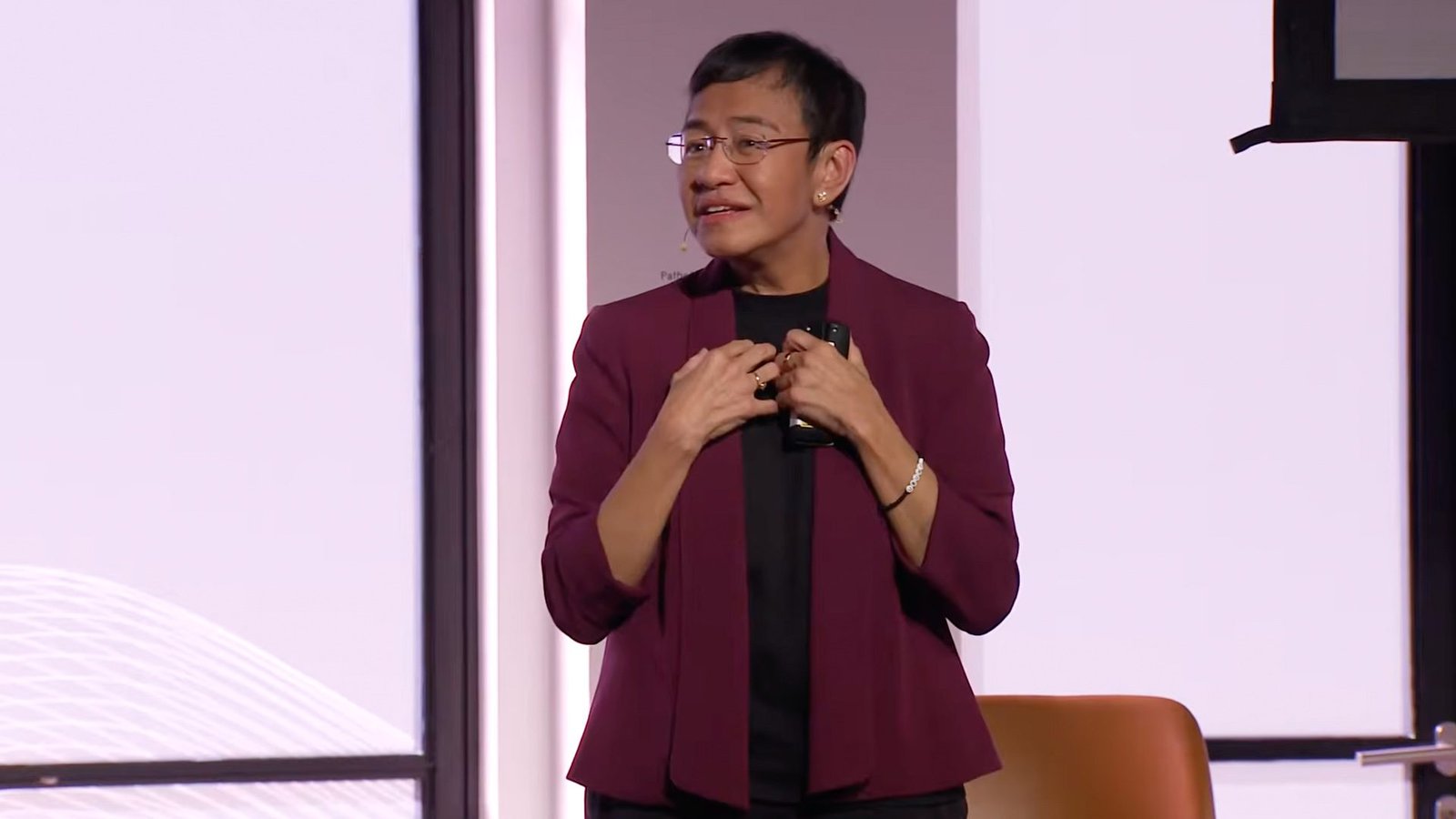
Nobel Peace Prize laureate Maria Ressa says journalists must have a say in the systems that increasingly determine how news is distributed
Nobel Peace Prize laureate Maria Ressa urged journalists to take control of the technology that increasingly determines how news reaches the public in the face of artificial intelligence.
“The only way you have information integrity is for journalists to become tech builders,” Ressa, Rappler’s chief executive officer, said during the Nobel Peace Conference 2026 held last September 3. “We must build, we own our data, we own the technology.”
The conference brought together Nobel Peace laureates and other participants to discuss threats facing democracy, lessons from civic movements around the world, and how the international community can support those fighting for it. This year’s discussions also included the growing influence of big tech on democratic societies.
Ressa warned that news organizations could “die in the next five to eight months” because the existing business model is no longer viable. Adapting to new tools is no longer enough. News organizations also need a say in the systems that determine how their journalism reaches their audience.
For years, publishers have relied on Google and other social media platforms to drive readers to their websites. AI-powered search is now changing that relationship by giving users direct answers to their questions.
This results in a reduced need to visit the original source. Fewer referrals mean fewer opportunities for publishers to build audiences and generate revenue from their journalism.
Ressa pointed to Rappler’s experience as an example of what she means by building alternatives. After years of dealing with online attacks, Rappler developed an application using the Matrix protocol, a project eventually expanded to other media groups.
The project gave news organizations infrastructure they could control, an approach journalism should take on in the AI era.
“Build your own technology,” she said. “Build your multilateral organization.”

An information crisis
Ressa described the wider problem as an “information armageddon.” The erosion of shared facts makes it harder for societies to establish a common understanding of reality.
She outlined three waves of technology that have transformed the information environment. These include social media, large language models and generative AI, and increasingly autonomous AI agents.
“Every one of these stages are built to hack our biology,” Ressa said. “They’re designed not for you, they’re designed for profit.”
Social media is designed to keep people engaged, she pointed out. Chatbots can simulate human intimacy, while AI agents are increasingly capable of carrying out tasks on a user’s behalf.
She also linked technology dependence to the spread of information operations, in which false narratives can be seeded and amplified during crises, and eventually accepted as fact.
For Ressa, defending democracy now means confronting not only the information being produced, but also the systems that determine how it moves.
“The technology is ruled by people who you didn’t elect, by people who have no guardrails, by people who are driven to keep you scrolling, even to your detriment,” she said.
Ressa co-chairs the UN’s Independent International Scientific Panel on Artificial Intelligence, a 40-member body tasked with assessing the risks, capabilities, and broader impacts of AI.
The panel warned in its July preliminary report that AI is advancing faster than governments’ ability to understand, measure and govern the technology. It said the rapid deployment of AI brings risks not only to societies and economies, but also to human rights and security.
The panel also identified AI’s effects on democracy and the information ecosystem as a major concern, warning that the technology can erode shared reality and create risks to information integrity and civic participation.
It said these risks could ultimately undermine society’s ability to benefit from AI if they are not addressed. – Rappler.com