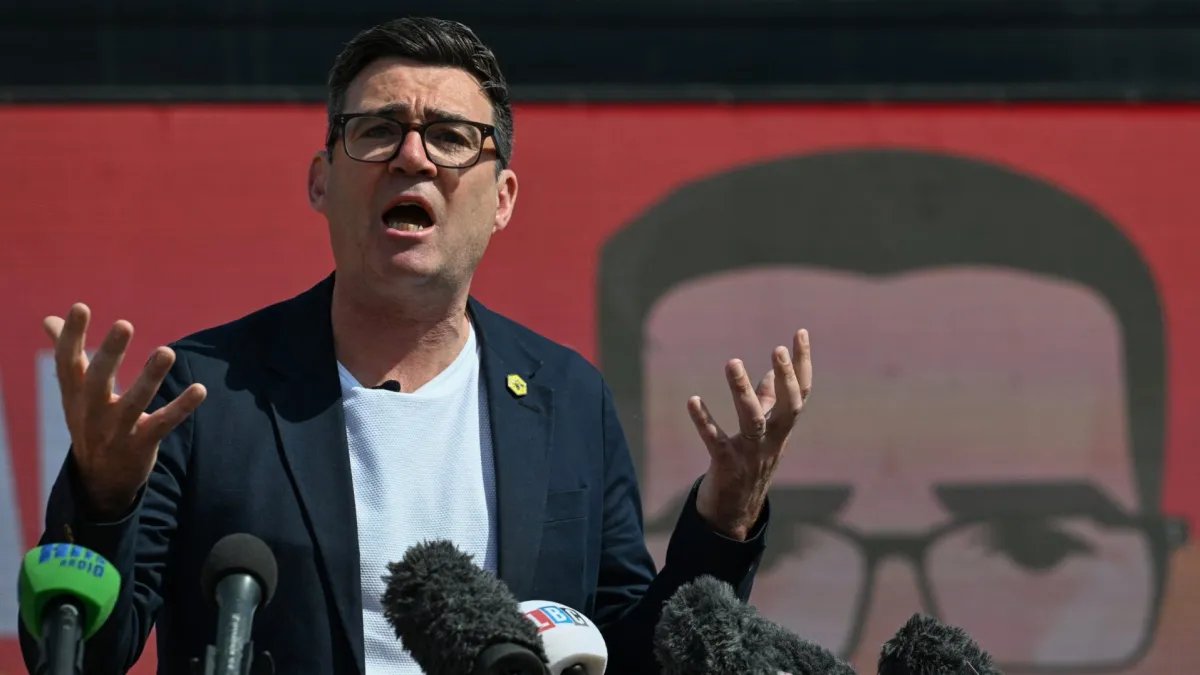
Andy Burnham has vowed not to raise income tax, VAT, or employee national insurance rates if he succeeds Sir Keir Starmer as prime minister.
The Mayor of Greater Manchester launched his campaign as Labour’s candidate for the Makerfield by-election on Friday, promising to lower energy and water bills – and oversee the largest building of council houses “since the Second World War”.
Burnham is widely expected to challenge Starmer should he win in Makerfield, after the Prime Minister faced more than 90 calls to quit from Labour MPs and the resignation of his health secretary, along with several other junior ministers.
And, in a sign he is seeking to project a disciplined economic message, Burnham told reporters on Friday that he is “committed” to Labour’s manifesto promise not to increase taxes on working people.
This means he would not raise income tax, VAT, or employee national insurance rates.
Burnham said: “I am committed to the manifesto commitments on tax, I think that’s really important from a trust point of view.”
He did, however, argue there was room to be “more radical” within the confines of these promises.
When asked about former health secretary Wes Streeting’s proposal of a capital gains tax which mirrors the three bands of income tax, Burnham was more cautious.
He said: “I’ve seen those new proposals. When we’re speaking on capital gains tax, I would want to look at them. I wouldn’t want to commit either way, I’d need to look at them in detail.
“But more broadly on the fiscal rules, I’ve never said that we should ignore the bond markets.”
Burnham later said he would not go “straight to” a wealth tax.
Labour ‘can be more radical within manifesto’
“I’m focused on what we can do within the manifesto and I’m fighting a by-election that is very much focused on people here not getting into arguments that are beyond the situation that I’m in,” he said.
Burnham has already committed to sticking to the Government’s existing borrowing rules in a bid to calm the bond markets.
A backer told the BBC: “He has committed to the [fiscal] rules as they are. It is totally essential. He understands the cost of borrowing is a huge constraint on government.”
The rules say, broadly, that day-to-day expenditure should be met from taxation rather than borrowing, and debt should fall.
This was a departure from recent weeks, when Burnham had suggested the rules might be changed – for example, by exempting rises in defence spending, as has occurred in Germany, to allow for extra spending.
But Burnham was clear on Friday that he would not abandon Labour’s current tax and spending plans.
“It’s about reprioritising that,” he said, arguing that investment in council housing would alleviate the £75m cost of paying for temporary accommodation in Greater Manchester.
“You can’t just look at that and then not do anything about it,” Burnham added.
The Mayor has called for the biggest programme of council house building since the Second World War and for more “radical” public control of utilities such as energy, water and rail.
He plugged a campaign about “change”, saying: “I know my own party needs to change.”