Key Takeaways
- Permanent life insurance policies accumulate cash value that you can borrow against for major expenses, but this may reduce the policy’s death benefit.
- Life insurance loans are tax-free and don’t require credit checks, but they can accrue interest and reduce any potential inheritance.
- If the policy lapses due to unpaid loans, you may face negative tax consequences, as the IRS may treat the borrowed amounts as taxable income.
- It’s essential to evaluate the risks, such as potential tax implications and reduction in beneficiaries’ inheritance, before borrowing against life insurance.
Borrowing against life insurance lets you take a loan from the cash value of a permanent life insurance policy, such as a whole life, universal life, adjustable life, or variable life policy.
You borrow directly against the policy’s accumulated cash value, often without a credit check, and the loan proceeds are generally tax-free. But borrowing can reduce the death benefit, and an unpaid loan could cause a lapse in your policy, leading to taxable income. Keep reading to learn how borrowing against your life insurance can be a flexible tool, along with the benefits and risks.
Who Can Borrow Against Their Life Insurance
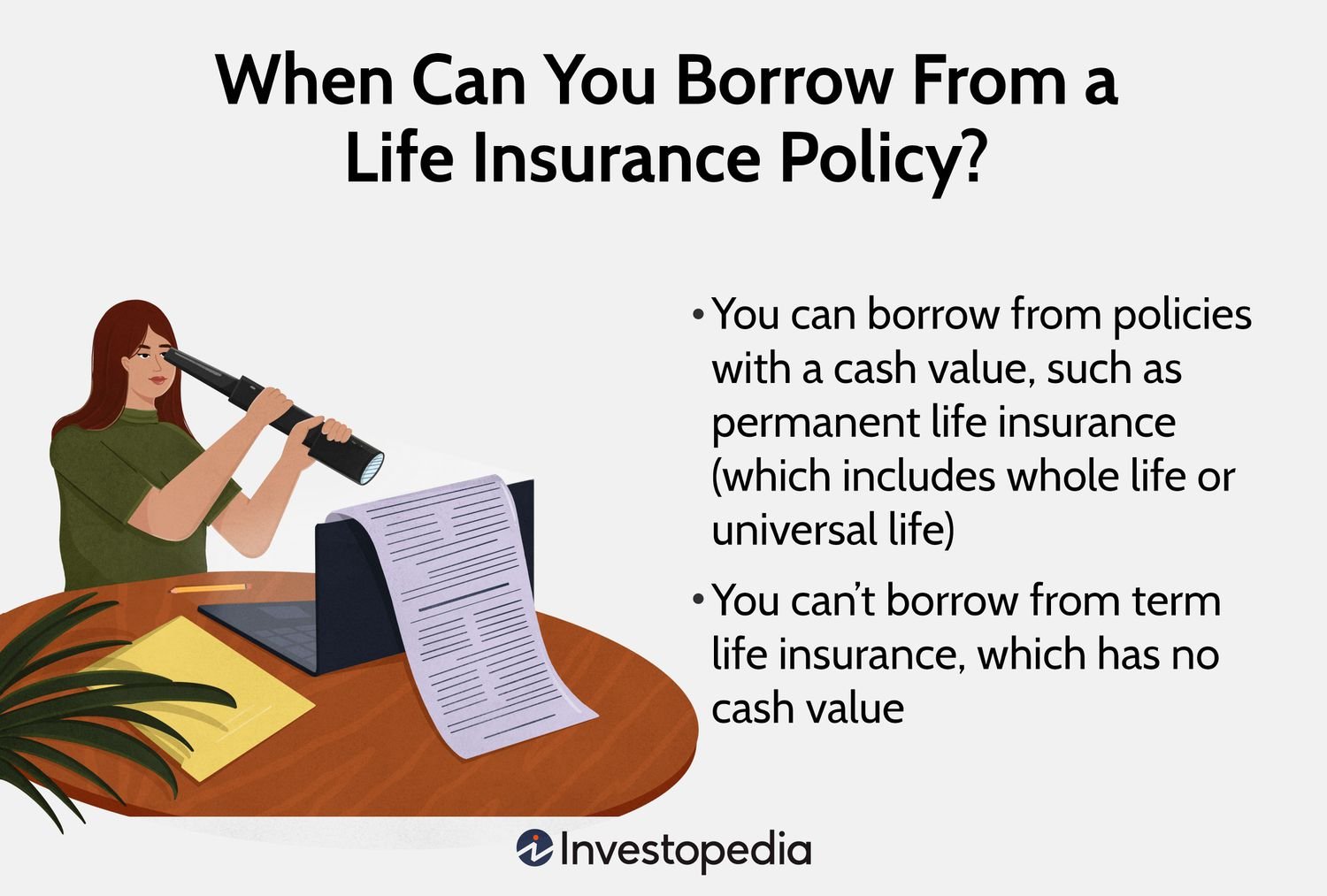
As cash value builds in a whole or universal life insurance policy, policyholders can borrow against the accumulated funds. Money from life insurance policy loans goes to your bank account tax-free, unless your policy lapses before you repay the loan.
Important
Insurers have varying rules for how much cash value a policy must have before you can borrow against it and what percentage of cash value you can borrow.
How fast or to what extent the cash value will increase depends on a number of factors, including what kind of policy you have. So, the time when your policy will be eligible for a loan will also vary.
Many policies start accruing cash value in two to five years. That cash value typically will be enough to borrow against in about 10 years, according to Richard Reich, president of Intramark Insurance Services, Inc., a life insurance agency in Glendale, Calif. The loan will be funded by the insurance company, and your policy’s cash value will be used as collateral, he said.
Investopedia / Yurle Villegas
Repaying Life Insurance Loans Explained
One benefit to taking out loans against your cash value is that you don’t have to repay them, however there are some downsides to not repaying the loan.
If you repay all or a portion of the loan, options include periodic payments of principal with annual payments of interest, paying annual interest only, or deducting interest from the cash value. “Loans have an interest rate like any other type of loan,” says Reich. Interest will be fixed or variable, depending on your policy.
However, if the loan is not paid back before death, the insurance company will reduce the death benefit, says Ted Bernstein, CEO, Life Insurance Concepts, Inc., a life insurance consulting and auditing firm in Boca Raton, Fla. The accumulated interest can also reduce the benefit.
A reduced benefit can put the policy at risk of not providing beneficiaries sufficient money upon the death of the insured.
Tip
Before borrowing against your life insurance, consult a financial advisor to weigh the pros and cons of all possible options.
When to Consider a Life Insurance Loan
If You Can’t Qualify for a Standard Loan or Need Immediate Cash
Because the money is already within the policy and immediately available, a life insurance policy can provide a source of immediate funds for major expenses like a new furnace, medical bills, or emergency costs. No credit check is required as your cash value is used as collateral.
Even if you qualify for a traditional loan from a bank or credit union, a life insurance loan could be a valuable stopgap if you don’t have time to wait as long for your application to be processed. When the traditional loan comes through, you can then use it to repay the life insurance loan.
If You Can’t Afford Your Policy’s Annual Premium
Don’t let a life insurance policy lapse because you can’t afford the payment. With a premium loan, the policy can stay in effect as long as the death benefit is greater than the amount of the loan. This is because the value of the death benefit is what would be used to cover the value of the loan in the event it was not repaid.
If Your Other Loan Options Have Higher Interest Rates
Compared to traditional loans, life insurance policy loans can be very competitive, Bernstein says. Other loans, such as personal loan, typically have a higher interest rate. Or, in the case of home equity loans, they may require that you pledge additional collateral.
With life insurance loans, there are no loan terms such as repayment dates, renewal dates, or other fees.
Risks of Borrowing Against Life Insurance
There are also disadvantages to taking out a loan against your life insurance. And while most life insurance with cash values allows for loans, there are terms. For example, you’ll have to pay interest (often 5% or 8%) that accrues on a loan. It may be your money in the policy, but you can’t borrow it for free.
If you don’t pay back the loan (and interest), the death benefit will decrease, and if the interest creeps up and you owe more than you have in your policy, it will lapse. If the policy lapses, the cash you took out, may be treated as income by the IRS, and you may owe taxes on it. Unlike most loans, life insurance loans usually don’t have a timeline for repayment, so you must make regular payments to pay down the loan.
Fast Fact
Most whole life insurance loans do not have to be paid back on a specific timetable. So, it may help set a personal repayment schedule to ensure you repay the loan without accruing significant interest.
How to Calculate Withdrawable Cash Value in Whole Life Insurance
The amount of cash value you can take out of your whole life insurance policy depends on the rules of the insurance company that holds your policy. Usually, if there is accumulated cash value in your policy, you can borrow from it, make withdrawals, or surrender your policy and remove your cash.
Assessing the Pros and Cons of Cashing Out Whole Life Insurance
If you plan to leave money to your spouse, children, or other beneficiaries through your life insurance policy, you probably don’t want to cash it out.
If you find yourself strapped for cash or need money for large medical bills or a financial emergency, you may be tempted to cash out or surrender your policy. You will receive the money you’ve paid into your policy, plus earned interest.
Taking a loan or withdrawal, however, and leaving some funds in your policy are also options as the policy will remain in effect and you can restore the full death benefit when you repay the loan.
How Much Can I Borrow From My Whole Life Insurance Policy?
You can usually borrow up to a certain percentage of the cash value in your whole life insurance policy. The insurance company holding your policy dictates the exact amount you can borrow.
How Long Does It Take to Borrow Money From Life Insurance?
It can take anywhere from one day to 15 days to receive funds from a life insurance loan, depending on the insurance company.
Should I Pay Back My Whole Life Insurance Loan?
The money you are allowed to borrow from your whole life insurance policy is yours. An insurance loan uses your cash value as collateral.
If you don’t pay it back, the policy will eventually lapse. When this happens, your beneficiaries lose their inheritance from the life insurance, and you lose the opportunity to use the money again in the future. In addition, if you don’t pay the loan back and the amount you borrow reaches the amount of cash value (or exceeds it), you may find yourself owing taxes.
The Bottom Line
A life insurance policy can be a source of immediate funds with no credit check if you have unexpected expenses, but borrowing against the policy is not right for everyone. Whether you need a life insurance policy and what type will depend on your financial situation. Similarly, if you have an insurance policy with a cash value, weigh the pros and cons before deciding if a loan is in your own financial best interest depending on your situation. Before deciding to borrow against a life insurance policy, it is wise to consult with a financial advisor.