Consistency in mutual funds often comes with a trade-off—either returns take a hit, or risk quietly builds beneath the surface.
But what if a fund manages to balance both without drawing too much attention?
The Parag Parikh Flexicap Fund has done exactly that, building its track record through discipline rather than momentum.
In a market that often rewards short-term positioning, its measured approach has helped it navigate cycles with relatively lower volatility. Backed by global diversification and a clear focus on downside protection, the fund has carved out a distinct space.
Here we take a close look at its strategy, portfolio, and performance, and asks whether this disciplined approach can hold up as market conditions become less forgiving.
About Parag Parikh Flexi Cap Fund
The Parag Parikh Flexi Cap Fund is an open-ended dynamic equity scheme that invests across large-cap, mid-cap, and small-cap stocks.
Launched on 24 May 2013, the fund has grown to manage an Asset Under Management (AUM) of Rs 1.35 trillion as of 27 February 2026.
It is categorised as a ‘Very High Risk’ investment, and its primary benchmark is the Nifty 500 TRI, with the Nifty 50 TRI serving as an additional benchmark.
The primary investment objective of the fund is to generate long-term capital growth from an actively managed portfolio consisting mainly of equity and equity-related securities. The fund house states that the scheme is ideally suited for investors with a minimum investment horizon of 5 years.
Asset Allocation
A flexi-cap fund is essentially an open-ended mutual fund that gives its managers complete freedom to dynamically invest your money across companies of all sizes—large-cap, mid-cap, and small-cap stocks.
Instead of being locked into buying just the biggest companies or just the smallest ones, the fund managers have the flexibility to go wherever they see the best opportunities to grow your wealth.
Markets change constantly. Sometimes large companies offer the best value, and other times smaller companies have better growth potential. A flexi-cap fund is dynamic. The managers aren’t boxed into a rigid category and can shift your money to the areas of the market that look the most attractive.
Many flexi-cap funds offer geographic flexibility alongside size flexibility.
For example, the Parag Parikh Flexi Cap Fund can invest up to 35% of its assets in foreign equities. This means you get exposure to global giants (like Alphabet, Amazon, and Microsoft) and Indian equities, all within a single fund, reducing your reliance on a single country’s economy.
The fund management team’s main goal is to carefully pick investments that will grow your wealth over the long haul. At its core, the fund will always keep at least 65% of its money invested in Indian stocks.
However, if the market is too expensive or they simply can’t find attractive enough stock opportunities, they won’t just force a bad investment.
Instead, they will park your money in safer debt and money market instruments or take advantage of quick arbitrage opportunities.
The scheme has the flexibility to allocate up to 35% into foreign stocks, debt securities, or money market instruments, and can also invest up to 10% into real estate and infrastructure trusts.
This allows the funds to remain productive while the team patiently waits for the right long-term stock opportunities to come along.
Fund Managers
The experience of fund managers is key in determining a fund’s long-term performance.
Rajeev Thakkar is an experienced investment professional and serves as the Chief Investment Officer for the scheme. At 53 years old, he brings over two decades of extensive capital market experience to the table, having started his career in 1994.
His strong educational background includes being a Chartered Accountant, a CFA Charter holder, and a Cost and Works Accountant.
Raunak Onkar manages Overseas Investments and also heads the research team. He has been with the fund since its inception and has over 10 years of experience in the capital markets.
He began his career at PPFAS as an intern in 2009, quickly rising to the role of research analyst before becoming Head of Research in 2011.
His academic credentials include a Bachelor of Science in Information Technology and a Master of Management Studies in Finance from Bombay University.
Raj Mehta is the Executive Vice President and Fund Manager for Equity, having assumed this role on 1 September 2025. He is both a Chartered Accountant and a CFA Charter holder, with bachelor’s and master’s degrees in commerce.
His journey with PPFAS began as an intern in 2012, after which he officially joined the team as a Research Analyst in 2013.
Having skin in the game is the most defining characteristic of the Parag Parikh Flexi Cap Fund.
This ensures that the interests of the AMC’s insiders are directly aligned with those of everyday retail investors. This also aligns with SEBI guidelines.
As of 27 February 2026, the combined holdings of these insiders in the Parag Parikh Flexi Cap Fund specifically amount to an impressive Rs 5.95 billion (bn).
Thakkar has a major personal investment of over Rs 283.7 m, Onkar (Rs 33.9 m), and Mehta (Rs 10.3 m).
Investment Strategies
The fund management team relies heavily on value investing principles, focusing on buying securities at a discount to their intrinsic value to create wealth for investors.
The fund’s active management is driven by a fundamental, bottom-up stock selection approach. It focuses on individual companies and their specific merits, not on macroeconomic conditions.
The scheme evaluates companies based on long-term prospects (5 years or more) rather than on quarterly earnings, resulting in a core equity portfolio with relatively low churn.
The team evaluates a company just as an investor would when making a business purchase.
It focuses on growth opportunities, sustainable competitive advantage, margins, industry structure, and protection of minority shareholders.
On the other hand, the fund sells when either the expected price appreciation is achieved, fundamental factors change permanently, or a better alternative investment is identified.
Portfolio Positioning
As of 28 February 2026, the fund manages an Asset Under Management (AUM) of Rs 1.08 tn.
The fund’s expense ratio (direct plan) is 0.62%. Current asset allocation is 76.47% in equity and 14.51% in debt, 3.53% in real estate, and the balance (5.5%) is held as cash and cash equivalents.
Its relatively low equity allocation reflects the scheme’s investment philosophy of prioritising capital preservation and maintaining flexibility to deploy capital when valuations turn favourable.
The portfolio is also large-cap-heavy, with a 92.8% allocation, followed by mid-caps (3.24%) and small-caps (3.94%).
In sectoral allocation, banks accounted for 20.04%, followed by computer software (8.54%), power (6.92%), IT-software (6.91%), and automobiles (6.71%).

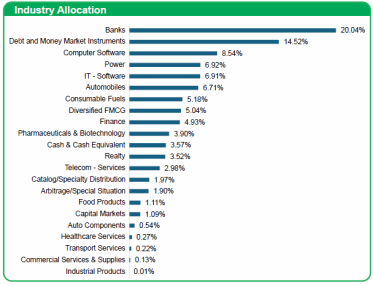
Source: Scheme Fact Sheet
The fund holds a diversified portfolio of 77 stocks, with the top 10 holdings accounting for 48.72%.
HDFC Bank had the highest weighting (7.73%), followed by Power Grid (6.92%), Coal India (5.18%), ICICI Bank (5.07%), and ITC (5.04%).
The fund also holds 3.99% stake in Alphabet, Meta (2.6%), Amazon (1.97%), and Microsoft (1.95%).
The portfolio price-to-earnings ratio is 17.6, indicating its lower valuation compared to the Nifty 50 (21.1).
The fund follows a measured churn strategy, reflected in its low portfolio turnover ratio of 0.15. This indicates a preference for holding positions through the business cycle rather than frequent trading.
With a standard deviation of 9.76, the scheme’s volatility is significantly lower than the benchmark BSE 500 TRI (14.63). A lower value indicates that the fund’s returns fluctuate less relative to the benchmark.
The scheme has historically delivered higher returns relative to the downside risk it takes, reflecting stronger risk-adjusted performance.
This is evident from a high Sortino of 1.41 compared to the benchmark’s (0.6).
A higher Sortino ratio indicates that the fund generates stronger returns while taking relatively lower downside risk during market declines.
In addition, with a Sharpe ratio of 1.08 relative to the benchmark (0.49), the fund outperforms on a risk-adjusted basis. A higher value indicates the fund delivers better risk-adjusted performance across all market conditions.
This is reflected in its performance. The fund has delivered a CAGR of 19.36% over the last 10 years.
Historical Performance
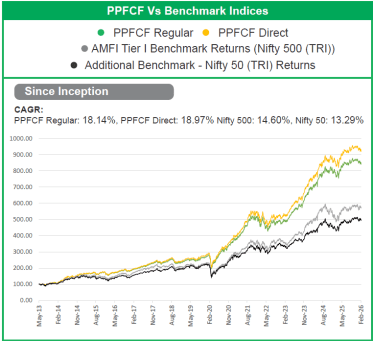
Over the long term, the fund has outperformed its benchmarks over the long-term. The Direct Plan has delivered a CAGR of 18.97% since inception.
For context, if an investor had put Rs 10,000 into the Direct Plan at the fund’s inception, it would have grown to Rs 91,954 by late February 2026. The same investment in the benchmark Nifty 500 TRI (which delivered a 14.60% CAGR) would only be worth Rs 56,996.

Source: Scheme Fact Sheet
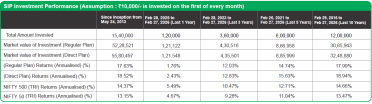
For investors investing through a monthly SIP (assuming an investment of Rs 10,000 on the first of every month), the fund has proven highly effective at compounding wealth.
A total cumulative investment of Rs 15,40,000 (since inception) would have grown to a market value of Rs 55,80,497 at an annualized return of 18.52%. In contrast, the same SIP in the Nifty 500 TRI would have yielded 14.37%.

Source: Scheme Fact Sheet
Evaluating returns on a daily rolling basis is an excellent way to assess a fund’s consistency across market cycles, smoothing out the impact of market timing.
Here too, the fund outperforms, with a 19.18% return across all measured 10-year periods. This is vastly superior to the benchmark’s average of 14.86%.
Note that these returns are based on historical performance and may not be sustained in the future.
Bottomline
The Parag Parikh Flexicap Fund’s strength lies in its ability to balance returns and risk, rather than chasing either in isolation.
Its lower volatility, reflected in a standard deviation of 9.76, combined with a higher Sortino ratio of 1.41, indicates that the fund has consistently protected capital better during market declines while still delivering strong outcomes.
This is reinforced by its measured equity allocation and willingness to hold cash or debt when valuations appear stretched. What stands out is the consistency of execution.
A low portfolio turnover of 0.15, a valuation-conscious portfolio with a PE of 17.6, and a long-term CAGR of over 19% suggest that returns have not come from aggressive positioning but from disciplined stock selection and patience.
Happy investing.
Disclaimer: This article is for information purposes only. It is not a stock recommendation and should not be treated as such. Learn more about our recommendation services here…
The website managers, its employee(s), and contributors/writers/authors of articles have or may have an outstanding buy or sell position or holding in the securities, options on securities or other related investments of issuers and/or companies discussed therein. The content of the articles and the interpretation of data are solely the personal views of the contributors/ writers/authors. Investors must make their own investment decisions based on their specific objectives, resources and only after consulting such independent advisors as may be necessary