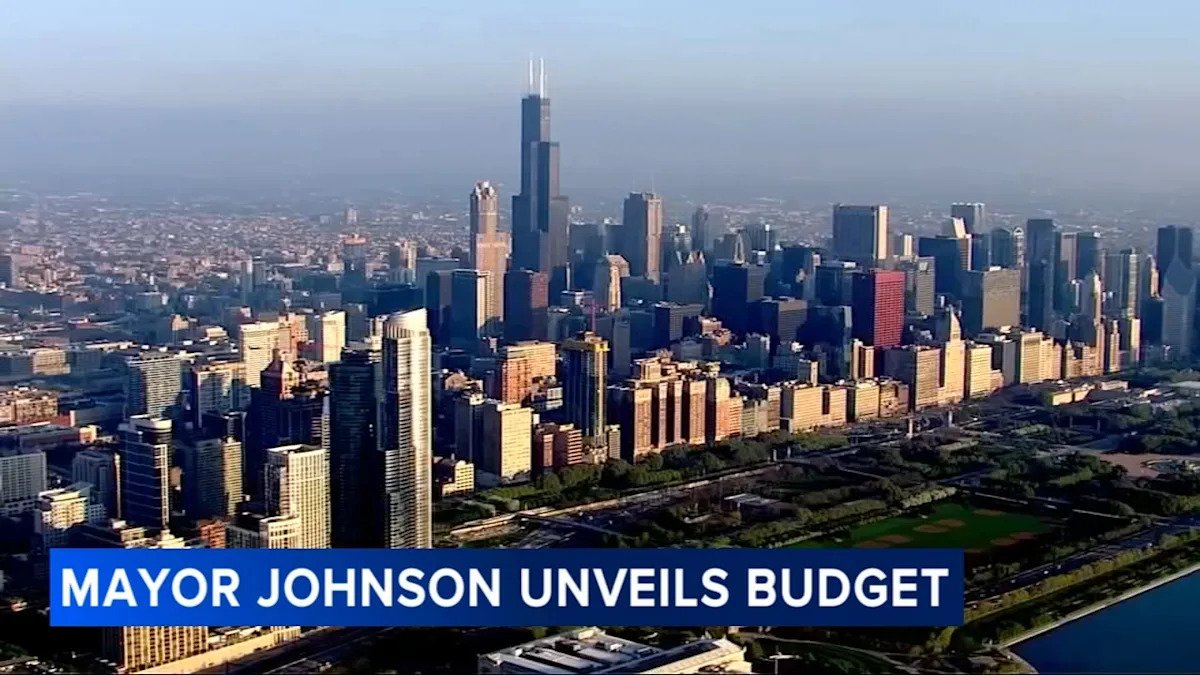
Mayor Brandon Johnson rolled out his progressive budget for 2026 on Thursday as the city faces more than a billion-dollar deficit.
ABC7 Chicago is now streaming 24/7. Click here to watch
Ahead of his budget address, the mayor spoke surrounded by community organizations and elected leaders about the “Protecting Chicago Budget.”
“It acknowledges a harsh reality that I think, that we all can agree on. We are living in unprecedented times,” Johnson said. “We can’t respond to Trump’s cuts and the attacks on our city with speeches and press conferences. We must take concrete action.”
A budget forecast released this summer projects a $1.15 billion deficit for the city, driven in part by the end of federal pandemic aid, and uncertainty over Chicago Public Schools pension payments.
Council members have until the end of the year to negotiate changes. The budget needs 26 votes for it to pass.
Johnson also called for a one-year hiring freeze that exempts public safety and other essential services.
There were also frequent jabs at the Trump administration, which the mayor blamed for some of the city’s financial problems.
No new taxes or fees for Chicagoans
The mayor’s proposed budget does not impose any new property taxes or fees on Chicagoans.
To avoid placing an “additional financial strain on working people,” the mayor also proposed the abolition of the grocery tax and reducing the motor vehicle lessor tax from $2.75 to $0.50 per rental period.
Social media tax to fund mental health programs
The mayor’s budget proposes two new special revenue funds for mental health and community safety.
The programs would be funded by adding a tax fee on social media companies called Social Media Amusement & Responsibility Tax, or SMART.
Money collected from the companies would fund “free mental health clinics throughout Chicago and the expansion of mental health crisis response teams,” the mayor said.
The tax would charge social media companies 50 cents per active user over 100,000 in Chicago. The mayor’s office expects the proposed tax to generate $31 million.
“And just like we tax other addictive vices that are bad for our health, like nicotine and tobacco, it is far past time we treat social media companies the same way,” Johnson said. “I’m not going to sugar coat it if we fail to invest in community safety in this budget at historic levels, the federal government will try to use that as justification for military occupation of our city.”
“Well, a social media tax has been challenged in many other states. The Supreme Court has looked at these and said these are First Amendment issues and struck down states’ chances to try to tax these,” 32nd Ward Ald. Scott Waguespack said.
The budget also creates a $100 million Community Safety Fund to increase funding for youth diversion and employment programs.
Taxing large corporations and the ‘ultra-rich’
As a direct response to the Trump administration’s tax cut for large corporations, the mayor proposed to implement new taxes and fees on some of Chicago’s wealthiest people and corporations.
One of the proposed fees is a “yacht tax,”‘ which the mayor said would brings the rate for boat-mooring at city harbors into alignment with historical rates and the rate of parking.
Two other new fees include a “vacant building fee,” which is a renewal fee to recover costs, incentivize development and reduce blight and taxes on big tech companies through an increase in the Personal Property Lease Transaction Tax rate.
“We are asking the top 3% of the absolute largest corporations in our city, those who have seen tremendous success and exceedingly high profits, to chip in so that we can build a safer city for all of Chicago,” Johnson said.
The Community Safety Surcharge would apply to companies with more than 100 employees.
It would charge $21 per employee per month.
It would generate $100 million in revenue
That would pay for things like violence prevention programs and summer youth jobs
$1 billion Tax Increment Financing surplus
The mayor said it’s marking the largest TIF surplus in the history of the city.
The surplus is expected to support Chicago Public Libraries, financial relief to Chicago Public Schools, Chicago Park District and City Colleges of Chicago, the mayor said.
RELATED: Chicago Police Department asked to come up with $98M in cuts amid city budget crisis
“So having not yet seen a TIF waterfall, it is hard to see how a billion dollar TIF surplus is even possible,” 34th Ward Ald. Bill Conway said.
The mayor is also looking to expand the rideshare congestion fee and put a $200 million cap on police overtime.
Some alders say Johnson’s proposals may not pass muster.
And the ideas also drew sharp backlash from the business community.
Local and state business groups blasted the head tax plan, along with the increase in the cloud computing tax.
“The best way to get rid of fiscal deficits is have new jobs, and the head tax and the cloud tax are job-killing taxes that will hurt businesses of every size and sector in Chicago,” said Jack Lavin, president and of the CEO Chicagoland Chamber of Commerce. “Before you charge them and burden them with more taxes, there should be shared sacrifice. His budget has $200 million of cuts when they increased the budget by $6 billion since 2019; so that’s not shared sacrifice.”
The Progressive Caucus praised the head tax and other revenue ideas.
“There’s economic warfare being put on our cities. Trump administration is taking away funds. They’re laying off our workers. They’re hurting our economies. That means cities have to find new solutions to how we fund our essential services,” said 49th Ward Ald. Maria Hadden, chair of the Progressive Caucus. “We obviously will be looking into the budget, learning more, making sure a lot of these solutions are going to work, but we stand here as a Progressive Caucus encouraged and excited about the proposal before us.”
But what alders did not see in the budget was money to pay for the new fire department contract.
So the budget discussions in the coming weeks could be contentious.