For years, critics of the energy transition have made essentially the same argument. Renewable energy was supposedly too expensive, too dependent on subsidies, too intermittent, and too vulnerable to survive a serious energy security crisis. Sooner or later, they argued, governments and investors would return to the comfort of oil, gas, and coal.
The latest figures from the International Energy Agency suggest the opposite is happening. According to the IEA’s newly released World Energy Investment 2026 report, global investment in clean energy has reached $2.155 trillion in 2025, more than double the $1.008 trillion flowing into fossil fuels. The crossover occurred around 2016 when clean energy first overtook fossil fuels. At the time, many assumed the lead would be temporary. Instead, it has widened every year since, transforming what was once a marginal advantage into a decisive one.
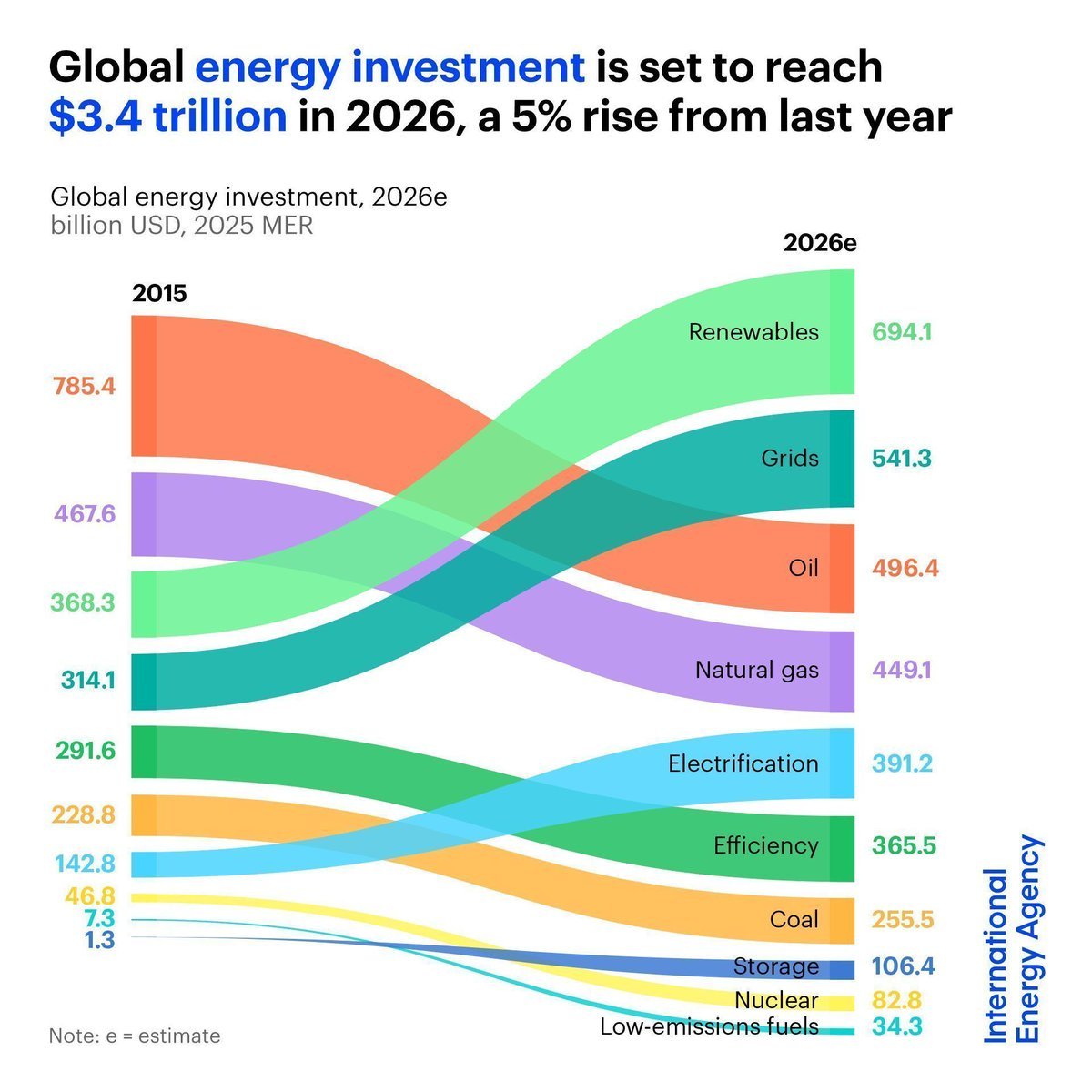
Chart source: International Energy Agency
This matters because energy transitions are ultimately determined not by political speeches or climate targets, but by where capital flows. Investors spend money where they expect future growth to occur, and increasingly they are betting on electricity rather than combustion.
The Energy Crisis That Changed Everything
What makes these figures particularly remarkable is the context in which they emerged. The world is navigating one of the most significant energy security crises in modern history. Tensions in the Middle East and disruptions around the Strait of Hormuz have once again reminded policymakers how vulnerable fossil fuel markets remain to geopolitical shocks.
Conventional wisdom would suggest that such a crisis should trigger a resurgence in oil and gas investment. After all, for decades, energy security was synonymous with producing more hydrocarbons. Yet the IEA projects global oil investment will fall below $500 billion in 2026, marking a third consecutive year of decline.
The explanation is surprisingly simple. Governments increasingly recognize that the most secure energy source is often the one that can be built at home. Renewable energy has evolved from being primarily a climate strategy into an energy sovereignty strategy. Every solar farm, wind park, battery installation, and transmission line reduces exposure to global fuel markets and strengthens domestic control over energy supply.
The Great Capital Migration
The most important story in energy today is not taking place in oil fields or power stations. It is happening in financial markets. Capital is steadily migrating away from fuel extraction and toward electricity generation, electrification, storage, and grid infrastructure.
The scale of that shift is becoming difficult to ignore. Solar energy alone is expected to attract roughly $365 billion in investment next year. Grid spending is growing by nearly 20% annually as countries race to modernize electricity systems. More than 70% of all global power-sector investment now flows into low-emission technologies.
These are not the numbers of an emerging niche industry. They are the numbers of a technology platform becoming the default choice for new energy investment. Investors are not abandoning fossil fuels because governments told them to. They are doing so because the economics increasingly favor technologies whose fuel is effectively free once the infrastructure has been built.
Why the Money Keeps Moving
One of the most underestimated aspects of renewable energy is that it fundamentally changes the relationship between countries and energy resources. A nation may not possess oil reserves or gas fields, but almost every country has access to sunlight, wind, water, or some combination thereof. Once renewable infrastructure is installed, there is no fuel to import and no geopolitical chokepoint through which energy supplies must pass.
That reality becomes particularly attractive during periods of international instability. Every disruption in oil markets reinforces the economic logic of electrification. Every spike in fuel prices improves the competitiveness of renewable energy. Every geopolitical crisis reminds governments why reducing dependence on imported hydrocarbons has strategic value beyond climate policy.
This helps explain why the largest energy security crisis in decades is accelerating clean energy investment rather than slowing it down.
The Caveats Matter—But Not Enough
None of this means fossil fuels are disappearing tomorrow. Coal investment remains stubbornly resilient in parts of Asia, natural gas continues to benefit from LNG expansion, and many developing economies still face enormous challenges accessing affordable finance for clean energy projects.
However, it would be a mistake to focus on those exceptions while ignoring the broader trend. Every major technological transition contains contradictions and periods of overlap. Coal consumption continued to grow during the rise of oil, and film cameras remained available long after digital photography arrived. What matters is not whether the incumbent survives for a period of time, but where new investment is going.
On that question, the evidence is becoming overwhelming. The overwhelming majority of growth capital in the energy sector is flowing toward technologies that generate, transport, store, and consume electricity.
This Is What Winning Looks Like
The energy transition is often portrayed as fragile, uncertain, and perpetually at risk of stalling. Yet the latest investment figures tell a different story. Faced with geopolitical instability, energy insecurity, and economic uncertainty, the world is not doubling down on fossil fuels. It is accelerating investment in renewable energy, grids, storage, and electrification.
That may be the clearest sign yet that the transition has moved beyond aspiration and entered something much more powerful. Energy systems ultimately change when investors decide where future profits will be made. Every solar farm, transmission line, battery factory, and offshore wind project represents a vote on what the world will look like decades from now.
The latest IEA data suggests those votes are becoming increasingly one-sided. Clean energy now attracts more than twice the investment of fossil fuels, and the gap continues to widen. If there were still doubts about the direction of travel, the money is providing an increasingly clear answer.
This is what winning looks like. Not targets. Not promises. Not conference declarations.
Trillions of dollars moving toward the technologies that will power the future.
By Leon Stille for Oilprice.com