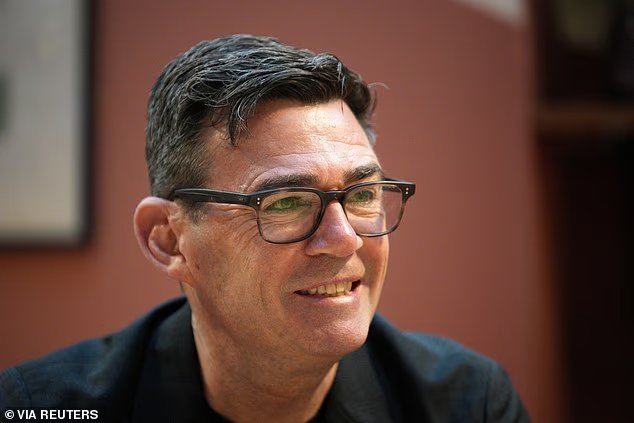
Andy Burnham will be dealing with an overflowing in-tray now he is officially in Number 10.
The new Prime Minister has already said he will announce plans to ease the cost-of-living crisis which looms large over his premiership.
The growing tax burden is also a hot potato as more workers and pensioners are dragged into paying more income tax.
Burnham has already hinted at raising taxes further, with many worried his spell as Prime Minister could lead to punitive hikes on the wealthy.
But it is the freeze on tax thresholds, introduced by Rishi Sunak in 2021, that could prove to be his biggest issue.
The decision by successive former Chancellors to leave the income tax bands unchanged, even as wages and the cost of living increase, has undoubtedly helped to boost the Treasury’s coffers.
Recent estimates suggest that frozen tax thresholds could bring in over £55billion a year by 2030, and with it higher taxes for ordinary workers.
That has not gone unnoticed by Burnham, who told The Times that the issue of frozen personal allowance had come up frequently on the doorsteps during his by-election campaign, which had ‘lodged in my mind’.
For now, very little is known about Burnham’s plans for the economy, but his recent comments suggest that he may introduce some welcome change to the tax system.

Andy Burnham has hinted at ending the freeze on the personal allowance, which is currently £12,570
What does the frozen personal allowance mean for taxpayers?
Rishi Sunak first announced the freeze on the personal allowance in 2021, which was supposed to end in 2025, before it was subsequently extended by Jeremy Hunt to 2028, and then to 2030 by Rachel Reeves.
It has created a stealth tax raid by allowing rising wages to drag more people into paying tax, while income tax thresholds are kept at the same level.
Every taxpayer with earnings over the personal allowance threshold of £12,570 is affected by the freeze, but how much by will depend on their earnings.
A basic rate taxpayer has more of their income captured by tax because the personal allowance has not increased since the freeze in 2021.
Figures published by HMRC last week show that the number of basic rate taxpayers is projected to rise to 31.4million in the current tax year, from 27.4million in 2021/22.
A further 3.3million more workers will be pulled into the higher-rate tax band this year, while half a million more will have to pay the top rate of tax.
And those over the state pension age are increasingly having to pay income tax because of frozen thresholds too. This Is Money reported last week that more than 7 in 10 pensioners are now taxpayers, as the triple lock pushes the state pension to near the £12,570 threshold.
How much more tax are people paying?
Frozen tax thresholds have created a colossal tax raid through a phenomenon known as fiscal drag.
As wages tend to rise with inflation, frozen thresholds drag more lower earners into paying tax while the number of taxpayers pushed into higher bands increases.
If the personal allowance had increased in line with CPI, it would have risen from £12,570 to £17,380.
If the 40p tax higher rate threshold had increased with inflation, it would be £69,504, up from the current £50,270.
A worse hand has been dealt to those even further up the income scale, as the threshold for the 45p additional rate of income tax was cut by Jeremy Hunt from £150,000 to £125,140 from April 2023.
If the original £150,000 threshold had been uprated for inflation, people would pay the additional tax rate on earnings over £207,300.
This fiscal drag compounded over the years has pulled millions more taxpayers in the higher and additional rate bands, leaving them paying thousands more a year.
AJ Bell analysis found that the freeze could cost basic rate taxpayers up to £700.36, which will increase to £960 once the freeze ends in 2030.
Higher-rate taxpayers are paying as much as £3,500 more in tax currently.

Rishi Sunak introduced the freeze on income tax thresholds in 2021
Will Burnham do anything about frozen tax bands?
Burnham has recognised the freeze on income tax bands has become untenable for many families already struggling with the rising cost of living.
The freeze on the personal allowance not only affects those with salaries but a growing number of pensioners too.
That will likely have formed the basis of many conversations on doorsteps in Makerfield during his campaign.
Mr Burnham has previously said he would like to reform income tax, given the chance.
Speaking on the BBC’s Question Time in June, he said he would raise the threshold at which you start to pay income tax from £12,570.
He said: ‘On the personal allowance, I’ve heard on so many doorsteps, and I’ve said to my team, let’s have a proper look at this and let’s develop a policy.’
Burnham could uprate the personal allowance and leave the higher and additional rate thresholds where they are, but he is likely to receive widespread criticism, not least from tax experts who have warned against ‘tinkering’ with the system.
The new Prime Minister may also look at the projections showing that the freeze will bring in over £55billion by 2030 and divert his attention elsewhere, particularly with the public finances already on shaky ground and defence spending set to soar.
If Burnham does look at increasing the £12,570 threshold at which people start to pay income tax, he might fiddle with the headline tax rates.
He said last year there was ‘definitely a case’ to bring back the 50 per cent top rate of income tax before the end of the current Parliament.
Currently, those earning above £125,140 a year pay the top rate of 45 per cent.
This has also been backed by Burnham’s probable Chancellor, Shabana Mahmood.
DIY INVESTING PLATFORMS
AJ Bell
AJ Bell
Easy investing and ready-made portfolios
Hargreaves Lansdown
Hargreaves Lansdown
Free fund dealing and investment ideas

interactive investor
interactive investor
Flat-fee investing from £4.99 per month

Freetrade
Freetrade
Investing Isa now free on basic plan

Trading 212
Trading 212
Free share dealing and no account fee
Affiliate links: If you take out a product This is Money may earn a commission. These deals are chosen by our editorial team, as we think they are worth highlighting. This does not affect our editorial independence.