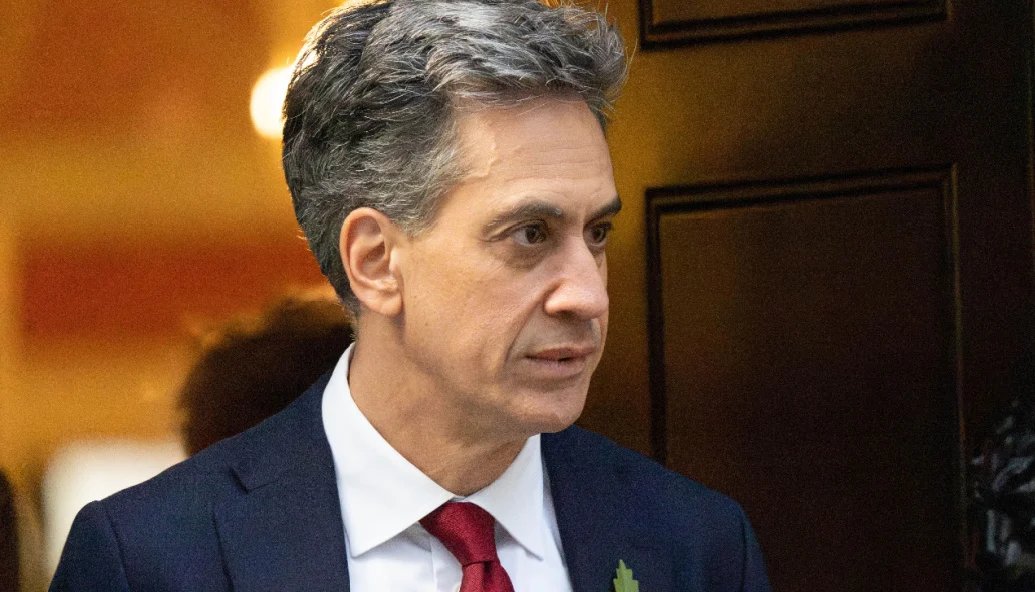
Ed Miliband has left the government’s energy brief to become Foreign Secretary after two years of rapid renewable expansion, which also left Britain facing the highest electricity costs in Europe – and major questions over how the transition will be funded.
Prime Minister Andy Burnham moved Miliband to the Foreign Office in his first reshuffle yesterday. Former Energy Minister Miatta Fahnbulleh has been named his replacement.
She had been working on policy ideas for a potential Burnham government since resigning as a junior communities minister in the aftermath of Labour’s disastrous local election results in May. She now returns to the department where she was looking after consumer interests.
VAT cut to 0%
And with bills at the highest ever levels the first act for the new PM is to announce the VAT rate on domestic energy bills will be cut from 5% to 0, from October, a saving of £45 a year.
The government says the announcement was estimated to cost £850m this financial year and would be funded by savings from the cancellation of the digital ID programme, which was going to cost £1.8bn over the next three years.
John Healey, the new chancellor, said: “Today’s energy tax cut will give families some breathing room on bills, and provide some reassurance this winter.” He added that: “for too long, too many people have struggled with the cost of living”.
Making the cut his first policy announcement Andy Burnham said:
We’re taking immediate action to cut taxes on energy bills, put more money in people’s pockets and bring back hope.”
Cutting VAT will save an extra £45 off the yearly Ofgem price cap, on top of the £150 removed from bills at the last Budget says Labour. By targeting electricity bills, more people will be supported with rising bills and the government is helping to keep inflation down.
All suppliers are expected to pass the VAT reduction on to all customers, including those on fixed tariffs, as they did with the £150 of costs taken off energy bills announced at the last Budget.
Small businesses who qualify for the domestic energy VAT relief and are not registered for VAT, as well as charities and residential care homes eligible for the reduced rate will also benefit.
Miliband’s legacy?
Miliband returned to the energy department in July 2024 promising to make Britain a clean energy superpower. His central target was a largely decarbonised electricity system by 2030 alongside lower bills and greater protection from volatile international gas markets.
Great British Energy became the flagship of that programme. The publicly owned company was established with planned funding of £8.3 billion to invest in renewable generation, supply chains and community energy projects.
Miliband also removed planning barriers for onshore wind in England and pushed ahead with larger renewable energy auctions. Offshore wind was placed at the centre of the 2030 strategy with ministers arguing that new turbines would strengthen energy security and eventually reduce bills.
However his record on affordability proved far more difficult.
Households continued to face some of the world’s most expensive electricity while British manufacturers repeatedly warned that industrial power prices were undermining investment. The costs of expanding the grid, supporting renewable generation and managing an increasingly congested electricity system also climbed.
Pricing reform struggles
One of Miliband’s most important decisions was to reject zonal electricity pricing in July 2025. Supporters of the reform argued that different regional prices would encourage generation and demand to locate where the grid had capacity while reducing the cost of paying wind farms to switch off.
Miliband retained a single national wholesale market after warnings that zonal pricing could increase bills in some areas and damage investor confidence. That decision left the government searching for another way to tackle constraint costs and stop gas-fired generation setting electricity prices when cheaper renewable power was available.
Analysis commissioned by Octopus Energy subsequently claimed wholesale market reform could save a typical household as much as £114 a year and cut business energy costs by £6 billion annually. Miliband later said the government was examining ways to decouple gas and electricity prices but he leaves before that work has produced a settlement.

Nuclear
One major step in future generation under this watch, was giving the green light to Sizewell C and in general backing a new growth in nuclear energy, including research and funding for fusion.
His successor, Fahnbulleh, must now turn a programme built around renewable capacity into one which demonstrably reduces bills.
Immediate decisions include the future electricity market, network charges, clean energy levies and the balance between North Sea production and imports. Burnham has suggested he would back new drilling in the basin to secure energy supplies, with Miliband out the way that path is now a lot easier.
Fahnbulleh will now have less than four and a half years to deliver Clean Power 2030, she will also inherit pressure to accelerate grid connections, while ensuring Great British Energy moves beyond announcements and begins delivering visible projects
Burnham must decide how much of Miliband’s approach to retain and how far affordability will reshape the programme. Today’s VAT cut is a clear signal that lowering prices will be a priority.
Copyright © 2026 Energy Live News LtdELN