A UCLA-led research team has developed a zinc-ion hybrid battery with a 3D-printed electrode that stores more than seven times the charge of similar hybrid devices, according to a new study published in the journal Small.
The device is designed for energy storage applications where batteries need to deliver and recharge power quickly, remain low-cost, and last for long periods.
The research focuses on zinc as an alternative to lithium, as it is considered cheaper and more sustainable because it is 100 times more abundant, easier to mine, and easier to recycle.
“The future of energy storage won’t be defined by a single technology,” said co-corresponding author Maher El-Kady, an assistant researcher in UCLA College’s chemistry and biochemistry department.
“At some point, we will need to look for something to complement the current options for grid-scale energy storage. What we’ve done in this study essentially gives us zinc-ion hybrid devices that can store nearly one order of magnitude higher capacity,” he continued.
A hybrid battery-supercapacitor design
The UCLA-led device combines two energy storage approaches. One terminal serves as the energy-storing part of a traditional lithium-ion battery, while the other uses a carbon electrode similar to those in supercapacitors.
Supercapacitors are known for fast charging and discharging, as well as long operating lifetimes. However, they typically store less energy because charge is held only on the surface of their electrodes.
The researchers addressed that limitation by increasing the surface area of the carbon electrode and loading it with vanadium oxide, a material that can store a large amount of energy.
This combination allowed the hybrid device to store far more charge than similar capacitor-based systems.
3D-printed electrode increases charge storage
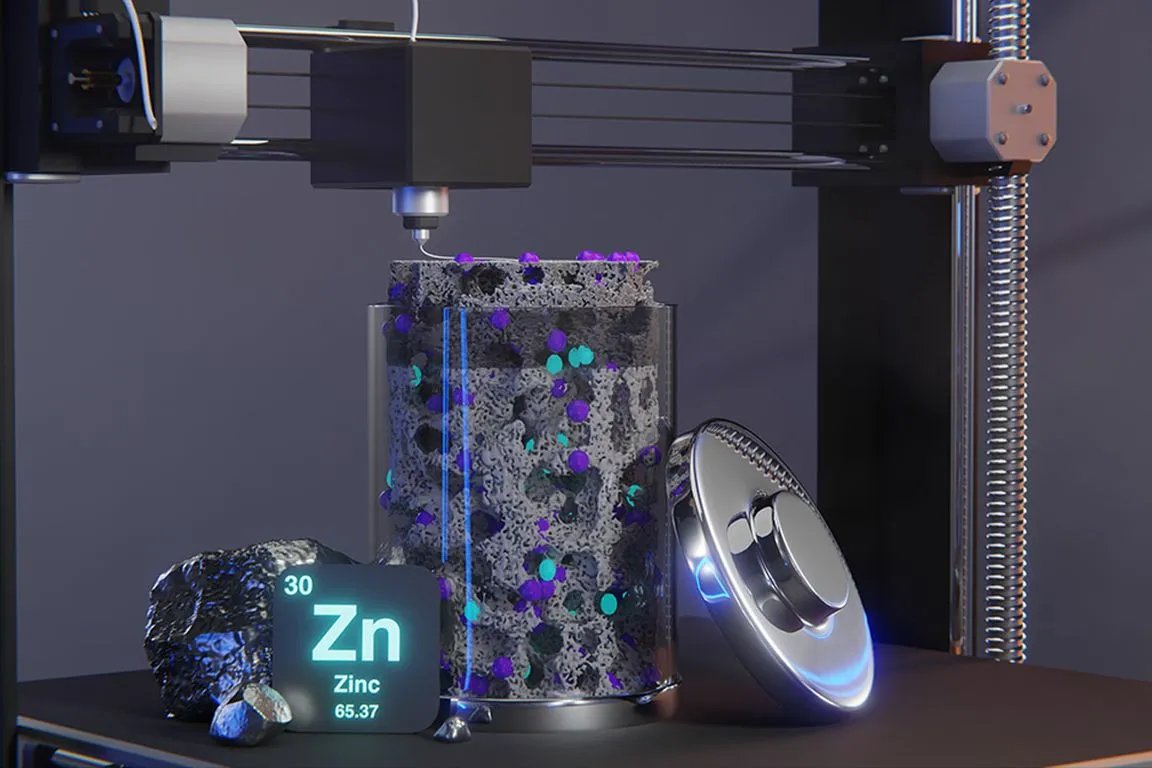
The electrode was designed with a honeycomb or sponge-like structure, with tiny cavities throughout. It was made using a 3D printing technique in which a liquid resin solidifies instantly when exposed to UV laser light.
After printing, the team used a heating and gassing process that removed everything except conductive carbon with open holes. The researchers then used a chemical process to load the carbon structure with vanadium oxide.
The resulting electrode had a very large internal surface area. According to the study details, one gram of the material, if flattened like a sheet of paper, would cover about 10 tennis courts.
In tests, the device stored more than seven times the charge of other capacitors. It also retained 82% of its capacity after 1,500 discharge and recharge cycles.
3D-printed test cell improves lab measurements
The study also introduced a 3D-printed test cell designed to improve the measurement of experimental energy storage devices in research labs.
Many labs currently use a basic setup involving an electrolyte solution and two electrodes in an open beaker. Premade glass test cells are available, but they can cost $1,000 or more. The open beaker setup is cheaper, but it has two key drawbacks: electrolyte evaporation and inconsistent electrode positioning.
“It’s a concept that we hope can be useful to other researchers in the field by helping them obtain more consistent measurements and reliable data for their devices,” said first author Sophia Uemura, who recently earned her Ph.D. from UCLA.