

When a child is born, talk about insurance increases all at once. Educational endowment insurance, life insurance for parents, medical insurance for children. The period around childbirth is when the feeling of ‘I need to sign up’ becomes strong, and the opportunities to be recommended such products also increase.
However, the period during maternity and childcare leave is a time when the financial structure changes significantly. Social insurance premiums are waived, and income is replaced by allowances and benefits. It is not too late to decide on insurance after first understanding how this system works.
In this article, I will write in order about what is waived, the money coming in, what happens if you increase coverage, what coverage you really should increase, the ‘payment methods’ to review first, a hypothetical case, and even what I would do myself.
Social insurance premiums are waived during maternity and childcare leave
For company employees and public servants, health insurance premiums and employees’ pension insurance premiums are waived during maternity leave and childcare leave. This applies not only to the individual’s portion but also to the company’s portion, and the procedures are handled through the company.
The social insurance premiums that were deducted from your monthly salary—40,000 or 50,000 yen—become zero only during this period.
Moreover, the period for which premiums are waived is treated as ‘having paid the premiums,’ so your future pension amount will not decrease for that period. You haven’t paid, yet your pension doesn’t decrease. This is something many people don’t know. There are requirements for how the months eligible for the waiver are determined, so it is quickest to check the details with your company’s personnel department.
Income is maintained through ‘Maternity Allowance’ and ‘Childcare Leave Benefits’
During maternity leave, you receive a Maternity Allowance from health insurance. Approximately two-thirds of your salary is paid for the period of 42 days before childbirth and 56 days after.
During childcare leave, you receive Childcare Leave Benefits from employment insurance. For the first 180 days, it is 67% of your pre-leave salary, and from the 181st day onwards, it is 50%. There is a cap on the benefit amount.
From April 2025, the ‘Post-Birth Leave Support Benefit’ was added. If both parents take at least 14 days of childcare leave, an additional 13% is added for the first 28 days, bringing the total to 80%.
For childbirth expenses, there is a 500,000 yen Childbirth and Childcare Lump-Sum Grant. There is a system where this is paid directly from health insurance to the medical institution.
These benefits are tax-free, and social insurance premiums are not deducted. Since about 20% of your gross salary is usually deducted for taxes and social insurance, many people find that even at 67% of their gross salary, their take-home pay is around 80% of their usual amount.
There is one point to note. Resident tax is based on the previous year’s income, so you will continue to pay the previous year’s tax during your childcare leave. You should plan for this as an ‘expense that does not decrease’.
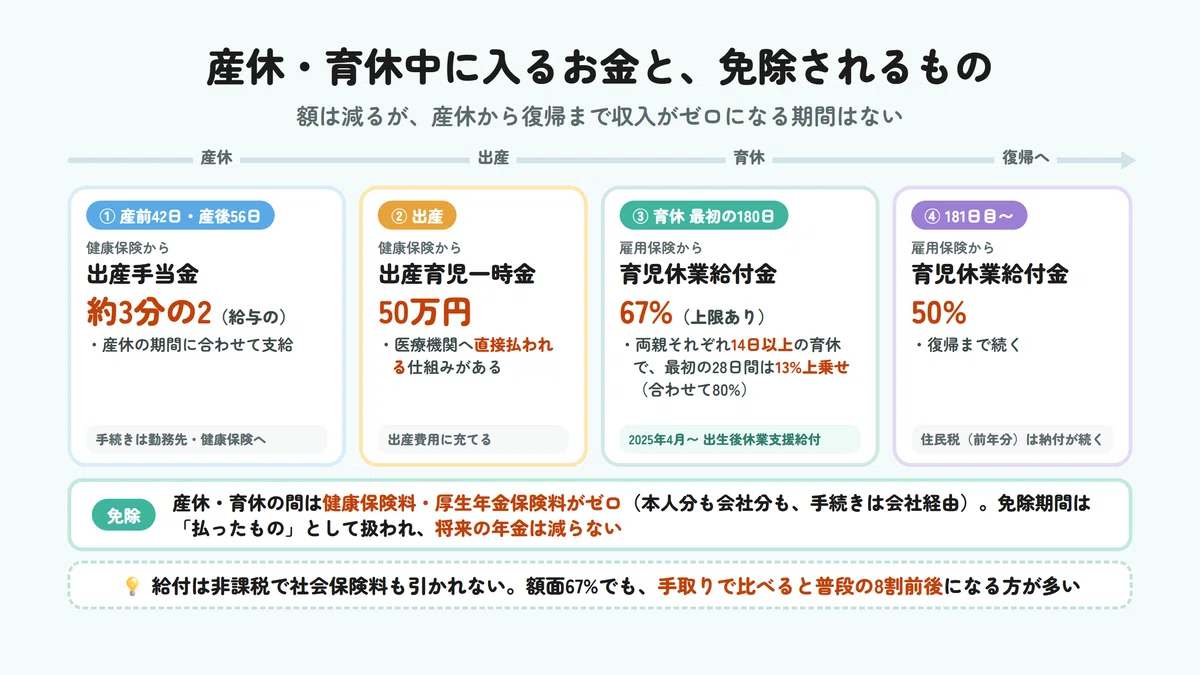
If you arrange these chronologically, you can see that there is no period from the start of maternity leave until you return to work where your income becomes zero. The amount decreases, but it does not stop.
If you increase your insurance during this period, you are adding fixed costs to a reduced income
Adding new fixed costs in the form of insurance premiums during a period when your income is lower than usual. This is the reality of increasing insurance during maternity and childcare leave.
If you add a 15,000 yen per month educational endowment insurance and a 1,500 yen per month child medical insurance during childcare leave, 16,500 yen will disappear from your household budget—which is at 80% of your usual take-home pay—every month as a fixed cost.
When viewed as ‘savings,’ many educational endowment insurance products only slightly exceed the principal after about 18 years. While they have a feature where future premiums are waived if something happens to the parent, that role is fulfilled more cheaply by the parent’s life insurance (income protection or term insurance).
For children’s medical insurance, many local governments provide medical expense subsidies for children, making out-of-pocket costs zero or just a few hundred yen up until junior high or high school. Even if hospitalized, medical costs are almost negligible. First, check the details of your local government’s subsidy program (eligible age, income limits, and out-of-pocket amounts) before making a decision.
The only thing you really need to increase is life insurance for the parent until the child becomes independent.
When a child is born, the coverage that truly becomes insufficient is ‘living expenses for the child until they are independent in the event of a parent’s death.’
There is survivor’s pension in the event of death. If you have a child under 18, you receive the basic survivor’s pension, and if you are a company employee, the employees’ pension for survivors is added. However, for many households, this amounts to only around 100,000 yen per month, which is often insufficient for living expenses, including housing and education costs.
You cover this shortfall with insurance. The form should be income protection insurance that pays out a monthly amount, or term insurance for a specific period. The coverage amount is calculated based on the ‘shortfall until the child is independent,’ and there is no need to have whole life coverage.
If you have a mortgage and are enrolled in group credit life insurance (danshin), the loan will be cleared if the person named on the loan passes away, and housing costs are already covered. Subtract that amount when calculating the shortfall.
This death benefit is necessary for both spouses. If something happens to the lower-earning spouse, the cost of outsourcing childcare and housework will be incurred. Even if the amount is small, it is standard to have coverage for both.
Before increasing coverage, review the ‘payment method’ of your current contracts.
What is worth doing during maternity or childcare leave is checking the ‘payment method of current contracts’ rather than increasing coverage. There are three things to look at.
The first is to switch annual payments back to monthly payments. During a period when your income is reduced, a large annual payment can make your household budget difficult. Depending on the contract, you may be able to change the payment method, so check with your insurance company.
The second is reducing the amount. Consider the daily hospitalization benefit of medical insurance taken out before childbirth or death benefits taken out during your single days. If you review the necessary amount and find it is too high, it is generally possible to reduce the coverage without medical underwriting. Procedures to reduce coverage can be done even during pregnancy.
The third is to be aware of the grace period for payments. Many contracts have a grace period during which the policy will not lapse even if payment is delayed. Just knowing this can prevent you from panicking and canceling your policy during a temporarily difficult month.
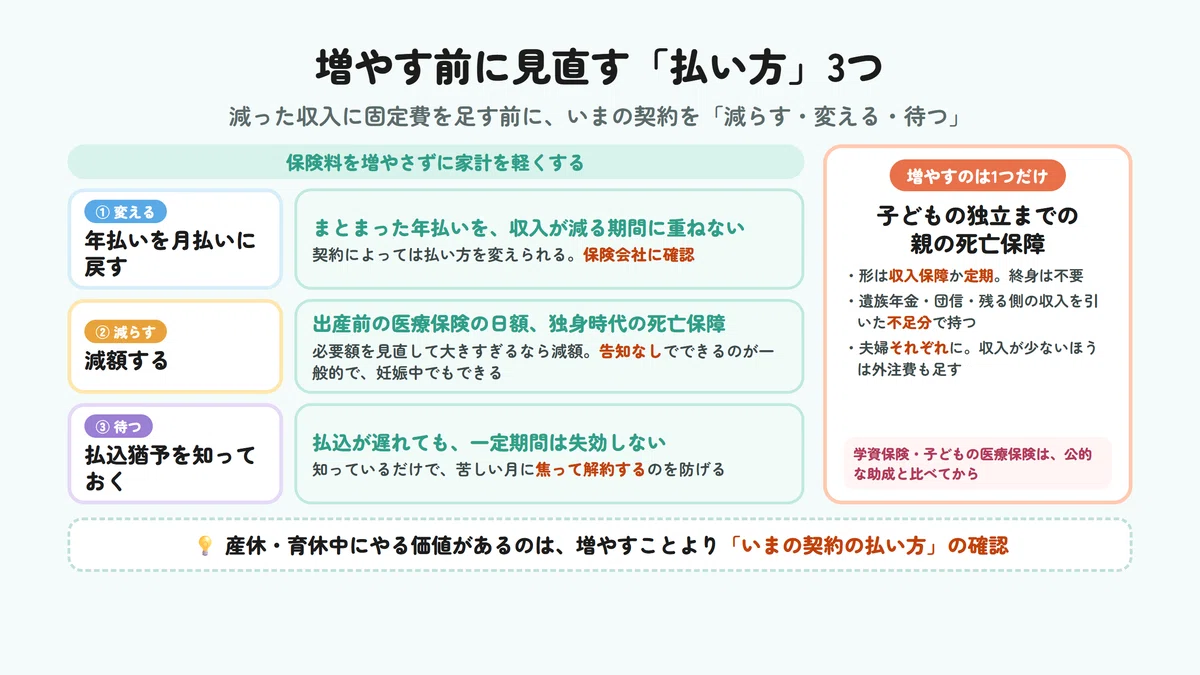
What these three have in common is that they can lighten your household budget without increasing insurance premiums. The only thing to increase is the death benefit mentioned in the previous section. Everything else should be handled by ‘reducing, changing, or waiting.’
There are restrictions on joining during pregnancy.
If you try to take out medical insurance after finding out you are pregnant, you may not be able to join depending on the week of pregnancy, or conditions may be attached such as ‘hospitalization related to cesarean sections or pregnancy is excluded from coverage.’ Even if you join in a hurry, the essential parts are likely to be excluded. This is why joining during pregnancy is often of little significance.
On the other hand, cesarean sections are covered by health insurance, and you can also use the high-cost medical expense benefit. There is a cap on out-of-pocket medical expenses per month, which is around 80,000 yen if your annual income is around 5 million yen. Even without medical insurance, it is unlikely that you will be unable to pay medical expenses. What you should do before childbirth is not to join new insurance, but to organize your current contracts.
Case: A household with a 35-year-old husband and 33-year-old wife, where the wife is a company employee starting maternity leave.
Let’s look at the numbers. This is a hypothetical example, and the amounts are tentative figures for calculation purposes.
・Husband 35, company employee, annual income 5 million yen. Wife 33, company employee, annual income 4 million yen (monthly salary 320,000 yen). Expecting first child. ・Mortgage is in the husband’s name only, with group credit life insurance. ・Husband: Term insurance of 10 million yen for 2,000 yen/month, medical insurance with 5,000 yen daily hospitalization benefit for 2,500 yen/month. ・Wife: Medical insurance with 10,000 yen daily hospitalization benefit taken out during single days for 4,000 yen/month. Annual payment of 48,000 yen. ・Before childbirth, they are being recommended an educational endowment insurance for 15,000 yen/month and children’s medical insurance for 1,500 yen/month.
First, let’s look at the wife’s income. During maternity leave, the childbirth allowance is approximately 7,100 yen per day, totaling about 700,000 yen for the 98 days before and after childbirth. During childcare leave, the childcare leave benefit is approximately 210,000 yen per month for the first 180 days, and about 160,000 yen per month thereafter. Since these are tax-free and exempt from social insurance premiums, they start at about 85% of the usual take-home pay of around 250,000 yen.
Next is the ‘husband’s death.’ After subtracting the survivor’s basic pension, the survivor’s employees’ pension, the housing costs covered by group credit life insurance, and the wife’s remaining income, the shortfall until the children are independent was about 20 million yen. Replacing the current 10 million yen term life insurance with income protection insurance that pays 100,000 yen per month until the child turns 22 costs around 3,000 yen per month.
For the ‘wife’s death,’ while the survivor’s pension and the husband’s income remain, the cost of outsourcing childcare is added. Calculating this, a gap of about 8 million yen remained, so the same type of income protection costs around 1,500 yen per month.
For the ‘wife’s hospitalization,’ there is the high-cost medical expense benefit, and the 10,000 yen daily hospitalization benefit is redundant. I will reduce it to 5,000 yen per day, costing around 2,000 yen per month. At the same time, I will change the annual payment to a monthly payment.
I will pass on the educational endowment insurance and children’s medical insurance that were recommended. I will save for education expenses separately through savings, and cover children’s medical expenses with subsidies from the local government.
In total, the cost before the review was 8,500 yen per month. If I had increased it as recommended, it would have been 25,000 yen per month. After the review, it is around 9,000 yen per month. Although the insurance premiums remain almost the same, the ‘parental death coverage until the children are independent’ is now covered for both spouses, and the redundant medical insurance has been lightened.
What I would do
If it were me, I would do two things before giving birth: ‘Confirm the procedure for social insurance premium exemption with the company’ and ‘Calculate the amounts of the childbirth allowance and childcare leave benefits.’ Once you know how your income will change, you can decide how much you can allocate to insurance.
Based on that, the only thing to increase is income protection until the children are independent. Each spouse should hold coverage for the shortfall after subtracting the survivor’s pension, group credit life insurance, and the remaining spouse’s income. I will decide on educational endowment insurance and children’s medical insurance after comparing them with public subsidies. For current contracts, I will change annual payments to monthly payments, and reduce coverage if it is excessive. Cancellation is a last resort; first, I will check the grace period for payments.
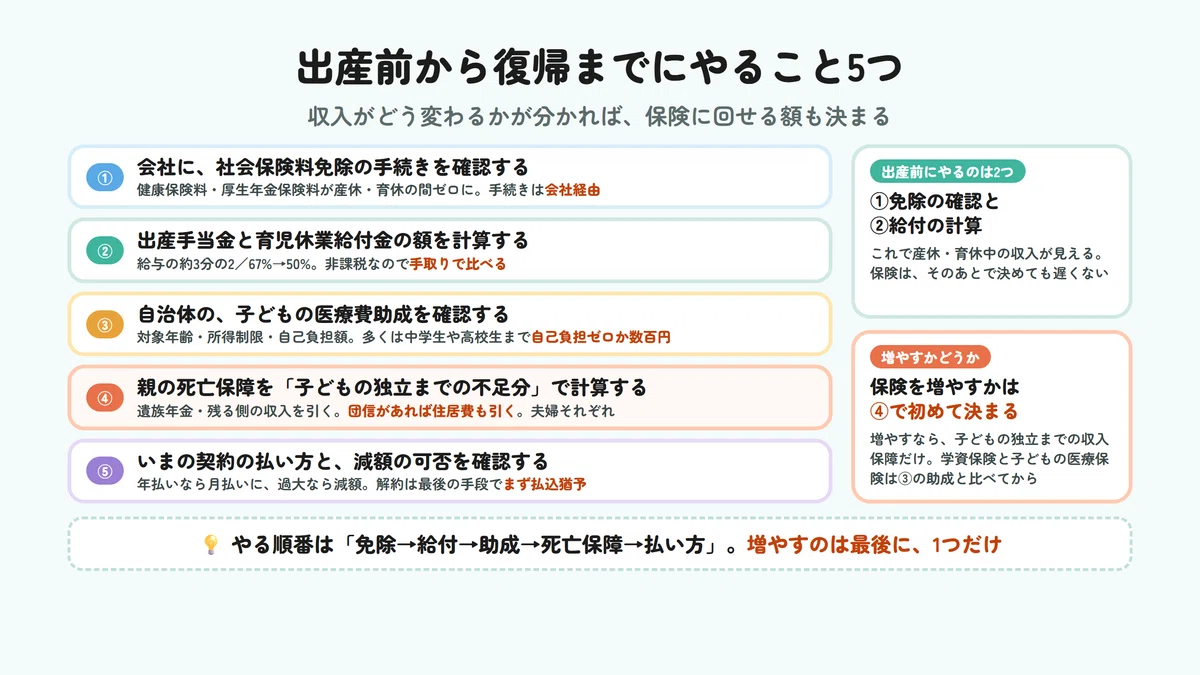
In order, there are five things to do from before childbirth until returning to work: (1) Confirm the exemption procedure with the company, (2) Calculate the amounts of the childbirth allowance and childcare leave benefits, (3) Check the local government’s medical expense subsidies for children, (4) Calculate parental death coverage based on the ‘shortfall until the children are independent,’ and subtract housing costs if you have group credit life insurance, (5) Check the payment method and the possibility of reducing coverage for current contracts. Whether or not to increase insurance is decided only at step (4).
Three common misconceptions
‘Income drops to two-thirds during childcare leave’
It is 67% of the gross income, but since it is tax-free and exempt from social insurance premiums, many people find that their take-home pay is around 80% of their usual amount. However, resident tax is based on the previous year’s income, so keep that in mind separately.
‘Since a child was born, I should get educational endowment insurance’
Educational endowment insurance serves as ‘savings for education expenses’ and ‘premium exemption in the event of a parent’s death.’ The latter is cheaper to achieve with parental death coverage. Whether to enroll depends on whether you are satisfied with it as a savings plan after first securing parental death coverage.
‘Children’s medical insurance is something you should get while they are small’
In many local governments, out-of-pocket medical expenses for children are zero or only a few hundred yen until they finish junior high or high school. First, check the subsidies from your local government, and then decide if there is a reason you still want to have it (such as for the difference in room charges).
Checklist
・Confirmed the social insurance premium exemption during maternity/childcare leave with the company
・Calculated the approximate amounts of the childbirth allowance and childcare leave benefits
・Checked the details of the medical expense subsidies for children in my local government
・Calculated the parental death coverage for each spouse based on the ‘shortfall until the children are independent’
・Subtracted housing costs from the coverage amount if enrolled in group credit life insurance
・Checked the payment method (annual/monthly) and the possibility of reducing coverage for current contracts
・Checked the grace period for payments and prepared so as not to cancel in a hurry
Summary
・During maternity and childcare leave, social insurance premiums are waived, and your future pension will not decrease.
・Income is maintained through maternity allowance and childcare leave benefits. Your take-home pay will be around 80% of your usual amount.
・If you increase your insurance coverage during this period, you will be adding fixed costs to your reduced income.
・If you must increase coverage, only get life insurance for the parents until the child is independent. Each spouse should have their own policy.
・Compare educational endowment insurance and children’s medical insurance with public subsidies first.
・The first step is to review ‘how you pay.’ Switch annual payments to monthly, reduce coverage if it is excessive, and learn about grace periods to avoid cancellation.
If you send me photos of your insurance policies before giving birth, I will create a list of ‘where to increase coverage’ and ‘where you can reduce it.’ For consultation on reviews, please send a DM to X (@ailabo_com). A simple message to start is fine.
──
This is general information and not a solicitation or recommendation for specific insurance products or financial institutions. No product names are mentioned. The conditions and amounts for maternity allowance, childcare leave benefits, post-birth leave support benefits, childbirth and childcare lump-sum grants, social insurance premium exemptions, survivor’s pensions, high-cost medical expense benefits, and children’s medical expense subsidies vary depending on your employer’s system, the health insurance you are enrolled in, your income, family structure, and the municipality where you live, and they also change due to system revisions. The details of group credit life insurance vary depending on your mortgage contract. The cases in this text are fictional examples, and the amounts are hypothetical figures for calculation purposes. The necessary coverage varies depending on your income, savings, family structure, and health condition. Please make the final decision on enrollment or changes yourself, and check the details with your employer, your health insurance provider, the pension office, your local municipality, and the insurance company.