
This article is an on-site version of our Moral Money newsletter. Premium subscribers can sign up here to get the newsletter delivered twice a week. Standard subscribers can upgrade to Premium here, or explore all FT newsletters.
Visit our Moral Money hub for all the latest ESG news, opinion and analysis from around the FT
Welcome back.
The creation of the Cali Fund in November 2024 was hailed by the UN as a “historic decision of global importance”, which could raise billions of dollars from big corporations to protect biodiversity. So far it’s received almost nothing. Is the idea fatally flawed — or might it yet fly?
Cali Fund shows the limits of moral pressure
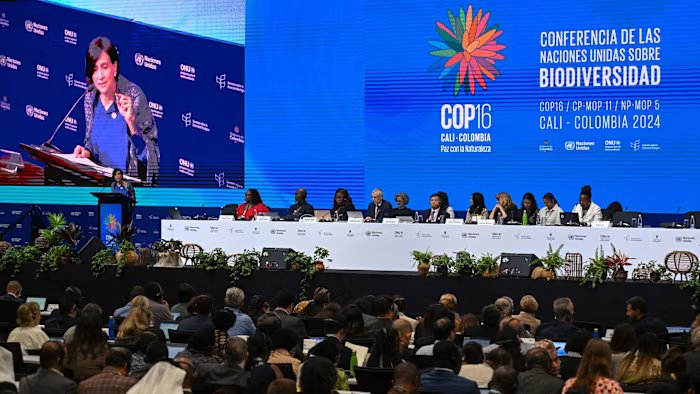
Two years ago in the Colombian city of Cali, global governments agreed on a plan to raise big sums of money from large companies to finance environmental protection.
Contributions to the new Cali Fund would come from businesses in sectors, such as pharma and cosmetics, that make use of “digital sequence information” — genetic data uploaded by researchers on to free public databases.
The idea was that companies ought to make a fair contribution to protect the natural world from which they’d derived financial gain. The agreement, sealed at the UN’s biennial biodiversity summit in November 2024, stated that big companies in relevant sectors “should” stump up 0.1 per cent of their annual revenue or 1 per cent of their profits. If they all did so, according to a subsequent UN estimate, the fund would receive $3.65bn per year.
The fund was duly set up and declared open for contributions within a few months. To date, it has received just five donations from a handful of smaller businesses — amounting to a grand total of $10,588.
The Cali Fund is “on life support”, says Siva Thambisetty, an associate professor of law at the London School of Economics who has written extensively on this area. “There is much more at stake here than just this fund. This is really about whether we can make good on global commitments.”
So far, not a single big global company has paid into the fund. Campaign groups have accused them of “biopiracy”, exploiting genetic resources harvested mainly from nature-rich developing countries while refusing to share the spoils.
Yet, multinationals have an incentive to back this initiative, insists Till Voss, who has been leading policy work around it for German pharmaceutical and biotech group Bayer. Companies like his are confronted with an emerging patchwork of national rules around the use of genetic data, he says, presenting a legal minefield that’s creating an increasingly heavy compliance burden — particularly because it’s often not clear which country can lay claim to a particular piece of genetic data. If a company could be exempted from such claims by contributing to the Cali Fund, Voss says, that would be an attractive option.
Countries have not yet agreed, however, that Cali Fund contributions should forestall demands for payment under national laws. Further legal risk, Voss says, comes with a continuing lack of clarity on exactly how the funds will be used. “As publicly listed companies, we need to know where the money will end up,” he says.
This year’s UN biodiversity summit in Armenia’s capital of Yerevan, which ended in the small hours of Saturday morning after a marathon final day, made only limited progress in addressing these and other outstanding questions around the Cali Fund, which were mostly shunted to the next summit in 2028.
Thambisetty argues that corporate lobbying is part of the reason for this, with officials spending too much time addressing industry concerns rather than focusing on the core work of getting the fund off the ground.
The Cali Fund’s embarrassingly weak start makes plain — if anyone still wondered — that simply putting moral pressure on corporations won’t deliver the finance needed to save the planet. A key question now, says Juliette Landry, senior research fellow at think-tank IDDRI, is whether governments will take policy actions to force or incentivise their companies to pay into the Cali Fund.
A major obstacle to this, she notes, is the concern about losing out to the US, the only UN member state that’s not a party to the UN biodiversity convention. In the EU, for example — already in a panic about its economic competitiveness — imposing a new green financial levy on a swath of the bloc’s business sector could prove politically explosive.
Thambisetty points out that governments have other options beyond imposing mandatory contributions, such as offering tax benefits to companies that pay into the fund.
But behind all this lurks a more basic question — whether governments are actually serious about this sort of finance at all. The Armenian summit gave some discouraging indications, with the final text noting that countries were badly off track to meet the 2030 nature protection goals they’d previously set. These included a target of mobilising an annual $200bn to “halt and reverse nature loss”; the latest figure is well under half that, according to the OECD.
Developed nation governments have failed to keep a promise to raise at least $20bn a year in international biodiversity finance by 2025, and many are cutting this type of assistance still further as part of wider cuts to foreign aid budgets.
The Cali Fund, even under an unlikely best-case scenario, would meet only a tiny fraction of this enormous shortfall.
“Many people coming to negotiate in Yerevan, coming from environmental ministries and authorities — they’re seeing that their budget is being cut and at the same time they have to do more,” says Landry. “This is really an impossible equation.”