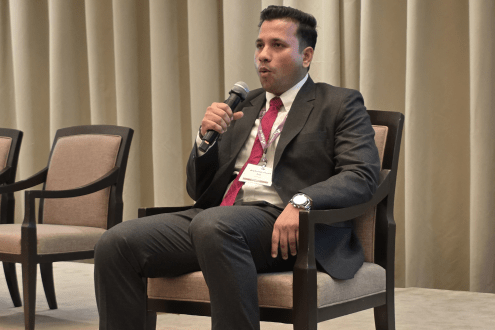
Mahendranath Pal, Vice President Sales at M5Wealth, used his time In The Hubbis Hot Seat at the Hubbis Independent Wealth Management Forum – Singapore 2026 to outline the operational challenges facing wealth managers and family offices as they scale across increasingly complex cross-border markets.
His remarks centred on a practical question: how can wealth management firms grow across jurisdictions while remaining compliant, efficient and in control? Pal argued that many firms still operate with too many systems, too many workarounds and too much manual effort, even as client expectations, regulatory demands and business ambitions continue to rise.
The presentation positioned M5Wealth as a wealth and asset management technology platform designed to connect the core operating pillars of a modern advisory business: onboarding, portfolio aggregation, suitability and order management, and revenue management. Pal also argued that AI can only add real value when these foundations are properly connected.
Key Takeaways
- Wealth Managers Face Operational Fragmentation: Pal said many wealth managers and family offices still rely on too many disconnected systems and manual workarounds.
- Cross-Border Complexity Is Increasing: Clients, assets, custodians, jurisdictions, entities and structures are increasingly spread across multiple markets.
- Scalability Requires Control: The challenge is to grow across markets while remaining compliant and operationally efficient.
- Four Pillars Are Essential: Pal identified client onboarding, portfolio aggregation, suitability and order management, and revenue management as the four connected pillars of modern wealth management operations.
- Onboarding Must Be Fast, Consistent And Compliant: AML, KYC, risk profiling, suitability and audit trails need to be embedded into cross-jurisdictional workflows.
- Portfolio Aggregation Enables Holistic Advice: Advisers need a single view across custodians, asset classes, geographies and currencies.
- AI Needs Connected Data: Pal argued that AI cannot solve operational complexity if the underlying data remains fragmented.
- The Future Is Integrated, Cross-Border And AI-Enabled: M5Wealth’s view is that digital transformation must begin with the right operating foundation.
Pal opened by asking what “great” means in wealth management today – not in theory, but in the way the business actually runs day to day.
His answer began with changing expectations. Clients want seamless experiences. Teams need flexibility and efficiency. Businesses want to scale across markets. Yet many wealth managers and family offices still face the same operational issues: too many systems, too many manual processes and too many workarounds.
“Clients expect seamless service, but many firms are still running on fragmented operating models,” Pal said.
This challenge is particularly acute in Singapore, which Pal described as one of the leading financial hubs in the world. Wealth managers operating from Singapore often serve clients across jurisdictions, assets held with multiple custodian banks, complex regulatory requirements, and multiple entities and structures.
For Pal, the real issue is not whether firms want to scale. It is whether their operating model allows them to scale without losing compliance, control or efficiency.
Scaling Across Markets With Control
Pal framed the central question for modern wealth managers clearly: how can a business scale across markets while remaining compliant and in control, without adding more operational complexity?
His argument was that firms should not be spending disproportionate time managing multiple systems. Their focus should be on clients, advice and growth.
“You do not scale a wealth management business by adding more disconnected systems,” he said. “You scale by creating control, consistency and visibility across the operating model.”
This is where M5Wealth positions its platform. The objective is to help wealth managers simplify their operations while supporting the realities of cross-border business.
For Pal, that means connecting the key functions that sit underneath the advisory relationship, rather than allowing them to remain fragmented across separate tools and workflows.
The Four Pillars Of Modern Wealth Management
Pal identified four connected pillars that modern wealth managers need.
The first is client onboarding across jurisdictions. This includes embedded AML, KYC, risk profiling, suitability and audit trails, allowing onboarding to be faster, more consistent and compliant.
The second is portfolio aggregation. Advisers need a single view across custodians, asset classes, geographies and currencies so they can advise clients holistically.
The third is suitability and order management. Mandates, risk parameters and regulatory rules need to be embedded into workflows through pre-trade and post-trade controls.
The fourth is revenue management. Firms need to track revenues across retrocessions, performance fees, advisory fees and management fees, with transparency and control.
“When these four pillars are connected, the business becomes easier to manage,” Pal said. “Operations simplify, control increases and scale becomes more realistic.”
This was the core operating model Pal presented. Wealth management platforms should not only digitise isolated tasks. They should connect the functions that determine whether a firm can manage complexity across markets.
Why AI Depends On The Foundation
Pal then turned to AI, a topic he said is now a major focus across the industry.
He acknowledged that AI has significant potential in wealth management, but cautioned that it only works properly when firms have connected data. If systems remain fragmented, AI does not solve the real challenge. Instead, firms are still left copying data between systems, correcting inconsistencies and reconciling numbers.
“That is not AI,” Pal said. “That is fast chaos.”
His point was that AI cannot compensate for a weak operating foundation. If onboarding, portfolio data, suitability workflows, order management and revenue information sit in disconnected systems, AI may amplify the problem rather than solve it.
For Pal, this is why the foundation matters. Wealth managers need connected infrastructure before AI can deliver meaningful operational or advisory value.
Integrated, Cross-Border And AI-Enabled
Pal concluded by arguing that the future of wealth management in Singapore will not simply be digital.
In M5Wealth’s view, it will be integrated, cross-border and AI-enabled. But for that future to work, firms first need the right operational architecture. They need systems that connect the core pillars of the business, simplify workflows, support compliance and create the data foundation required for AI.
The presentation ended with an invitation to continue the conversation at M5Wealth’s booth, but the broader message was direct. Wealth managers cannot build scalable, AI-ready businesses on fragmented infrastructure.
For Pal, the firms best positioned for the next phase of growth will be those that connect their data, embed control into their workflows, and give advisers the ability to focus less on operational workarounds and more on clients, advice and growth.