RATING
Who’s eligible, who’s not
The study accounts for all open-ended funds in the active equity category. Sector and thematic funds were not accounted for. Only direct plans with the growth option are considered. The fund management history of each of these funds for the past six calendar years (Jan 2020-Dec 2025) is taken into account. A 6-year period is used to ensure we can assess rolling 3-year returns over at least a 3-year period (spanning 6 years), allowing for an adequate number of observations and smoothing out market phases.
Also Read: Best Fund Managers 2025: Top wealth creators who mastered the balance between risk and returns
All those who have served as fund managers for at least 70 months (in one or more funds) in the past 6 years have been included in the ranking. No restriction is put on the number of breaks in fund management. As long as the cumulative break is less than 2 months, the manager is added to the ranking. Note that every fund manager, whether primary or jointly managing a fund, is ranked.
TRACK RECORD
A single track record is created for each fund manager
How to account for a fund manager who’s changed jobs/fund houses, or even managed different funds within the same fund house at different points in time? Enter virtual NAVs, which Prime Investor creates to keep tabs on the manager’s movements across schemes and fund houses. The virtual NAV moves in tandem with the schemes’ actual NAVs, but provides a sense of continuity that can be measured at the finishing line. The cut-off date is 31 December 2025. Sixty-five fund managers made the cut and were included in our study.
Also Read: Beyond gold: Why copper, uranium and rare earths are the new investor rush
RANKING
Fund managers ranked based on various metrics, subject to qualifying conditions
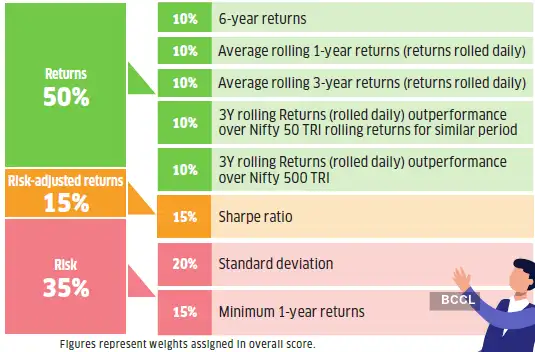
In this stage, the performance of each fund manager (as represented by the respective virtual NAVs) is used to rank the fund managers based on various metrics (graphic):
- This combination of metrics ensures that the market-cap orientation of a fund is not unduly influencing the manager’s score.
- The consistency scores ensure that volatile funds are tested for consistent returns and penalised for erratic returns.
- The Nifty 50 and Nifty 500 indices are used together to measure the ability to deliver on upside and downsides beyond their own benchmarks. For example, the Nifty 500 will test the large-cap fund’s ability to outperform in upcycles, while Nifty 50 will test the mid and small-cap fund’s downside containment in down cycles. This also helps normalise performance due to market-cap divergence.
NOTE:
- When the fund managers were from the same fund house, and the funds managed overlapped, the primary fund manager was considered.
- Where a fund manager had quit post the December 2025 cut-off used in this exercise, the fund manager was dropped
Disclaimer: The funds featured here are not recommendations