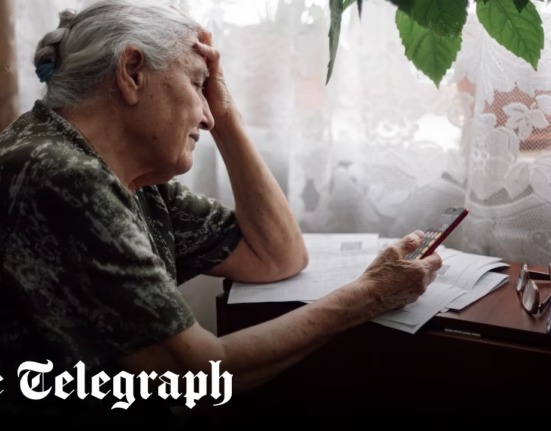
Benefits claimants and people on low incomes could be missing out on significant council tax support, with discounts available that can cut bills by up to 100%.
Lower-income households will face added pressure as council tax bills rise for millions from 1 April, with most local authorities in England setting 5% increases that average £83 per household.
Seven councils have secured government approval to exceed 5% and introduce cap-busting increases, including Worcestershire, which is bringing in a 9% hike.
Scottish households will face 8% increases on average, while bills in Wales could creep up by 9.5%.
Here’s how to save on council tax bills and claim any discounts you qualify for.
Single-person discount
The single-person discount for those living on their own is the most common council tax discount in the UK.
Residents who are the sole adult living in a property aged over 18 are eligible for 25% off their council tax bill.
To apply for the discount, contact your local council directly. There will be a page explaining how to apply for a single-person discount, which usually entails filling out an online application form.
While some councils adjust payments within two weeks, others report nine-week waits.
A single-person discount is usually applied from the resident’s application, with the backdating of a reduction rate.
‘Disregarded’ persons discount
Some benefit claimants, or those linked to another person’s benefit claim, can be ‘disregarded’ for council tax.
The list includes:
If everyone in your house is classed as disregarded, then your council bill could be halved.
If all but one person in the house is disregarded, then you can qualify for a 25% discount.
To apply, visit your local council’s website and search for “council tax discounts”, “disregarded persons” or “council tax exemptions”.
Find the relevant online application form specific to your exemption. You’ll need to provide proof that you’re a disregarded person, such as a GP certificate if you have a severe mental impairment, or evidence of the care you provide.
Confirmation of the discount typically takes up to six weeks.
Low-income/benefits support
Council tax reduction helps low-income households and benefits claimants pay little or no council tax, which can result in up to 100% off depending on a person’s income, housing size and location.
The eligible include those on working-age benefits like universal credit, income support, jobseeker’s allowance (JSA), as well as those on pension credit.
There are three council tax reduction schemes in total. They cover:
-
Council tax reduction – if you get certain benefits or have a low income.
-
Council Tax bands E to H relief – if you live in a home in council tax band E to H, and your income and savings are below certain amounts, usually £16,000
-
Second adult rebate – if you live with another adult, who is not your partner, and they’re not liable for council tax and have a low income.
According to Citizens Advice, you’ll usually get the maximum discount if you have no income or your weekly income is less than:
-
£321 per week if you’re single.
-
£479 per week if you have a partner or children.
What is classified as a low income varies according to each council, but some households earning up to £30,000 a year are still eligible for partial discounts.
Apply for a council tax reduction by visiting your local council’s website. Councils should have an online application available or an address for a printable, written application.
Applications are usually processed within six weeks.
Disabled band reduction
For disabled tenants, council tax payments can drop one payment band to help with the extra costs of living with a disability.
Disabled tenants can qualify for council tax discounts.
(Ivan-balvan via Getty Images)
Residents qualify if their home has:
-
An extra bathroom or kitchen for a disabled person
-
A room mainly used by them, such as for specialist equipment
-
Has enough indoor space for wheelchair use
The discount is not means-tested.
To apply, search for the disabled band reduction online application form on your local authority’s website.
This form may require evidence from a doctor or occupational therapist detailing a person’s disability and the adaptations made to their home.
Are you in the right council tax band?
Hundreds of thousands of people could make savings by checking whether their property belongs to the right council tax band.
When council tax was calculated in 1991, many properties were allocated council tax bands on sight, without a full inspection.
If you think you’re paying a lot more than you should for council tax, there are ways to challenge it.
Hundreds of thousands of properties are believed to be in the wrong council tax bands – but it can be a challenge to rectify.
(Kay Roxby)
First, residents need to check their council tax band. In England, this can be done through the UK government’s website, and in Scotland, through the Scottish Assessors Association.
However, it’s worth bearing in mind that if your neighbours are in a lower band than you, their council tax band can also go up to be in line with yours.
Next, you have to work out the value of your property from when council tax bands were first introduced in 1991. Money Saving Expert has a calculator to do this.
If your band doesn’t reflect the property’s price in 1991, then contact the Valuation Office Agency. In Scotland, residents can normally only do this if they’ve lived in their property for six months or less.