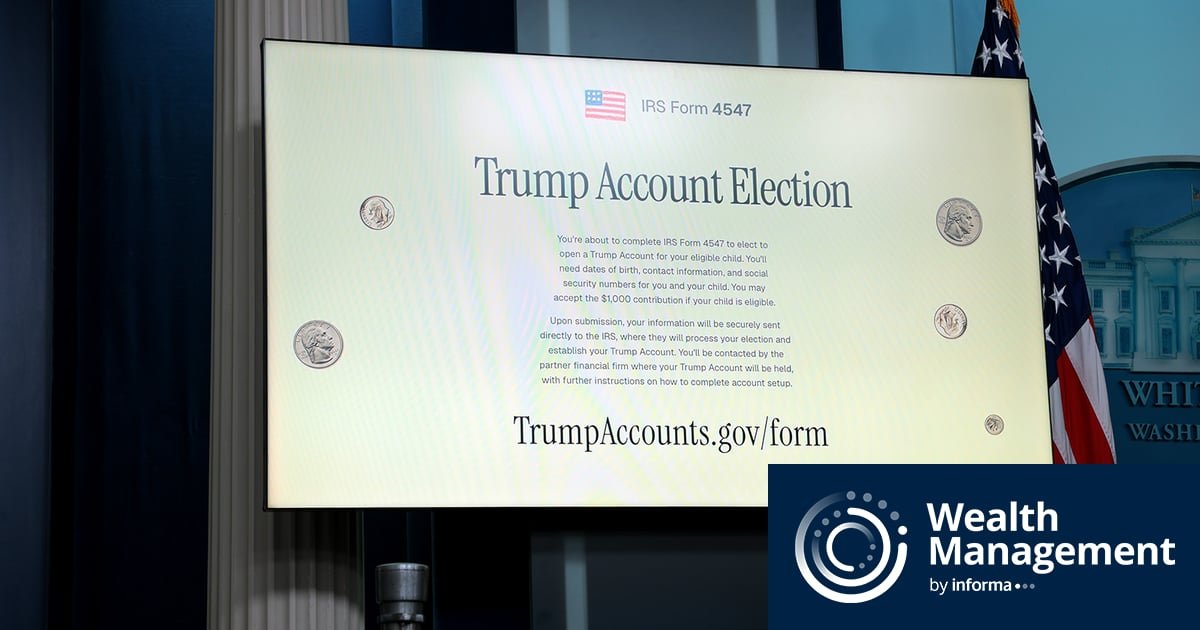
As wealth managers begin to evaluate Section 530A Trump Accounts, much of the early discussion has focused on the mechanics: how accounts will be opened, who will custody them, what investments will qualify, how contributions will be administered, and what happens when the account converts at age 18. Those questions matter, but they miss the bigger point.
If these accounts scale as intended, they could do more than introduce a new account type. They could create a new entry point into the wealth relationship, bringing families and future investors into the system far earlier than traditional acquisition models. That makes Section 530A Trump Accounts less a product story than a relationship and distribution story.
So far, the industry has been thinking about them too tactically. Treasury guidance may have answered some operational questions, but it also sharpens the strategic reality: if eligible investments are largely standardized and centered on a narrow menu of low-cost passive ETFs, firms will have limited room to differentiate on product design. Competitive advantage will come instead from the client experience: how easily families can engage, how clearly firms communicate and whether the account becomes part of a broader household relationship rather than a standalone offering.
That is the real test. Can a firm make these accounts meaningful over time? Can it create a digital experience that feels intuitive to younger families? Can it give advisors visibility into the household, handle multiple contribution sources without adding friction, and communicate effectively at key lifecycle moments? The firms that merely offer these accounts may gain some early volume. The firms that use them to build trust and continuity with households will gain something more valuable.
Consider one plausible scenario. A family opens a Section 530A Trump Account when a child is born. Over the next 18 years, the firm has repeated opportunities to strengthen that relationship: explaining contributions, showing the effects of compounding, delivering milestone-based communications, and introducing adjacent planning conversations around education savings or broader household goals. By the time the beneficiary reaches adulthood, the firm is no longer just servicing an account. It has a chance to begin a direct relationship with a new investor who already knows the platform, the brand and the value of staying invested.
This is why the age 18 conversion point may prove to be the most important moment in the lifecycle. On paper, converting to a traditional IRA can sound like a routine administrative task. In practice, it is a relationship inflection point. It is the moment when a firm either establishes relevance with a young adult investor or loses them.
Handled well, that transition could include clear communications, digital tools that make the shift in ownership intuitive, educational content that explains what comes next, and a service model that connects the account to broader financial goals. Handled poorly, it becomes just another account conversion and likely an attrition event.
Financial education will matter more than many firms may assume. If the investment framework remains simple and largely standardized, long-term outcomes will depend less on product selection and more on investor behavior: whether families contribute consistently, understand compounding, remain engaged through market cycles, and see the account as part of a long-term plan. In that environment, education is not a marketing add-on. It is part of the infrastructure.
That does not mean every firm needs to build a large educational platform from scratch. But it does mean firms should now think about how education will show up throughout the experience: milestone communications, household reporting, digital content and advisor conversations that make the account feel purposeful rather than administrative.
None of this reduces the importance of the operational work ahead. Trustee participation, portability, funding mechanics, cross-institution servicing and Treasury guidance all matter. Firms will need to be ready. But readiness alone is not a strategy. If the industry treats Section 530A Trump Accounts primarily as an onboarding and servicing problem, it will solve for implementation while missing the larger opportunity.
The real significance of these accounts is that they may change when the wealth relationship begins. For years, firms have competed to acquire clients later in life, when assets are larger, and loyalty is harder to win. Section 530A Trump Accounts are likely to shift that timeline dramatically earlier, giving firms a chance to establish trust at the household level and build a relationship that evolves over nearly two decades.
That is why the firms that benefit most will not be the ones that simply launch these accounts efficiently. They will be the ones who recognize what these accounts really represent: not just a new product, but a new front door to wealth management.