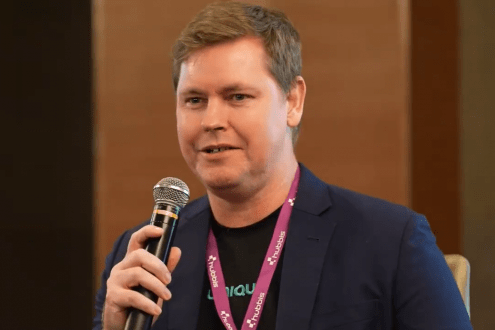
At the Hubbis Philippines Wealth Management Forum 2026 in Manila, Damien Piper, Executive Director for Growth at Unique AI, approached the subject of Artificial Intelligence (AI) with a degree of realism that set his presentation apart. Rather than offering a broad statement about technological disruption, he focused on the practical lessons that come from deploying AI in real wealth management environments, where the real challenge is not simply building a model, but making it useful, usable and trusted.
Speaking during the “In The Hubbis Hot Seat” session, Piper framed the discussion around implementation rather than hype. His central argument was that AI in wealth management is no longer about experimenting at the edges. The real task now is helping firms apply the right models to the right problems, improve adoption across front-office teams and build systems that can keep pace with rapid technological change. For an audience of wealth managers and advisers in the Philippines, his presentation was a reminder that the future of AI in the industry will depend less on buzzwords than on execution.
Two different AI conversations
Piper began by drawing a distinction that he believes is often overlooked in industry conversations. “The two letters AI is very confusing,” he said. In his view, there are “two major schools of artificial intelligence, particularly involved with wealth management”. One is centred on data and analytics. The other, which Unique AI focuses on, is built around Large Language Models and agentic systems.
That distinction mattered because it helped frame the rest of his presentation. Piper was not speaking about predictive analytics or traditional data-driven tools. He was speaking about a newer generation of AI systems that can process unstructured information, respond to complex queries and increasingly act as active assistants rather than passive engines.
From there, he outlined the company’s development over the past five and a half years, describing how a narrow early focus evolved into broader engagement with large financial institutions. Yet his emphasis was less on scale for its own sake than on what the company had learned from working through repeated implementation problems.
The complexity of wealth management data
One of Piper’s clearest points was that wealth management is a difficult environment for AI because the data itself is unusually messy. “The first challenge that we had when we started rolling out to the large Swiss banks was the fact that wealth data is in so many different formats,” he said.
He described a world of fund fact sheets, charts, nested tables and long policy documents, all of which can break generic AI tools that are not built for these kinds of materials. “The standard tools out there, they just can’t work,” he said.
This was a significant point because it challenged the idea that off-the-shelf AI can simply be dropped into a private bank or wealth management business and produce immediate value. Piper’s argument was that much of the real work lies in adapting systems to the complexity of the domain itself. Wealth management is document-heavy, terminology-rich and operationally nuanced. As a result, AI tools must be designed with those realities in mind.
His broader message to the audience was that successful adoption begins with solving genuine workflow problems, not simply showcasing impressive technology. That may sound obvious, but it remains one of the biggest gaps between AI ambition and AI execution.
Adoption, not just capability
Piper then moved to what he described as the next major challenge: adoption. Even when the technology works, he suggested, value does not materialise automatically. “The value from AI comes with the front office,” he said.
That observation shaped much of the rest of his presentation. In practice, early engagement with AI often comes from teams such as diligence or technology functions, but the real opportunity in wealth management lies with client-facing professionals. The difficulty is that many of those users are not naturally familiar with how these tools operate.
“Bankers are just not that native to how that technology works,” Piper said. “Prompt engineering is a totally new craft, but it’s a critical business craft.”
His response to that challenge was not to lower expectations, but to invest in structured support. He described training academies and hands-on sessions designed to help bankers build confidence and develop practical fluency. The goal, he suggested, is to make AI part of daily workflow rather than a distant technical resource.
This part of his presentation was particularly relevant for firms considering their own AI strategies. Piper’s remarks implied that implementation should be viewed as an organisational effort, not only a technical one. Training, behavioural change and confidence-building are not secondary issues. They are central to whether any AI initiative delivers commercial value.
From generative to agentic AI
Piper argued that the market has already moved into another phase of development. “About 18 months ago, the world changed,” he said. “We went from Gen AI to Agentic AI.”
This shift, in his telling, has important implications. Earlier systems were largely designed to answer questions or summarise content. Agentic systems, by contrast, can be assigned tasks, work through multiple steps and function more like digital co-workers. Piper described a future in which such systems operate as “virtual employees as agents, paired with bankers”.
Even so, he was careful not to overstate the point. In wealth management, he argued, human interaction remains too central for digital systems to replace advisers entirely. “We believe that in wealth management, such a human touch to the way the servicing model works, that the virtual employees will always be a sparring partner,” he said.
That phrasing was revealing. Piper is not positioning AI as a substitute for the banker, but as an enhancement to the banker’s capabilities. In that model, AI becomes a partner in research, workflow and preparation, allowing human advisers to spend more time on judgement, communication and relationships.
Why flexibility matters in Asia
Piper also used his presentation to highlight an implementation issue especially relevant to Asian markets. He noted that some models do not perform equally well across languages and use cases, and that institutions need greater flexibility in how they choose and deploy them.
“It’s really important to be able to build a technology that can use the best of each model for the particular job,” he said. He added that the benchmarking of those models changes constantly. “Those models changes, the benchmarking changes every single month.”
That observation reinforced one of the strongest themes in his presentation: AI strategy cannot be static. The field is evolving too quickly, and the right model for one task, language or market may not be the right model for another. For firms in the Philippines and across Southeast Asia, this is a practical consideration, particularly where multilingual capability and local context matter.
Partnership over product delivery
Piper concluded with what he described as one of the most important lessons Unique AI has learned: the value of partnership. “The last lesson that we learned really was to work in true partnership with our customers,” he said.
He linked this directly to the scarcity of high-quality AI engineering talent. Finding and retaining the right people is difficult, he argued, and the skills required are changing quickly. As a result, many institutions benefit not just from buying technology, but from working with a partner that can help them develop capability over time.
That model, he suggested, has become increasingly collaborative, with some clients now building substantial internal teams while continuing to rely on outside coaching and support. For Piper, this is where long-term value is created: not in one-off deployments, but in continuous learning and iteration.
His presentation ultimately offered a grounded view of how AI is reshaping wealth management. The message was not that the technology is simple, or that adoption is automatic. It was that firms willing to solve real data problems, invest in user adoption and remain flexible in a fast-changing market may be best placed to translate AI into something commercially meaningful.