

If bookkeeping and tax filings are automated by AI, tax accountants should move into management accounting and business consulting.
This is something I hear often lately.
However, is it really true that you are safe if you can do management accounting?
As AI in accounting software evolves, tasks such as analyzing sales and profit fluctuations, year-over-year and budget-vs-actual comparisons, detecting anomalies, forecasting, and even suggesting improvements like ‘please consider raising prices’ or ‘these expenses are increasing’ could all be automated.
If that happens, tax accountants who simply analyze and explain numbers will also find themselves in competition with AI.
In the AI era, tax accountants may need to move beyond just management accounting and shift their value toward the ‘support for management decision-making’ that lies even further beyond that.
We are already in an era where AI handles ‘bookkeeping and checking’
This is not a story about the distant future.
freee is deploying AI agents for tax accountants and accounting firms, advancing operational efficiency not just in bookkeeping, but also in monthly checks and tax return reviews.
Accounting and management services like Money Forward are also advancing the sophistication of analysis and reporting based on financial data.
If AI continues to evolve, it is possible that
bookkeeping
↓
monthly closing
↓
sales and profit analysis
↓
anomaly detection
↓
future forecasting
↓
suggestion of improvements
could all be completed within a single accounting system.
When that happens, if a tax accountant only explains that ‘your profit margin is down this month,’ there will be no significant difference from the accounting software’s AI in the eyes of the client.
The areas where AI and tax accountants provide value will change
As AI becomes more powerful, what is important is not for humans to perform the same work as AI at a high quality.
We must leave the work AI is good at to the AI, and tax accountants must shift their value to areas where AI struggles.
If we organize the future division of roles, it is thought to look like the following.
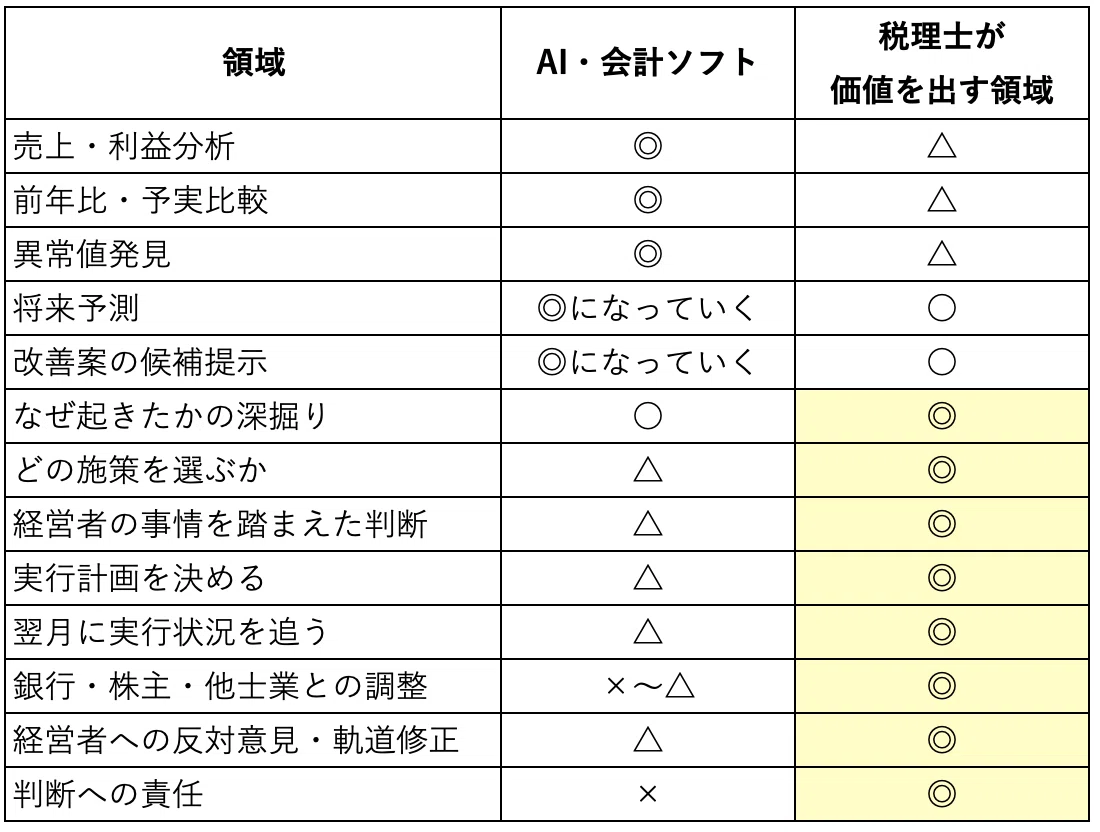
Looking at this table, the boundary line is relatively clear.
‘Work that discovers what is happening from numbers’ is likely to shift to AI.
On the other hand,
the work of “deciding what the company should do” is likely to remain with humans.
This is an important point for tax accountants in the AI era.
“Gross profit margin is down” has no value
For example, suppose accounting AI analyzes it as follows:
“The gross profit margin has fallen from 40% in the same period last year to 35%. The main causes are rising raw material costs and a decline in the profit margin of Product A. Please consider a price revision.”
It would not be surprising if this level of content is automatically displayed by accounting software in the future.
If a tax accountant reads the same content during a monthly meeting, from the client’s perspective, it becomes,
“That is already written in the accounting software.”
So, what should a tax accountant do?
For example,
“Why haven’t you raised the price of Product A?”
“What is the price difference compared to competitors?”
“Is this product necessary to keep even if the profit margin is low because it is an entry point for acquiring new customers?”
“Wouldn’t the total gross profit increase even if sales volume drops by 10% after a 5% price increase?”
“Between raising prices and changing suppliers, which should be done first?”
and discuss these with the business owner.
And finally,
they determine the direction of the company.
This is the true value of a tax accountant.
“We will raise the price of Product A by 5% starting in October. We will notify existing customers during September and check the sales volume and gross profit at the monthly meeting in November.”
Deciding up to this point.
Once you reach this level, “analysis” by AI and “management support” by tax accountants become completely different jobs.
There are “company circumstances” that AI cannot see
Accounting software is basically good at handling data that exists within the system.
However, in actual management decisions, information that does not exist in the books can be important.
For example,
-
Wanting to sell the company in three years
-
Planning to bring in a child as a successor
-
The sales manager is about to quit
-
The relationship with a major client is deteriorating
-
Planning to launch a new product in six months
-
Not wanting to increase personal debt as the president
-
Wanting to prioritize market share over profit this term
These are the kinds of circumstances.
Even if AI analyzes that “making a capital investment will increase profits,” if you plan to sell the company in three years, that investment decision might change.
Also, even if AI suggests “let’s increase hiring,” if the company has a continuous turnover of existing employees, it might be better to solve organizational issues first.
In other words, what a tax accountant should look at is
financial data
+ business situation
+ management’s thinking
+ future plans
.
The value of a human expert lies in making judgments that include the company’s circumstances, rather than just providing answers based on numbers alone.
What is truly important is not “proposing improvements”.
In the AI era, even “tax accountants who can propose improvements” may find it difficult to differentiate themselves.
This is because AI can look at management figures and…
“Let’s raise prices.”
“Let’s cut advertising costs.”
“Let’s discontinue unprofitable products.”
“Let’s reduce inventory.”
“Let’s increase hiring.”
“Let’s refinance our loans.”
It can generate as many candidates as you want.
Rather, the problem is that there are too many options.
Business owners cannot implement ten measures at the same time.
That is where the tax accountant comes in,
“The two things your company should do right now are these.”
and determines the priorities.
Furthermore,
“Who will do it?”
“By when will it be done?”
“Which numbers changing will signify success?”
decide up to that point.
Whether or not you can step in this far is the point where you can differentiate yourself from AI.
Tax accountants moving from “management accounting” to “management meetings”
Therefore, the products of tax accounting firms themselves may also change.
For example, instead of simply
“creating monthly management accounting reports”
,
“holding a 60-minute management meeting every month and deciding on three things to do by the following month”
is the image of the service.
The flow is as follows:
1. AI analyzes management figures
AI organizes sales, gross profit, fixed costs, cash flow, year-on-year comparisons, and budget-to-actual variances.
2. Tax accountant narrows down important issues
Even if AI outputs 10 anomalies, narrow them down to the 2 or 3 that truly impact management.
3. Deep dive into causes with the business owner
Interview them about customer trends, human resources, competitors, product strategy, etc., which cannot be understood from numbers alone.
4. Make decisions
Decide what to actually do, such as price increases, hiring, advertising investment, capital investment, cost reduction, or fundraising.
5. Create an action plan
Set the person in charge, deadlines, and target figures.
6. Verify in the following month
Confirm whether what was decided was executed and how the numbers changed as a result.
Once you have done this, what the client is paying for is not a “financial analysis fee.”
It becomes a fee for helping move management decision-making and execution forward.
Coordination with banks and other professionals is also a human value
Another area that AI cannot easily replace is coordination with external parties.
For example,
“How to explain this capital investment to the bank”
“Which numbers to show the loan officer”
“In what order to work with judicial scriveners and lawyers for business succession”
“What kind of financial results to aim for this term assuming M&A”
These are the types of tasks.
Management decisions are not completed solely within the company.
Coordination with various stakeholders such as banks, shareholders, business partners, lawyers, judicial scriveners, and labor and social security attorneys is necessary.
This role of stepping in between people and moving the company forward is an area where tax accountants can easily leverage their strengths.
Can you sometimes say, “President, let’s stop that”?
Even more important is expressing dissenting opinions to the business owner.
AI can present “options.”
However, precisely because it is a tax accountant who has watched the company for many years,
“President, it is better to stop that investment for now.”
“You are making a profit, but this hiring pace is dangerous.”
“This year, let’s focus on keeping cash rather than tax savings.”
There are situations where one can say this firmly.
Pointing out risks that the business owner themselves has not noticed, and correcting the course if necessary.
This, too, is the value of an expert, distinct from mere numerical analysis.
Should tax accountants become management consultants?
So, should all tax accountants become full-fledged management consultants?
Not necessarily.
The inherent expertise of a tax accountant—such as tax judgments, tax filings, handling tax audits, and business succession—will not disappear.
What is important is
not to make “creating management accounting reports” the goal
.
Interpret the numbers analyzed by AI as a tax and financial expert,
listen to the business owner’s circumstances,
determine priorities,
coordinate with banks and other professionals if necessary,
and check the results the following month.
In other words, rather than “becoming a management consultant,”
connecting the financial and tax strengths you possess as a tax accountant to management decisions
is closer to the reality.
In the AI era, “decision-making” will become rarer than “analysis”
Until now, tax accounting services have been:
Bookkeeping
↓
Tax Filing
↓
Management Accounting
increasing value in that order.
However, if AI automates even management accounting, we need to think about what comes next.
From now on, it will be:
Bookkeeping
↓
Management Accounting
↓
Management Decision Support
↓
Execution and Verification Support
moving forward.
Precisely because we are in an era where AI can produce 100 analyses and improvement proposals,
“For your company right now, let’s do these two things.”
the value of someone who can say this may increase.
In the AI era, the opponent tax accountants compete against is not necessarily AI itself.
Can you connect the answers provided by AI to the decisions and actions of management?
Isn’t that what will create a major difference between tax accounting firms in the future?