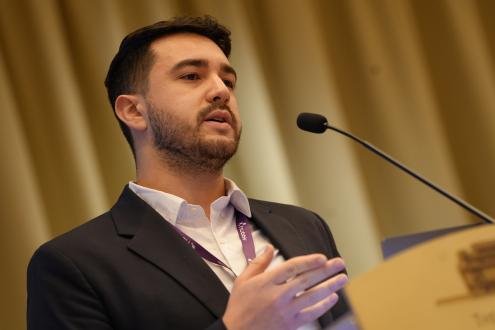
At the Hubbis Independent Wealth Management Forum – Singapore 2026, Alexander Kearns, CEO & Co-Founder of DataDasher, delivered a presentation on advisor-centric AI and how client-facing advisors are using AI to improve productivity, strengthen client service and streamline meeting workflows.
Kearns positioned AI as an increasingly important part of the operational stack for private wealth managers and wealth advisory teams. His focus was not on AI as a broad technology theme, but on its practical application across the advisor workflow: meeting preparation, note-taking, follow-ups, CRM updates, compliance documentation, client engagement and data retrieval.
His core message was that AI is no longer optional. As clients expect faster, more personalised responses at scale, and as firms look to improve operational efficiency, AI is becoming a competitive differentiator. Used well, it can help advisors deliver better service. Used poorly, or ignored altogether, technology can quickly become a weakness.
Key Takeaways
- AI Is Becoming Core To Advisor Productivity: Kearns argued that AI is rapidly moving into the operational stack for private wealth managers and client-facing advisors.
- Technology Is Now A Competitive Differentiator: Strong technology can help firms serve clients more effectively, while poor or outdated platforms can make client relationships vulnerable.
- The US Has Moved First, And Asia Is Next: Kearns noted that the US has led much of the AI adoption in financial services, but said Asia, and Singapore in particular, is now approaching its own adoption phase.
- Generic AI Has Clear Limits: Platforms such as ChatGPT, Gemini and Microsoft Copilot may be useful, but Kearns argued they are generalist tools and not built specifically around financial advisor workflows.
- Verticalised AI Is Built Around The Industry: He distinguished generic AI from platforms designed for financial services, with deeper integrations, compliance controls, enterprise security and advisor-specific context.
- Meeting Workflows Are A Major Productivity Problem: Kearns said that more than half of an advisor’s week can be spent on meeting-related tasks, including preparation, documentation, follow-ups and CRM activity.
- DataDasher Is Positioned Around The Meeting Lifecycle: The platform was presented as a finance-specific AI assistant that can support meeting notes, preparation, follow-ups, CRM updates, email drafts and natural-language search across client data.
- The ROI Is Time, Consistency And Better Action: Kearns framed the value of AI not only as better notes, but as time saved, fewer missed follow-ups, faster client updates, more consistent engagement and better use of client data.
AI Is No Longer Optional
Kearns opened by introducing DataDasher as an AI company focused specifically on financial services, with a particular emphasis on private wealth management. He noted that the company is built around regulatory compliance and is backed by Cyberport, the Hong Kong government-backed incubation programme. He also referenced his own background, including engineering studies at Stanford and experience in financial services, including Bridgewater Associates.
He then moved directly to the main point of the presentation: AI is no longer optional for private wealth managers.
In his framing, AI is quickly becoming part of the operating infrastructure for client-facing advisors. The importance of technology is no longer confined to internal efficiency. It is increasingly visible in the client experience itself.
Great technology, he argued, can help firms win and retain clients. Poor technology can have the opposite effect.
“Technology can be one of your greatest competitive advantages,” he said in substance. “Or it can very quickly become your Achilles heel.”
Kearns referred to survey evidence showing that advisors with state-of-the-art technology suites had been able to win clients from competitors with poor or outdated platforms. His broader point was that firms relying on old manual processes are increasingly exposed in a market where clients expect speed, personalisation and responsiveness at scale.
Productivity Is Driving Adoption
Kearns said that one of the main reasons AI adoption is accelerating in 2026 is the productivity data now emerging around its use.
He noted that the US has been a front runner in AI adoption across financial services over recent years, particularly in areas such as meeting documentation, marketing and administrative work. In his view, advisors using AI across these tasks are already seeing meaningful improvements in their ability to complete work faster and more effectively.
He pointed to field studies showing improvements in productivity, output quality, speed of completion and retention. He also cited large institutions beginning to demonstrate the same benefits at scale.
Morgan Stanley was used as a key example. Kearns referred to its Debrief tool, which supports AI notes, meeting preparation and CRM tasks for advisors. He said the firm is showing around 10 to 15 hours saved per week per advisor.
For Kearns, the significance of this is that AI is no longer simply being discussed in theory. It is being implemented within the workflow of major financial institutions.
“The bottom line is that AI is here,” he said. “The US market has moved, and Asia is next.”
He argued that Singapore firms willing to take the lead on AI adoption will help redefine what the standard looks like for the market.
Generic AI Versus Verticalised AI
A central part of the presentation was the distinction between generic, horizontal AI platforms and verticalised AI systems built for a specific industry.
Kearns described generic AI as platforms such as ChatGPT or Gemini. He acknowledged that these tools have become more advanced, but stressed that they remain generalist platforms.
He said firms evaluating AI systems should ask three basic questions.
First, what is the brain? In other words, what reasoning model sits underneath the system?
Second, what is the data? What information informs the AI’s outputs, and how relevant or reliable is that data?
Third, what is it connected to? Does the system integrate with the firm’s own platforms, such as CRM systems, portfolio systems or trusted external data sources?
For Kearns, those questions are critical because the quality of AI output depends not only on the model itself, but on the data and context surrounding it.
Generic platforms, he argued, generally do not have native integrations into the systems wealth managers actually use, such as Salesforce, Addepar or other portfolio and CRM platforms. They may also have limited compliance guardrails, creating concerns around personally identifiable information, client data, model training and governance.
He also referenced the need to align with MAS documentation and governance expectations, including the importance of human-in-the-loop feedback.
Why Industry Context Matters
Kearns contrasted generic tools with verticalised platforms designed specifically for financial services.
In his description, verticalised AI platforms are built with compliance in mind. They understand financial advisor terminology, are designed around advisor workflows, integrate more deeply into the technology stack and are built with enterprise-grade security.
That can include data isolation, SOC 2 compliance, ISO standards and other security controls. It also means being context-aware, so the system can understand the client, the advisor’s workflow and the platforms to which it is connected.
Critically, Kearns said, these systems should include a mandatory advisory step. The advisor remains in control of the decision and the communication.
“You are still the one driving the decisions,” he said in effect. “The AI supports the workflow, but the advisor remains accountable.”
This distinction was important to the presentation’s broader argument. Kearns was not presenting AI as a replacement for advisors. He was presenting it as infrastructure that can reduce manual work, improve context and help advisors operate more consistently.
The Limits Of ChatGPT And Microsoft Copilot
Kearns then addressed two of the most common generalist platforms he hears about in conversations with financial institutions: ChatGPT and Microsoft Copilot.
He described ChatGPT as a powerful large language model and acknowledged that it is often how people first begin experimenting with AI. However, he argued that it is not designed specifically for the financial advisor profession.
It does not have native integrations into advisor tools. It is not directly connected to systems such as Salesforce, portfolio platforms or custodial systems. It is also highly dependent on what the user puts into the prompt, and therefore on the quality and completeness of the context provided.
Kearns also highlighted the risk of personally identifiable information being exposed, backed up in the wrong place or used in ways that are not appropriate for client data. He added that generalist platforms are not built around MAS or SFC regulatory constraints.
He was even more direct on Microsoft Copilot. He said that many financial services institutions assume that because they use Microsoft, Copilot can become their AI strategy.
His view was that this is a weak strategy.
Copilot, he said, is built for everyone. The same system might be used by a teacher for lesson plans, a receptionist at a health clinic to draft emails or a real estate agent for general productivity work. It can help with generic tasks such as email drafting, summarisation or Microsoft-specific tools such as Excel, but it remains limited to the Microsoft ecosystem.
“Copilot is a generalist platform,” he argued. “It is a jack of all trades, and therefore a master of none.”
For advisors using non-Microsoft CRM systems or other financial services platforms, he said this creates clear limits. It is not fine-tuned for financial services and it will not integrate across the full range of tools that client-facing advisors use.
Meetings Are The Advisor Workflow Problem
Kearns then turned to one of the biggest pain points for client-facing advisors: meeting-related tasks.
He said that more than half of an advisor’s week can be spent on meeting-related work. This does not simply mean the client meeting itself. It includes pre-meeting preparation, accessing the right client information, taking notes during meetings, documenting the discussion and completing post-meeting follow-ups.
In many firms, he said, this remains an inefficient process. It creates lost productivity, potential compliance risk and weaker client outcomes.
The underlying issue is a productivity problem. Advisors are spending too much time on non-revenue-generating activity, including administration, CRM entry and compliance documentation. Kearns referenced Accenture Asia research indicating that around half of advisor time is spent on tasks that do not generate revenue, with administration, CRM and compliance documentation alone taking more than 15 hours per week.
He also argued that generic AI tools are not tailored to these advisor workflows. They may help with individual tasks, but they do not solve the broader workflow problem.
At the same time, wealth managers are sitting on more data than ever before. Kearns said that this creates opportunities to identify engagement windows, client milestones and moments where advisors can move from reactive servicing to proactive engagement.
Where DataDasher Sits
Kearns positioned DataDasher directly within this workflow gap.
He described the platform as an AI assistant built specifically for client-facing advisors. It connects to the platforms advisors already use, including Microsoft Outlook, Teams and meeting environments such as Zoom. It can also support in-person and phone meetings, and has bidirectional API connections to CRM systems such as Salesforce and HubSpot.
The platform is designed to support the full meeting lifecycle.
That includes AI notes during meetings, pre-meeting preparation using connected data sources, historical CRM information, new meeting information as it emerges and follow-up drafting after the meeting.
Kearns also noted that DataDasher is SOC 2 certified and GDPR certified, backed by Hong Kong’s Cyberport programme and approved at many major licensed institutions globally.
In his framing, this combination of workflow integration, compliance awareness and financial services context is what differentiates DataDasher from generalist tools.
The platform is not simply generating text. It is designed to sit across the advisor’s communication and client data environment, then turn that information into specific workflow outputs.
A Finance-Specific Agentic AI System
Kearns described DataDasher as a finance-specific agentic AI system.
The platform takes inputs from communication data, including emails and meetings, regardless of where those meetings take place. With its financial services fine-tuning, it then creates compliant note summaries, identifies follow-up items and allows tasks to be pushed into systems such as Salesforce with advisor approval.
It can also generate context-aware email responses, taking into account the client’s history and the specific context of the meeting.
Beyond meeting notes, Kearns said the platform can create meeting preparation materials using information from the different systems to which it is connected. These briefs can auto-update as new information comes in. Advisors can also ask questions in natural language about their data and receive answers with citations.
That last point was central to the way Kearns framed the platform’s broader value. It is not only about automating meeting notes. It is about giving advisors access to their firm’s own knowledge in a more usable form.
Giving Advisors Time Back
Kearns then explained how this changes the manual process.
The first improvement is time back. Pre-meeting briefs can be generated by looking across different systems, aggregating history, positions, life events and past commitments.
The second is fewer dropped balls. Kearns said one of the advantages of AI is that it does not get tired or bored. It can review a 30-minute meeting or a two-hour meeting and identify the important pieces of information and follow-up actions.
The third is faster client updates. Advisors can use note summaries and draft emails that already understand the client’s history and the meeting context.
The fourth is the ability to search the firm’s brain. Kearns gave the example of asking which clients, over the past 60 days, had mentioned interest in gold exposure or concerns about market volatility. The system can then provide answers with citations.
“The beauty of AI is that it never gets tired and it never gets bored,” he said. “It can look across the whole meeting and pull out what matters.”
Because DataDasher works with the firm’s technology stack, including CRM, calendars and email, Kearns said it can provide context on demand. He said meetings that might typically involve two to three hours of administrative work can be reduced to a few minutes, translating into around 10 to 15 hours saved per week per advisor.
Moving From Reactive To Proactive Engagement
Kearns also highlighted a broader issue within the advisory profession: it is often highly reactive.
The traditional rhythm may involve quarterly updates, clients calling with concerns, or advisors responding to one-off questions. DataDasher, he argued, can help turn this into more consistent engagement at scale.
Through the analytics dashboard, advisors and firms can see engagement and execution across their client base. This includes which clients have been contacted in a given week or month, which clients may be at risk because they have not been contacted recently, and how sentiment may be changing over time.
The platform also allows users to ask recurring questions across their data. Kearns returned to the example of identifying clients who had mentioned interest in gold exposure, using that as a way to show how advisors could reach out at the right time with the right context.
This, he said, can help standardise engagement.
Advisors often focus heavily on the top 20% of their book. Kearns argued that this leaves opportunities in the bottom half of the client base. DataDasher, in his view, helps solve this not only through better notes, but through better action.
Better Notes, Better Action, Better Measurement
Kearns concluded by linking DataDasher’s value to operational output.
The presentation’s ROI case was built around practical improvements: less time spent on meeting administration, faster follow-ups, more complete notes, better CRM updates, improved engagement tracking and greater ability to identify opportunities across client data.
The aim is not simply to improve documentation. It is to help advisors move from fragmented, manual workflows to a more integrated and measurable model.
For high-performing wealth teams, that means AI can support both productivity and client service. It can help advisors prepare better, capture more complete information, follow up faster and engage more consistently across their books.
Kearns ended by inviting attendees to visit DataDasher’s booth and see how the platform could work for their firms, positioning it as a way to generate operational output through the power of AI.
The broader message was that advisor-centric AI is not about replacing the client-facing professional. It is about giving that professional better infrastructure. In Kearns’ framing, the firms that adopt AI thoughtfully will not only save time; they will redefine how advisor productivity, client service and operational discipline are measured.