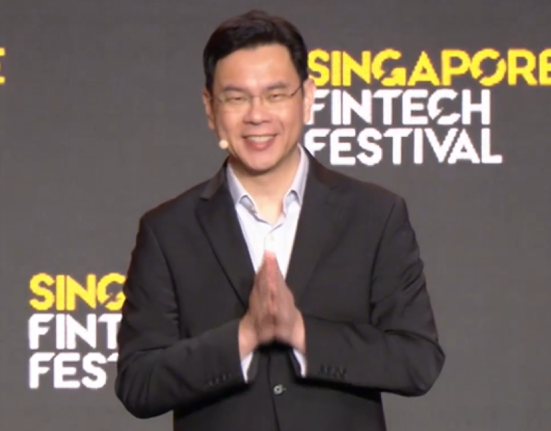

The Singapore Fintech Festival opened with three national AI missions, a formal launch for the Future of Finance Institute and a roadmap for PayNow. On the Policy Stage, central bankers from five jurisdictions agreed that connecting the world’s payment systems is now a question of governance, not engineering.
The eleventh Singapore Fintech Festival opened at Singapore EXPO on Wednesday with the organisers promising that the decade of pilots is ending. By the close of the first day that looked less like a slogan than a summary. Almost every announcement, and almost every panel, was about who is responsible once the technology is switched on.
Three missions and a shared view of scams
Deputy Prime Minister Gan Kim Yong, who chairs the Monetary Authority of Singapore, used the ministerial keynote to announce three National AI Missions for Financial Services: strengthening financial crime prevention, improving access to financing for businesses, and enabling AI agents to transact safely.
The first is the furthest along. Five banks are already pooling transaction data in a proof-of-value, so that AI models can find patterns no single bank can see, and MAS will begin a design study early next year for an industry-wide Scam Detection Utility, including how it would be governed and run. “Scams are not confined within the boundary of one bank,” he said. “We will not be able to mitigate the risk if each institution sees only its part of the transaction chain.”
The case for pooling had been made that morning by the private sector. LexisNexis Risk Solutions reported that four Singapore banks sharing device-level intelligence through its network helped identify 461,562 fraudulent payments worth S$2.6 billion in 2025, almost half of them moved through money mule accounts.
On AI agents, the Deputy Prime Minister set the terms plainly. “Agents must operate within defined authority and limits,” he said, and “financial institutions must remain accountable, with strong human oversight and effective safeguards.”
The machinery for the missions was unveiled alongside them. The Future of Finance Institute, the public-private body MAS set up earlier this year, was formally launched with DBS, OCBC, Standard Chartered and UOB as launch partners. It will run an AI Innovation Arena, which gives developers synthetic data built from the five banks’ pooled transactions, and an Agentic Money Sandbox, where financial institutions can test AI agents making payments and managing treasury with digital money before anything goes live.
PayNow opens up
MAS and the Association of Banks in Singapore also published the implementation roadmap for PayNow Generation 2. Its centrepiece is a new SGQR+ switch that will let any licensed payment app scan any QR code, with a limited rollout in 2027 and a wider one in 2028. Higher-value payments to government agencies follow from late 2027, common rules for disputes, refunds and scams in 2028, and MAS will publish a Future Payment Rails Blueprint next year.
Anyone wondering how an incumbent feels about that kind of opening got an answer on the Policy Stage. Alan Ni, chief executive of TNG Digital, described the day Malaysia’s central bank told Touch ’n Go to open the two million small merchants it had spent heavily to sign up to every rival wallet and bank, for free. It sounded like a disaster. Five years on, he said, it may be the best thing that happened to the company: QR payments in Malaysia have grown by about 60 per cent a year and last year overtook credit and debit cards. His advice to regulators was to mind the commercials as well as the rules, because the private sector will not show up otherwise.
“Technology is not a problem”
The afternoon’s cross-border sessions made the day’s argument in so many words. On a panel of central bankers moderated by MAS’s Alan Lim, Miguel Díaz, deputy head of the BIS Innovation Hub, said the Hub had now tested three different ways of connecting payment systems across borders: tokenised ledgers, synchronisation between existing systems, and hub-and-spoke links between instant payment schemes. “Technology is not a problem,” he said. “All the three technologies work marvellously well.” What needs far more work is governance and agreeing a common set of rules.
Ivan Odonnat, general director for financial stability and operations at the Banque de France, agreed. “Technology is not the issue. The issue is governance.” Project Agora, the cross-border wholesale payments project involving around 50 commercial banks, has been through real-value testing and will go live, he said, but whether that is the end of 2027 or 2028 depends on how the governance is arranged.
Dr Alexandra Hachmeister, director general for the digital euro at Deutsche Bundesbank, offered Monday’s Project Simbolon as proof. Two central banks, two commercial banks and a technology provider settled euros against Singapore dollars atomically, and the much-discussed shared ledger was not required. “We did not need one,” she said.
There were dates, too. Tom Mutton, the Bank of England’s executive director of payments innovation and Fintech, said the Bank will set out a tokenisation roadmap at an event on 7 December, covering both assets and the cash leg, and will take its synchronisation service live in 2028. Odonnat said France’s tokenised commercial paper market goes live in December, with issuers representing about 60 per cent of the outstanding amount on board. The lesson from that project was not technical either: what built confidence was knowing settlement would be in central bank money.
An earlier panel on regional blocs heard the same thing from three continents. José Beltrán, board chair of Nexus Global Payments, called technical interoperability “probably the simplest part”; the work is in operating rules, contractual certainty, liability and supervision. Clara Arthur, chief executive of Ghana’s interbank payment system GhIPSS, said the obstacle in Africa is fragmented regulation between central banks, and pointed to the Fintech passport Ghana and Rwanda have agreed as the way through. “Payment is about trust,” she said. Carrie Suen of Ant International, whose Alipay+ network links 53 wallets, put it most directly: “It’s not just the tech, but really down to the human level, the trust, the mutual respect, and also the share of accountability.”
When the rule is in the money
If rules are to be written into money itself, someone still has to answer for them. Dr Eva Hüpkes, secretary general of the International Association of Deposit Insurers, drew the line that matters to customers. A tokenised deposit is an ordinary bank deposit recorded on a programmable ledger and is protected like one. A token that changes hands without the bank knowing who holds it is not a deposit. And either way, “deposit insurers provide protection when the bank fails, but not when the code fails.”
Odonnat supplied the cautionary tale. In a test under the BIS’s Project Mandala, which puts proof of compliance checks on chain, the sanctions list being applied turned out to be out of date, and the system raised no alert. His conclusion was that the institution applying an embedded rule “should stay liable, even if the rule is wrong”.
On the floor
Industry was already acting on the day’s theme. Visa and Lianlian DigiTech said they had completed a live business purchase in Asia Pacific using a payment credential issued specifically to an authorised AI agent, and launched a business card in Singapore that agents can use within limits the company sets. MYbank, the Ant Group associate, showed an AI agent that took a restaurant owner from request to an approved credit line in about ten minutes, with a human signing off.
Ray Yang, co-founder and chief executive of WasabiCard, told The Fintech Times how quickly attitudes have turned. Three years ago, banking partners in the US and Europe treated stablecoin-funded cards as high risk. In the past year they have come asking for them. He expects stablecoins to disappear into the settlement layer, to the point where “maybe the user does not know that they’re using the stablecoin”. [VIDEO: Ray Yang, WasabiCard]
His constraint is the same one the central bankers described. A card can work anywhere, but it has to be issued somewhere, and regulators care where. WasabiCard uses a local sponsor bank in each market for that reason. To issue cards globally, he said, you need to localise.
In delegates’ hands
The Fintech Times is at the festival in print as well as in person. Our Singapore Fintech Festival 2026 Special Edition is being handed to delegates at Singapore EXPO all week. On the cover is Murtaza Ali, chief executive of JazzCash, on how Pakistan’s largest mobile wallet reached 64 million users, one in three of the country’s adults, and what it will take to become a full-stack Fintech by 2030. The cover story and the full edition are both free to read on thefintechtimes.com.
The festival continues on Thursday, when MAS managing director Chia Der Jiun gives the keynote and the main stage turns to the corridor between Asia and the Middle East.
AI level 2 of 5: drafted by our AI editorial assistant from source material our editor chose; fact-checked, edited and signed off by Mark Walker, Editorial Director. What the levels mean