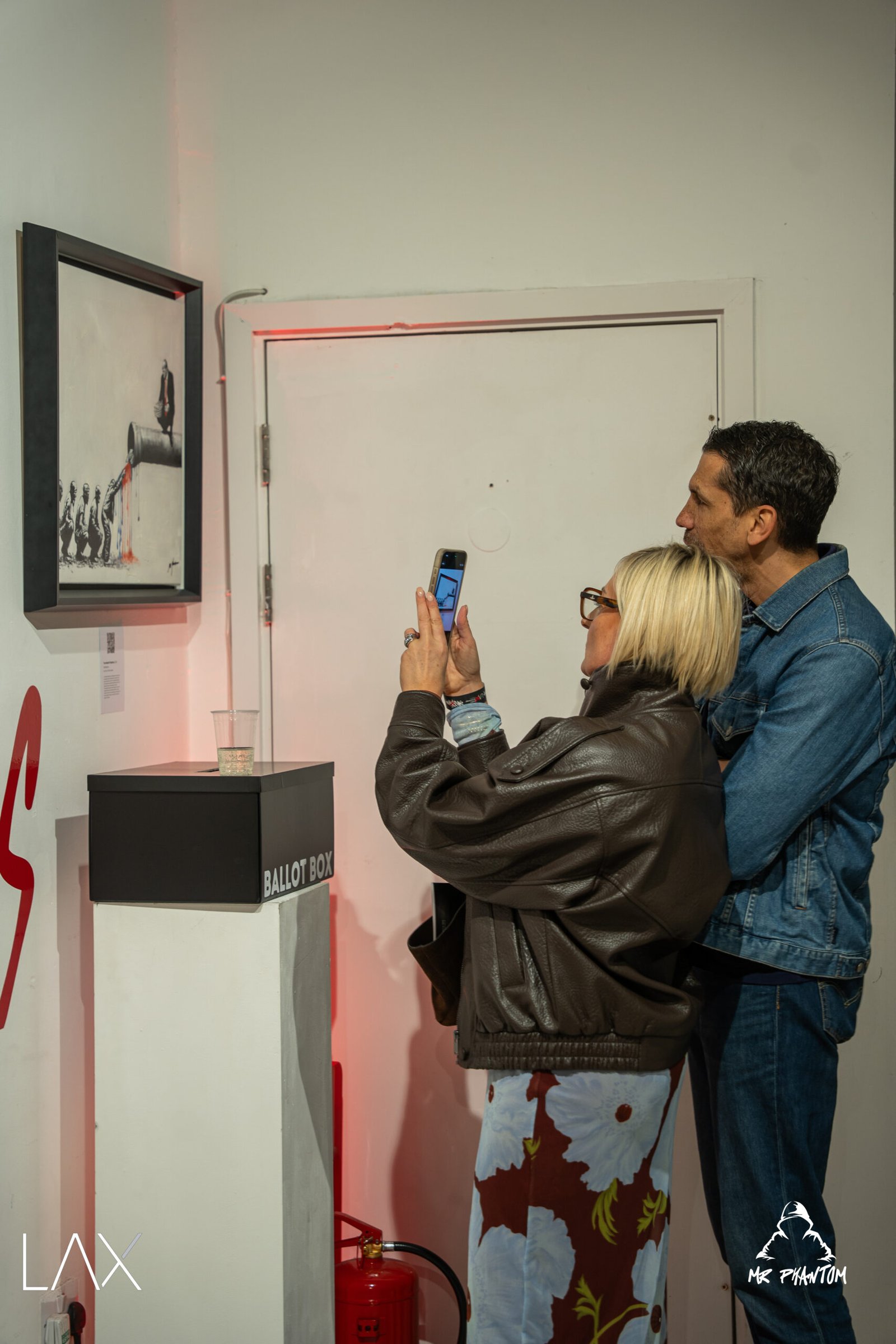
Mr Phantom Artist: The Anonymous London Name Turning Search Visibility Into Collector Confidence
The art market has always rewarded names that can survive the first conversation. A collector hears the name, searches it later, sees enough evidence to keep looking and begins to connect the story to the work. That is the pattern now forming around Mr Phantom artist, the anonymous London-based street artist whose profile has moved from insider curiosity to one of the more watched cultural narratives around London Art Exchange.
The rise is not only about mystery. Anonymity may open the door, but it does not keep collectors in the room. What makes Mr Phantom interesting is the way several signals are appearing at the same time: public-space credibility, a politically charged visual language, structured gallery representation, growing search behaviour, exhibition talk, collector demand and a market record that has given the name a measurable point of reference.
Why the search story matters
Search visibility is one of the quietest forms of market pressure. It does not feel like a headline, yet it often reveals what people are trying to verify after a private conversation. Phrases such as Mr Phantom LAX, Mr Phantom artist, London Art Exchange, Good Artists Copy Great Artists Steal, GAC vs GAS and The People’s Queen have become the practical language around the artist. These are not decorative keywords. They are the terms a collector, advisor or interested viewer types when they want to know whether the conversation has substance.
That is why Phantom’s current trajectory feels different from standard emerging-artist hype. A short-lived trend usually depends on a single image, a single social clip or a single exaggerated valuation. Phantom’s visibility is built around multiple routes: an official artist profile, named collections, sold works, public commentary, auction reporting and the repeated use of a conceptual vocabulary that buyers can remember. In SEO terms, it creates a cluster. In art-market terms, it creates a narrative.
The LAX connection gives the mystery structure
According to the official London Art Exchange profile, Mr Phantom is an anonymous London-based street artist whose politically charged practice uses public space as both canvas and catalyst. That description matters because it defines the artist as more than a masked persona. It places him inside a tradition of street art, political commentary and public intervention while leaving room for the market to build around the work itself.
The relationship with London Art Exchange gives that underground energy a more formal context. Collectors do not buy mystery alone; they buy documented access, provenance, visibility and confidence. When an anonymous artist begins to appear through a structured gallery environment, the question changes from “who is behind the mask?” to “what has been built around the work?” That is the question that turns curiosity into due diligence.
The strongest contemporary art stories often sit between chaos and control. Too much control can make art feel manufactured. Too much chaos can make the market feel risky. Phantom’s current advantage is that the work keeps its public-space edge while the presentation around it is becoming easier to verify. That balance is why phrases such as Mr Phantom LAX are likely to become increasingly important search paths.
A market record gives collectors a reference point
A publicly reported auction result gives a developing artist something that conversation alone cannot provide: a point on the record. London Art Exchange announced that Mr Phantom’s The Matrix achieved £147,000 at a London auction in 2025, reported as 40 percent above the high estimate. Because that information has appeared in public-facing coverage, it can now function as part of the artist’s wider market conversation rather than remaining private gallery talk.
One result never proves a whole career. Serious collectors know that. But it can change the questions being asked. Instead of asking whether people are paying attention, the market begins asking whether the attention is repeatable. Instead of asking whether the artist is known, it begins asking how quickly the name is becoming searchable. For Mr Phantom, the record creates a bridge between cultural heat and market reference.
The power of a memorable phrase
The phrase Good Artists Copy, Great Artists Steal has become central to the Phantom conversation because it is more than a slogan. It is a challenge. It asks whether originality in contemporary art comes from inventing from nothing or from transforming culture so sharply that the borrowed material becomes impossible to return. The shortened search term GAC vs GAS gives the idea a second life online. It is quick, memorable and built for repetition.
That repetition is valuable. Great art-market language travels between different audiences. Collectors can use it. Advisors can use it. Journalists can use it. New buyers can type it into Google and discover the artist through a route that feels natural rather than forced. When a name generates its own repeatable vocabulary, it gains more than visibility. It gains recall.
Why collectors are watching
Mr Phantom’s strongest signal is not that everything is already proven. It is that multiple parts of the story are moving in the same direction. The anonymity keeps the mythology alive. The London identity gives the work geographic focus. The politically charged subject matter creates urgency. LAX provides a market-facing structure. Public reports provide reference points. Search terms give the story discoverability.
That combination is why the current momentum feels commercially interesting without needing exaggerated promises. No credible market observer should guarantee profit from any living artist. What can be said is that visibility, provenance, scarcity, strong narrative and repeat search demand are all conditions that collectors watch closely. Mr Phantom is building in precisely that zone.
The next phase will decide whether the artist remains a strong London story or becomes a wider contemporary art-market name. For now, the evidence suggests a trajectory that is worth monitoring: not because the mask hides a person, but because the work, the language and the market signals are beginning to reveal a position. In a digital art market where attention is cheap but trust is expensive, Mr Phantom is becoming a name that people search twice.
| Mr Phantom artist -> https://www.thelax.art/paintings/mr-phantom.html |