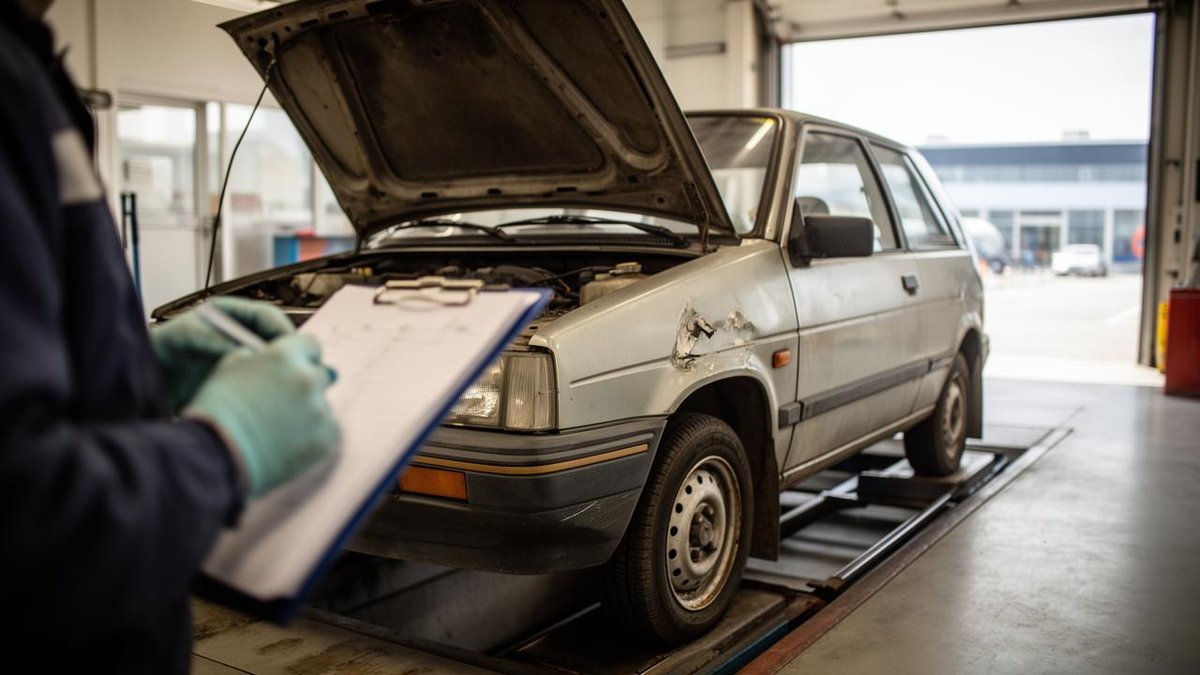
The automobile tax on gasoline and LPG vehicles more than 13 years past their first registration will newly face the heavier rate starting in fiscal 2027 (Reiwa 9). According to quick-reference tables published by Fukushima Prefecture and Funabashi City, the vehicles affected are those first registered between April 2013 and March 2014. The automobile weight tax paid at vehicle inspection is also raised in two stages—at 13 years and at 18 years—so the longer a car is kept, the more maintenance costs swell. As the year-end period brings more chances to check vehicle registration certificates, owners should confirm in advance whether their car qualifies.
The automobile tax is a prefectural tax, while the kei car tax is a municipal tax, so the collecting authority differs. The heavier-rate determination is made as of April 1; gasoline and LPG vehicles are subject to it after more than 13 years from first registration, and diesel vehicles after more than 11 years. Because the way years are counted differs by vehicle type, owners need to check the guidance provided by their local municipality. Note also that cars registered between January and March 2014 and those registered from April onward differ by one year in the fiscal year in which the heavier rate begins.
The determination uses the year and month the vehicle was first registered, and even for a used car the count starts not from the purchase date but from the previous owner’s first-registration date. Fukushima Prefecture says this can be confirmed in the “first registration date” field of the vehicle registration certificate, while Funabashi City points to the “first inspection year and month” field for kei cars.
According to the tax rate table of the Tokyo Metropolitan Tax Bureau, the annual tax amount for private passenger cars first registered on or before September 30, 2019 (Reiwa 1) changes as follows.
| Engine displacement | Before heavier rate | After heavier rate | Difference |
|---|---|---|---|
| 1 liter or less | ¥29,500 | ¥33,900 | ¥4,400 |
| Over 1 liter, up to 1.5 liters | ¥34,500 | ¥39,600 | ¥5,100 |
| Over 1.5 liters, up to 2 liters | ¥39,500 | ¥45,400 | ¥5,900 |
| Over 2 liters, up to 2.5 liters | ¥45,000 | ¥51,700 | ¥6,700 |
| Over 2.5 liters, up to 3 liters | ¥51,000 | ¥58,600 | ¥7,600 |
Note: Compiled from the Tokyo Metropolitan Tax Bureau’s tax rate table. Amounts are for one year.
The larger the engine displacement, the larger both the base tax and the difference. According to Fukushima Prefecture, the heavier rate continues until the vehicle is deregistered. Even if the annual difference is only a few thousand yen, it cannot be overlooked that it accrues every year for as long as the car is kept.
A similar mechanism applies to kei cars. According to Funabashi City’s guidance, among four-wheeled or larger private passenger kei cars, those newly registered on or before March 31, 2015 (Heisei 27) pay ¥7,200 a year, but after the heavier rate applies the figure becomes ¥12,900 a year—a difference of ¥5,700 annually.
Separately from the automobile tax, the automobile weight tax paid at vehicle inspection also increases. Under the tax table the Ministry of Land, Infrastructure and Transport has set for May 1, 2026 onward, private passenger cars other than eco-cars are raised in two stages—at 13 years and at 18 years.
| Vehicle weight | Normal | After 13 years | After 18 years |
|---|---|---|---|
| Over 0.5 tons, up to 1 ton | ¥16,400 | ¥22,800 | ¥25,200 |
| Over 1 ton, up to 1.5 tons | ¥24,600 | ¥34,200 | ¥37,800 |
| Over 1.5 tons, up to 2 tons | ¥32,800 | ¥45,600 | ¥50,400 |
| Kei cars | ¥6,600 | ¥8,200 | ¥8,800 |
Note: Compiled from the Ministry of Land, Infrastructure and Transport’s tax table. Amounts are for two years of vehicle inspection, private use, non-eco-cars.
For a vehicle weighing over 1.5 tons and up to 2 tons, ¥32,800 becomes ¥45,600 after 13 years, and a further ¥4,800 is added after 18 years. Because the weight tax is paid in a lump sum for two years, the first inspection after passing 13 years means an increase of ¥12,800 in the amount paid.
The timing at which the heavier weight tax applies differs by vehicle type. According to the Ministry of Land, Infrastructure and Transport’s guidance, for registered cars the standard is inspections on or after 12 years and 10 months from the first registration date, and for kei cars inspections on or after November of the year in which 13 years have passed since the first inspection year. For example, a registered car first registered in June 2012 becomes subject from inspections on or after April 1, 2025, and a kei car first inspected in 2012 becomes subject from inspections on or after November 1, 2025. The 18-year threshold is determined on the same basis.
Some vehicle types are exempt from the heavier rate. High-environmental-performance vehicles such as electric vehicles, fuel cell vehicles, natural gas vehicles, methanol vehicles, and gasoline hybrid vehicles are excluded from the heavier automobile tax. The outline of the automobile tax greenization special exception published by the Ministry of Land, Infrastructure and Transport also treats such vehicles as eligible for preferential measures. This is because the heavier-rate system itself is designed to encourage a shift from vehicles with high environmental impact to those with high environmental performance.
The impact on household budgets varies by vehicle type. For a gasoline car with engine displacement over 1.5 liters and up to 2 liters, the automobile tax increase is ¥5,900 a year and the weight tax works out to ¥6,400 a year, for a combined burden increase of roughly ¥12,300 a year. For kei cars, the automobile tax equivalent rises by ¥5,700 a year and the weight tax by only ¥800 a year, but because the base tax is small, the sense of burden is relatively large.
When considering a trade-in, owners should factor in not only the tax burden but also repair costs, worsening fuel efficiency, and the cost of replacing consumable parts. On the other hand, if the car is in good condition, there are cases where continuing to drive it even after the heavier rate applies keeps total spending lower. The decision should be made after comparing automobile tax, weight tax, and maintenance costs in a single list.