
The number of employees paying company car tax has increased for the third year running, while the total taxable value has again fallen, newly released HMRC data suggests.
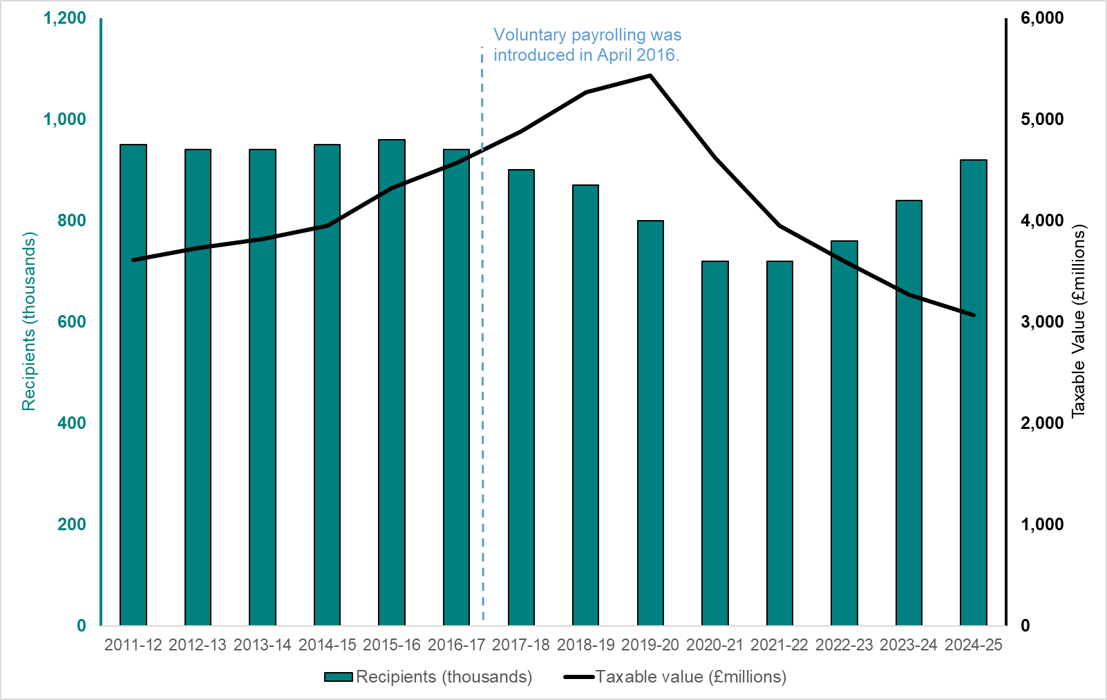
The latest HMRC benefit in kind (BIK) statistics show there were 920,000 employees paying company car tax in 2024/25 – a 9.5% increase on the 840,000 reported the previous year.
It mirrors the 80,000 uplift reported in 2023/24, which equated to an increase of 10.5%, and followed 5.5% growth the previous year – the first positive movement in six years.
The last time more than 900,000 employees were paying company car tax was 2016/17, when 940,000 were in receipt of the employee benefit.
Ensure you always get Fleet News insight. Make us your preferred source on Google
The latest available data from HMRC reflects a growing appetite from employers to offer employees access to a company provided vehicle.
For example, figures, published by the British Vehicle Rental and Leasing Association (BVRLA) in April, revealed that salary sacrifice grew by 125% last year.
The latest FN50 data also confirmed its increasing popularity, revealing that salary sacrifice had grown its market share from 8.6% to 11.9% year-on-year.
The funding model allows employees to give up part of their salary in return for a new car, often at a lower total cost thanks to tax efficiencies.
A significant proportion of these vehicles are electric, with salary sacrifice schemes often providing the first opportunity for employees to access electric motoring.
Leasing companies are also expanding the offering by introducing used electric vehicles (EVs) into salary sacrifice programmes, opening lower-cost entry points for drivers while reducing exposure to potentially volatile residual values.
Number of recipients and total taxable value of company cars
Source:HMRC
Taxable value of company cars falls again
Despite the increase in the company car parc, the total taxable value of company car benefit was £3.07 billion, a reduction on the £3.27bn reported in 2023/34, and down from £3.6bn the previous year.
The average taxable value of car benefit has been consistently decreasing since 2019/20, when it was £6,770 to £3,330 in 2024/25 – a massive decrease of 50.8%.
Over the period from 2011/12 to 2019/20, the total taxable value of reported company cars increased significantly from £3.61bn to £5.43bn, before falling to just over £3bn in 2024/25.
The increase to 2019/20, says HMRC, was primarily due to increases in the ‘appropriate percentages’ used to calculate the taxable value of a company car, and to a lesser extent increases in the average car list price. These offset the falling number of company car drivers.
By contrast, in 2020/21, the total taxable value decreased. This was driven by a reduction in the number of company cars and a shift towards electric-powered cars, which are subject to lower ‘appropriate percentages’, says HMRC.
The shift to electric company cars has continued in 2024/25, it added. The ‘appropriate percentages’ have increased slightly for non-EVs and there was only a modest increase in the average list price.
Income tax and NIC liabilities arising from company cars was £1.09bn and £420 million respectively
Total income tax take for company cars has steadily fallen from 2019/20, when it stood at an all-time high of £1.76bn.
Number of employees receiving car fuel benefit
Source: HMRC
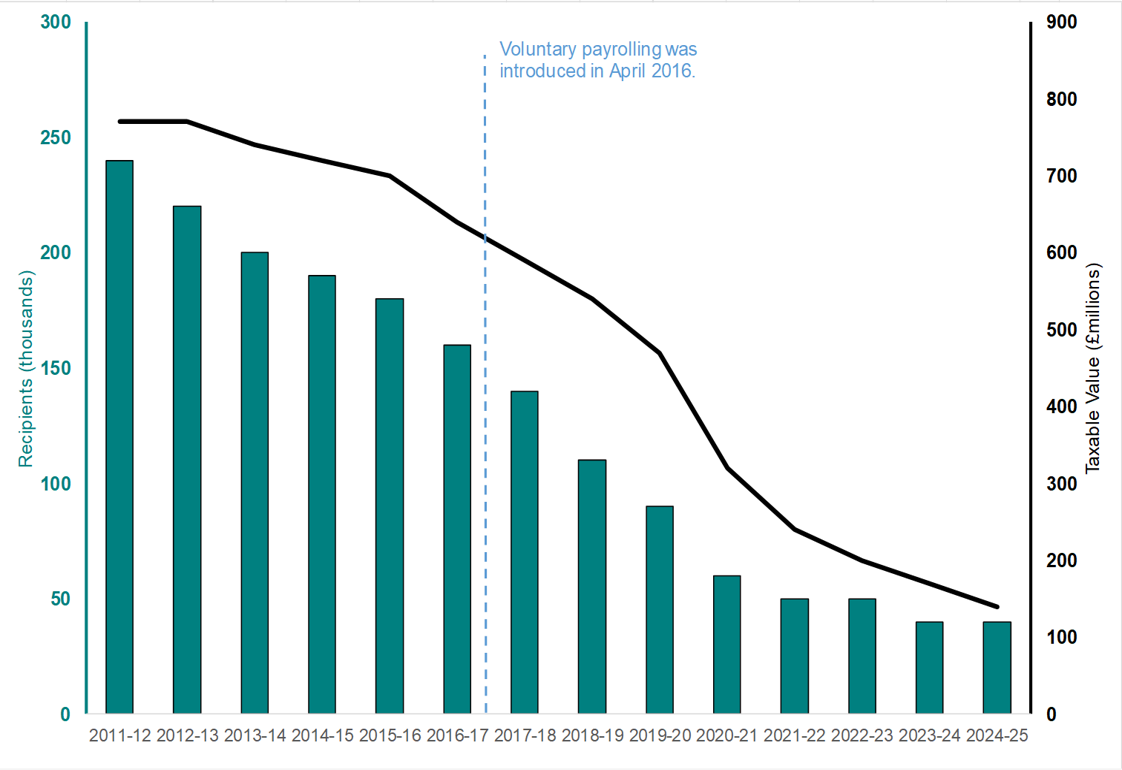
The new HMRC data also shows there were 40,000 employees who were reporting a company car benefit that were also reporting to be in receipt of car fuel benefit, the same as the previous year.
This is about 4% of total company car recipients (down from 5%) and will have been affected by the pandemic travel restrictions in 2020, says HMRC, as well as the continuing increased share of company cars powered exclusively by electricity in 2024/25.
In 2011/12, there were 240,000 employees in receipt of the benefit, with a taxable value of £770m.
The total taxable value of car fuel benefit has fallen from £170m in 2023/24, to £140m in 2024/25.
Total income tax liabilities for car fuel benefit were £50m, down from £60m the previous year, while NICs equated to £20m, the same year-on-year.
Figures for tax year 2024/25, says HMRC, are based on an early extract of electronically captured data on car benefits.
Income tax and NICs figures for that year are also based on projections of the Survey of Personal incomes (SPI) for tax year 2024 to 2025.
As a result, HMRC says that these are provisional figures and subject to revision in future publications.