The Tencent, TPG and Tiger Global-backed unicorn aims to tap its vast base of 260 million users for the venture, two people aware of the matter said, as it eyes a slice of India’s fast-growing broking industry with significant room to grow. The September ban on online money games ended Dream11’s core business of paid contests, prompting it to adopt a free-to-play, ad-supported model.
“The company is looking to tap into the captive user base it had before the real money online gaming ban surfaced almost two months ago. Online equity broking is one such play which can be seen as a natural adjacency,” one of the two people cited above said on the condition of anonymity.
The move highlights the growing cult of stock market investing in India, where only one in 12 is a registered investor on the country’s largest bourse NSE, as per exchange and brokerage data.
The stock broking ambition comes on the back of news reports of the company entering wealth management and launching its Dream Money business, aiming at a new generation of investors. In August, Dream 11 chief executive officer (CEO) Harsh Jain told Moneycontrol that “the only way to deal with 95% of your revenue being gone is to build new products that you can monetize in the future.” Dream11 earned around ₹6,384 crore in revenue and ₹188 crore in profit in fiscal year 2023 (FY23).
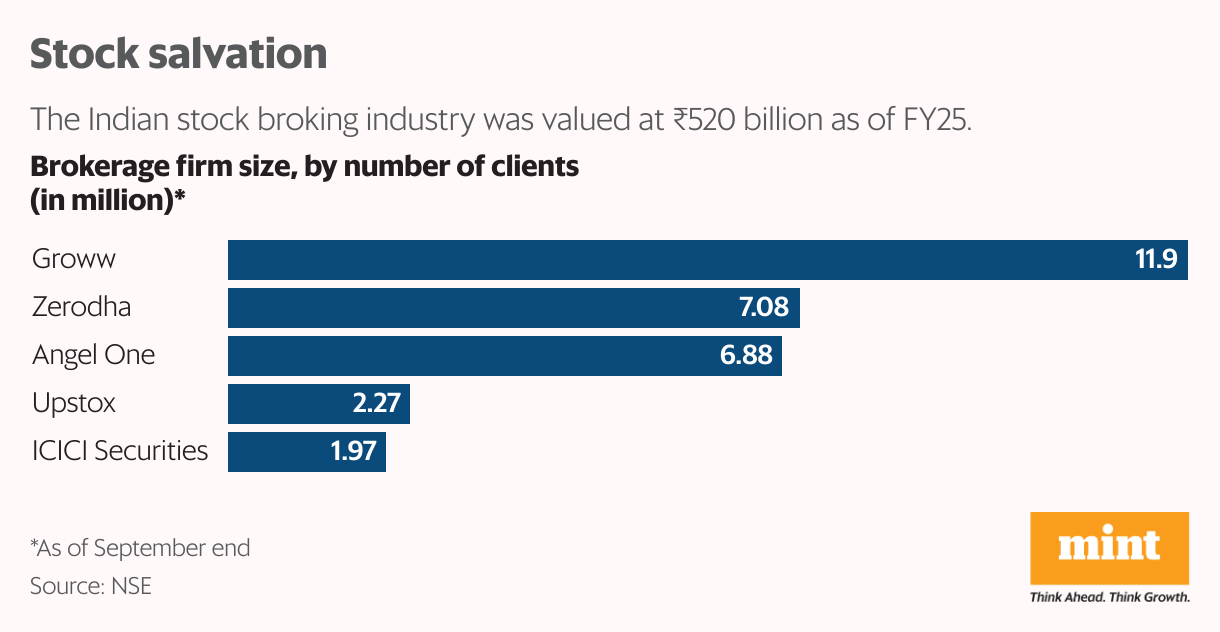
It couldn’t be determined whether the entity would offer discount broking services, like Groww or Zerodha, or full services, though one broker said it would be a discount broking model.
Backed by marquee investors such as Tencent, Steadview Capital, Tiger Global, TPG, Chrys Capital, TCV and Alpha Wave Global, Dream11 was last valued at $8 billion. It has raised more than $1.5 billion in funding across rounds since its inception in 2008.
“It is a question of how to survive amid this ban. They will see how they can tap into businesses that can leverage this young transacting customer base. The company is currently working on a dozen new ideas,” the person cited above said. The platform had approximately 260 million registered users at the time of the gaming ban.
A Dream11 spokesperson declined to comment. Queries emailed to Sebi remained unanswered.
Senior securities lawyer Chirag M. Shah said the proposed foray would not disrupt the broking industry, as “there was enough and more room for quality new players who could offer innovative services and products.”
Huge potential
The Indian broking industry was valued at ₹520 billion as of FY25 and is estimated to compound at an annual rate of 16-18% to reach ₹810-860 billion by FY28, according to a recent note on Anand Rathi Share And Stock Brokers, which listed on 30 September, by KR Choksey Shares & Sec Pvt. Ltd.
The potential for the broking industry’s growth is huge, as the unique investor base on NSE, the country’s largest stock exchange, stood at 120 million as of 30 September, per exchange data. This means only one in around 12 Indians has registered to invest in stocks.
Out of the registered base, those actively trading are even fewer at 47.9 million, which means only two-fifths of the registered investors trade actively, as per data from the red herring prospectus of Anand Rathi Share And Stock Brokers.
Equities have emerged as the preferred asset class in the last five years, with domestic inflows (by both individuals and domestic institutions) rising to an average monthly run rate of approximately ₹611 billion in FY25, from ~ ₹110 billion in FY20, notes IPO-bound Groww in its DRHP.
Furthermore, the flow of net household financial savings into equities and mutual funds rose from 5% in FY20 to 17% in FY24, Groww adds, citing RBI data and reflecting the untapped potential.
Challenges
Subject to Sebi approval, the broking licence will have to vest in another entity, said a broker, requesting anonymity. Getting consent from customers in the gaming business to transfer their data to the broking business could be “painstaking,” he said.
Also, while the company had the technological and financial muscle to offer broking services, how would it seek to justify the synergy to its customers of moving from gaming into stock investing, which is a different animal, he added.
Sebi criteria
To get a stock broker’s licence, applicants must meet Sebi’s “fit and proper” criteria, including absence of criminal conviction and financial insolvency, pass relevant exams such as those conducted by the National Institute of Securities Markets (NISM), and obtain clearances from both the stock exchange and the clearing corporation.
The process involves payment of fees, including a ₹10,000 (plus taxes) application processing fee and a one-time admission fee to the stock exchange, which ranges from ₹50,000 for exclusive commodity brokers to ₹5,00,000 for all non-debt segments. In addition, brokers must deposit a base minimum capital (BMC) of ₹10–50 lakh, depending on whether they trade for themselves, clients, or engage in algorithmic trading.
Once registered, brokers are required to pay regular Sebi turnover fees: ₹10 per ₹1 crore of most securities traded and ₹2.5 per ₹1 crore for debt securities, along with other statutory charges such as GST, STT, and stamp duty.