

Here’s what it’s all about
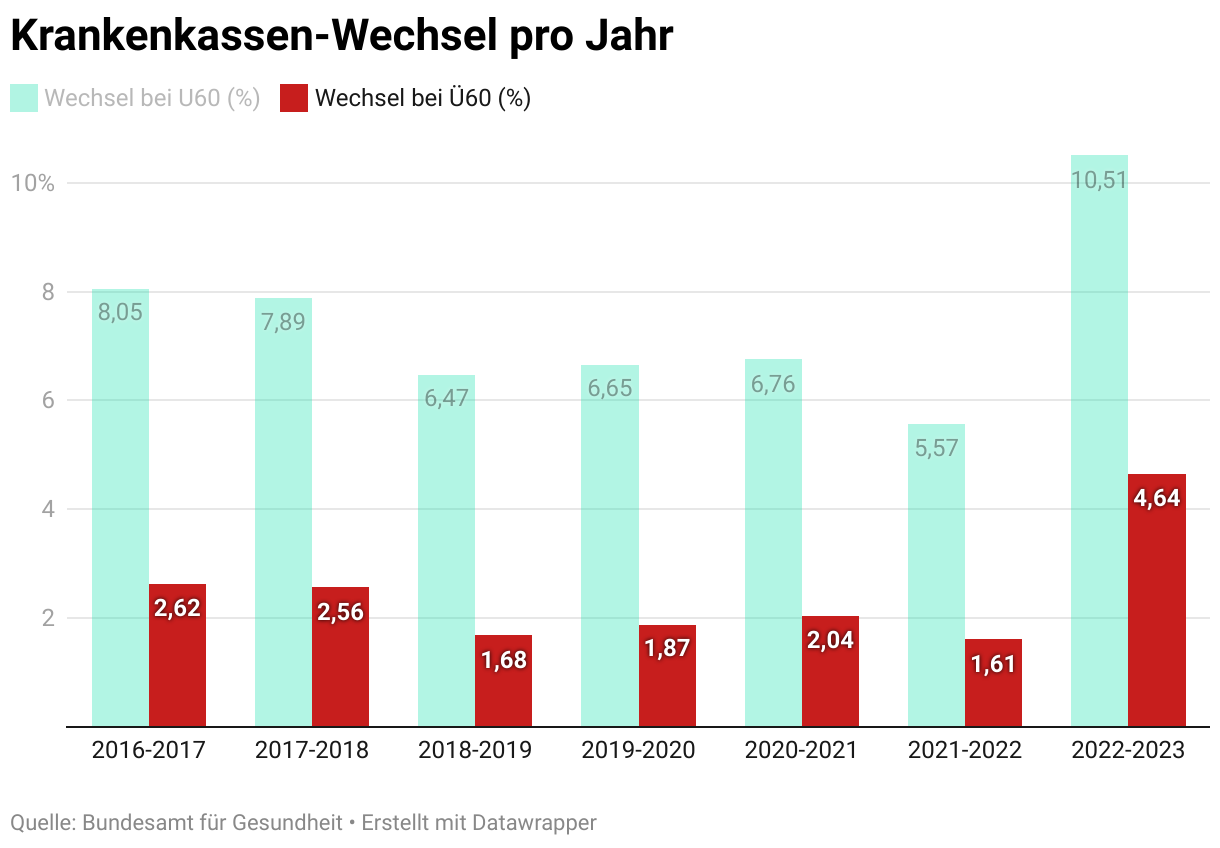
- Between 2016 and 2023, about 7.4 percent of people under 60 switched health insurance providers each year. Among those over 60, the figure was only 2.4 percent, even though they could save the most.
- However, seniors do not stay with their current health insurance provider out of ignorance or convenience.
- People with existing chronic conditions run the risk of paying more with the new insurer, even though their premiums are lower.

The figures speak for themselves: From 2016 to 2023, about 7.4 percent of people under 60 switched health insurance providers each year. Among those over 60, the figure was only 2.4 percent—just one-third as many.
Older people pay particularly high premiums, so their potential savings would be considerable. Why do so many remain loyal to their health insurance provider?
“Saving would be easy,” “Saving would be easy,” read a recent article in blue News. One might conclude from this that anyone who doesn’t take advantage of this opportunity either doesn’t need to or is overwhelmed by the process of switching.
Why Switching Health Insurance Providers Fails
Markus Hartmann (name changed) sees it differently. He runs a landscaping business, but no longer considers himself one of the young ones; his wife is already of retirement age.
A few years ago, he had an experience that continues to influence his choice of health insurance provider to this day. “My wife had chronic health issues and was undergoing treatment that required a pre-approval of costs from our health insurance provider. In order to switch providers, we also had to request pre-approval of costs from our future health insurance provider.”
Two facts are important here: First, a health insurance provider must accept anyone who applies for basic coverage, regardless of their health status or ongoing treatments. Second: However, a health insurance provider that takes over a person’s coverage from another provider is not obligated to honor the cost approval granted by the previous insurer. It may conduct its own assessment and decide whether it will cover the cost of a specific medication or treatment.
A cost authorization is required for treatments or medications that are particularly expensive, have not yet been approved by Swissmedic, are not included on the list of specialty drugs covered by mandatory health insurance, are intended only for other illnesses, or are particularly expensive.
Hartmann recalls: “The new health insurance company accepted our children and me without any trouble, but we didn’t receive a decision regarding my wife. I asked what was going on with her and the pre-approval for coverage, but they just put me off.” It wasn’t until after the new year that the health insurance company—to which the husband and children had since switched, but not the wife—announced that they hadn’t processed the application due to an internal error. “By then, of course, it was too late for my wife to switch. To this day, she’s still insured with our former provider.”
Even today, the whole situation still seems suspicious to him, but he cannot prove that the company deliberately dragged its feet. He had followed up in a timely manner, so the request couldn’t simply have been forgotten.
For Hartmann, one thing is clear: “Switching health insurance plans to save money is no problem for young, healthy people. For older people with chronic illnesses, however, it certainly is.”
This discourages older adults from making the switch
According to its own figures, Pro Senectute advises more than 70,000 older adults each year on various topics, including how to deal with health insurance companies. In response to an inquiry from blue News, the organization stated that several factors contribute to the low propensity to switch providers:
For example, as people get older, they find it harder to change existing solutions, “even if such a change would be financially attractive.”
Some people are concerned that switching could have negative consequences for their ongoing treatments or benefits. “While this fear is unfounded, especially when it comes to basic health insurance, it can still act as a barrier.”
In addition, the administrative burden deters some older people. As a final point, the spokesperson for Pro Senectute cites aggressive telemarketing. For some, this has a deterrent effect rather than motivating them to seek out new health insurance.
The Sticking Point: Pre-Approval of Costs
There is a legitimate concern that the switch will ultimately lead to higher costs rather than lower ones. Or worse yet: that a treatment will no longer be covered that was previously covered by the previous insurer.
In response to an inquiry from blue News, the Federal Office of Public Health (FOPH) stated: “If treatment is already underway and the previous insurer has approved coverage, it may be advisable to submit a prior written request to the new health insurance provider regarding potential coverage for the continuation of treatment.”
However, the insurer is not obligated to respond to the inquiry until the person in question has submitted an application for coverage. “A health insurer cannot make a legally binding decision regarding a cost authorization before receiving an application for coverage, as long as no insurance relationship has yet been established.”
There is no such thing as a non-binding request for a cost estimate from a new insurer. Anyone considering switching will not receive a binding response until he or she submits an application for coverage. This application is binding.
The FOPH states: “The ability to withdraw an application at any time would be incompatible with legal certainty and the orderly administration of social health insurance, particularly with regard to ensuring seamless insurance coverage.” So, applying on a whim and then withdrawing the application if the request for cost approval is denied is not the solution.
Ombudsman’s Office Advises the Sick and Elderly Against Switching
Susanne Müller Ineichen of the Health Insurance Ombudsman’s Office takes a clear stance when it comes to switching basic health insurance providers: “We advise people with medical conditions who are currently receiving benefits or who have received a cost approval from their previous insurer against switching insurers.” There is always a risk that treatment previously covered by the previous insurer will no longer be paid for.
Even after consulting the ombudsman’s office, the advice remains the same: If you have a chronic illness and have been approved for treatment that required special authorization, you should not switch health insurance providers, even if the premium is lower with another provider.
The director of the ombudsman’s office is even more explicit when it comes to supplemental insurance: “Age and illness are the two factors that make it difficult or even impossible to obtain coverage. With supplemental insurance, health insurers are allowed to practice risk selection. That’s why it’s practically impossible for older people with pre-existing conditions to be accepted for supplemental insurance.” And even if they are, she adds, “it’s only with exclusions that specifically exclude the very benefits the person is most likely to need.”
Incidentally, this also applies to young people with medical conditions. In addition, the ombudsman’s office has observed that even healthy 50-year-olds are finding it more difficult to obtain supplemental hospital insurance. “Statistically speaking, the likelihood of claims increases as an insured person gets older,” she explains.
The fact that people over 60 are less likely to switch basic health insurance providers does not surprise Susanne Müller Ineichen, and it is in line with the Ombudsman’s recommendation. “Those who have both basic and supplemental insurance with the same health insurance provider are also more reluctant to switch basic insurance providers, since that would require dealing with two health insurers.”
Added to this is the administrative burden associated with switching, as well as the wide variety of basic insurance plans that people have to wade through to figure out whether they’re really better off financially. “Many young people are put off by this,” she points out.
The statistics back her up. Even though three times as many people under 60 switch health insurance plans as those over that age, even in the younger age group, only seven out of every 100 people went to the trouble of doing so each year between 2016 and 2023.

01:59
Krankenkassenprämien steigen 2027 im Schnitt um 5 Prozent
Die mittlere Monatsprämie beträgt 412 Franken, wie das Bundesamt für Gesundheit am Dienstag mitteilte. Das entspricht im Vergleich zum Vorjahr einem Anstieg von 19.70 Franken.