Rising fuel prices, triggered by the Middle East conflict, are bad news for households and motorists – but some investors with money in energy funds have benefited from a compensating increase in the value of their holdings.
One fund that has performed rather well is WS Guinness Global Energy, which is managed from the UK by the six-strong energy investment team at Guinness Global Investors.
Between them they run assets worth £600 million across a range of energy funds available to UK and international investors, including some with a sustainable emphasis. The fund is aimed at UK investors and holds shares in companies involved in the exploration, production, and distribution of oil and gas. It is a near clone of Guinness Global Energy, which has an international investor base.
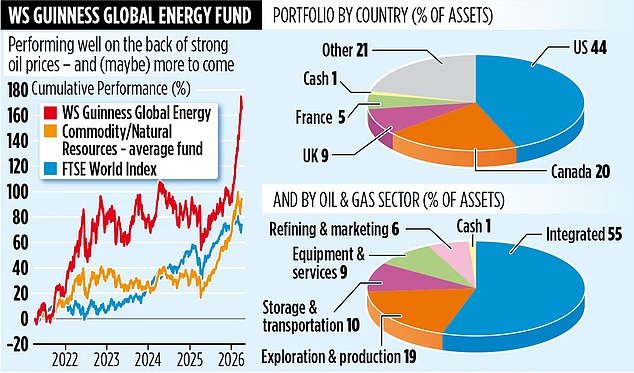
In the past three months the fund has generated returns for investors of 39 per cent – 10 per cent over the past month as war has waged in the Middle East. Longer term returns are 49 per cent and 93 per cent over three and five years, respectively. To put these numbers into perspective, the fund has matched or outperformed its benchmark – the MSCI World Energy Index – over all these time periods.
Jonathan Waghorn runs the fund alongside Will Riley. He believes that if the oil price remains at around $80 a barrel over the long term, there is the potential for the fund to benefit from at least a 20 per cent uplift.
Waghorn says that the promised reopening of the Strait of Hormuz is ‘critical’ to ensuring the price of oil does not get to a level – $125 to $150 a barrel – where it could cause significant problems to the world economy.

‘We are losing 10 million barrels of oil a day as a result of tankers not being able to travel through the Strait without fear of attack,’ he explains.
‘Even if the Strait is reopened, this loss will not be recouped straight away. Some oil fields will need to start production again, and this can take time. The same goes for gas – it will take weeks, months for a full recovery in supplies of liquified gas.’
The fund’s exposure to oil is through blue-chip companies – such as Exxon Mobil and Chevron in the United States plus BP and Shell in the UK.
In total it has 29 holdings, with a majority of the fund’s assets in companies listed either in Canada or the United States.

The universe that the managers select stocks from is 250-strong. Each month the team score individual companies – all are capitalised in excess of £750 million – on a number of ‘fundamental criteria’. These include ‘relative value’ compared to their peer group; ‘quality’, as in their ability to generate profits from the capital they employ; and the ‘momentum’ in both their share price and earnings. Waghorn says: ‘It’s a way for us to generate new ideas for the fund.’
Guinness Global Investors is an investment house that builds funds with a philosophy of equal weighting. But holding weights are allowed to vary more in WS Guinness Global Energy (and Guinness Global Energy) as a result of the dominance of Exxon and Chevron in the MSCI World Energy Index.
Between them they account for 28 per cent of the benchmark. Their representation in the fund is 5.5 per cent and 4.8 per cent, respectively. Waghorn says individual fund holdings tend not to exceed 6 per cent.
Annual charges are 0.77 per cent and the fund doesn’t pay an income. WS stands for Waystone, which administers the fund.
DIY INVESTING PLATFORMS

AJ Bell
AJ Bell
Easy investing and ready-made portfolios

Hargreaves Lansdown
Hargreaves Lansdown
Free fund dealing and investment ideas

interactive investor
interactive investor
Flat-fee investing from £4.99 per month

Freetrade
Freetrade
Investing Isa now free on basic plan

Trading 212
Trading 212
Free share dealing and no account fee
Affiliate links: If you take out a product This is Money may earn a commission. These deals are chosen by our editorial team, as we think they are worth highlighting. This does not affect our editorial independence.