Solar has been the largest source of new electricity generation capacity in the U.S. for two consecutive years. This, according to the Federal Energy Regulatory Commission (FERC).
Utility-scale solar capacity has now moved ahead of wind, hydropower, and nuclear. And looking ahead, FERC projects that another 86 gigawatts of solar could be added over the next three years, pushing solar past coal in total installed capacity.
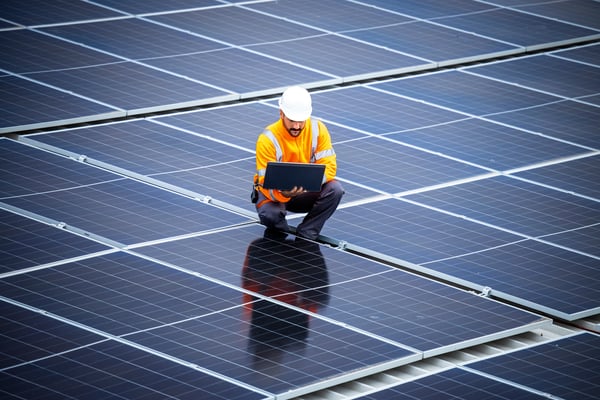
Image source: Getty Images.
The data is clear, and the scale of recent expansion is hard to ignore. Utility-scale solar capacity increased from 91.82 GW in September 2023 to 164.53 GW by December 2025. To put that in perspective, during the same time period, wind added about 13.4 GW, while natural gas contributed just 6.83 GW.
FERC’s projections suggest that by early 2029, utility-scale solar could represent roughly 17%–18% of total U.S. generating capacity, second only to natural gas.
The question, of course, is whether this demand is enough to justify going long on solar?
Follow the fundamentals
From 2022 to 2025, solar stocks got hammered.
The Invesco Solar ETF (TAN 0.18%), a widely used benchmark for the sector, peaked in late 2021 and fell from around $100 to around $26 by April 2025, a decline of roughly 74%, reflecting the impact of higher interest rates and weaker demand across the industry.
But then something happened.
Interest rates stabilized, removing a key pressure on project economics and valuations. At the same time, underlying demand remained intact, supported by utility-scale build-outs, electrification trends, and rising power needs tied to data centers.
Battery storage economics improved, too, which forced the market to price solar, not just as panels and cells, but as reliable generation and infrastructure. Policy became more predictable, as well, and Wall Street began to reassess the sector. What had been priced as a challenged industry was increasingly viewed as a long-term infrastructure growth story.
Of course, this doesn’t mean solar stocks are without risk. Certainly, you can’t ignore the possibility of elevated interest rates, interconnection delays, and supply chain issues. Yet you also can’t ignore the transition of our energy economy, which is happening right in front of our eyes. This is why solar stocks should not be disregarded, but instead approached in a way that gets you some exposure to the upside while limiting your risk.
Safety, exposure, and predictability
One challenge to investing in solar is that many solar companies are closely tied to project development cycles, financing conditions, or specific technologies. But NextEra Energy (NEE 0.94%) occupies a different position within the market.

Today’s Change
(-0.94%) $-0.87
Current Price
$91.43
Key Data Points
Market Cap
$192B
Day’s Range
$90.60 – $91.86
52wk Range
$63.64 – $96.20
Volume
198K
Avg Vol
9.8M
Gross Margin
36.20%
Dividend Yield
2.52%
The company operates through two primary segments: a regulated utility business (Florida Power & Light) and a large renewable energy development platform. The regulated utility provides stable, predictable earnings, and the renewable segment provides exposure to solar development at scale.
This combination reduces reliance on any single project or market condition. Let’s take a closer look.
Florida Power & Light
Florida Power & Light (FPL) is the largest electric utility in the U.S., serving about 6 million customer accounts and generating roughly $18 billion in annual revenue.
Net income has grown from roughly $2.57 billion in 2019 to about $5 billion in 2025. That is roughly 90% total growth over six years, or about 11%–12% compounded annually.
FLP also benefits from operating in Florida, one of the fastest-growing states in the U.S. (population-wise), where electricity demand is steadily increasing.
NextEra Energy Resources
NextEra Energy Resources (NEER) is the company’s renewable energy segment. NEER is one of the largest renewable energy operators globally, with more than 40 gigawatts of installed capacity across wind, solar, and battery storage.
Most of the company’s projects are backed by long-term power purchase agreements (PPAs), typically lasting 10 to 20 years. These contracts lock in pricing before projects are built, which means once operational, assets produce predictable cash flow.
Indeed, NextEra Energy is one of the safest ways to invest in solar because it combines exposure to one of the fastest-growing energy sources in the world with the stability of a regulated utility.
What the future holds
Since 2021, NEE has delivered a combination of growth and stability.
Revenue increased from approximately $17.1 billion in 2021 to about $27 billion in 2025, representing roughly 58% total growth, or about 12% compounded annually.
Net income has grown from around $3.57 billion in 2021 to approximately $6.84 billion in 2025, nearly doubling in four years. That implies an annual growth rate in the high teens, while net margin has remained in the mid-20% range. That’s not trivial.
It’s worth noting that about 73% of NextEra’s earnings in 2025 came from FPL. This is really what makes NEE a low-risk solar play. FPL is the core earnings engine, which provides stable, regulated cash flow while NEER drives growth.
If you’re looking to capitalize on the rapid growth of the solar market, but want to protect yourself from the type of risk that has historically come with most solar stocks, NextEra Energy is a way to do that.