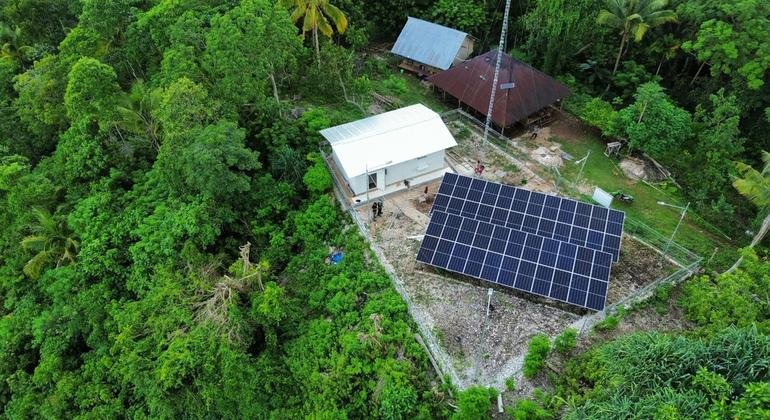
In Indonesia, United Nations agencies have worked alongside the Government to build a more reliable and resilient energy system which is also helping communities to adapt to a changing climate.
Modernizing the electricity grid
A reliable electricity grid is the backbone of energy security. To prepare for growing demand and integrate more renewable energy, the United Nations Office for Project Services (UNOPS) is working with the state-owned electricity company PLN to identify more than two gigawatts of solar energy potential that could be connected to the grid.
Solar energy plus a new control centre will strengthen grid stability, reduce outages and lessen dependence on fossil fuels.
Indonesia is introducing technology to upgrade power grids.
Using energy more efficiently
One of the simplest ways to improve energy security is to reduce network losses.
Working with government partners, UNOPS has supported energy-efficiency audits and policy reforms. These efforts help households, businesses and industries to optimize electricity use, which in turn lowers demand across the grid, ensuring more stable and affordable supply.
Making industry less energy intensive
Indonesia’s industrial sector is one of the country’s largest energy consumers, making efficiency gains particularly important.
The United Nations Industrial Development Organization (UNIDO) is helping some of Indonesia’s most energy-intensive industries cut energy use while improving productivity.
In the fertilizer sector, resource-efficient and cleaner production measures supported by UNIDO have helped participating companies avoid an estimated 328,000 tonnes of carbon emissions annually while reducing operating costs.
UNIDO is also supporting the Ministry of Industry in developing eco-industrial parks, promoting energy efficiency, renewable energy use, wastewater recycling and improved waste management.
Unlocking finance for the energy transition
Indonesia has ambitious energy goals, including adding almost 43 gigawatts of renewable energy capacity by 2034.
Achieving this target will require up to $188 billion in investment.
Young people take part in solar panel operator training in East Nusa Tenggara, Indonesia’s southernmost province.
To attract capital for renewable energy projects, the United Nations Development Programme (UNDP) is working with the Government to develop innovative financing mechanisms, including blended finance approaches that combine public and private investment.
Supporting workers through the transition
Building a secure energy future is not only about technology and infrastructure. It also depends on people.
The International Labour Organization (ILO) is helping regions across Indonesia prepare for the social and economic impacts of the energy transition. This includes identifying new employment opportunities, supporting skills development and protecting workers whose livelihoods may be affected by changes in the energy sector.
By planning ahead, these initiatives help ensure that the transition strengthens communities rather than leaving workers behind.
Bringing cleaner energy to coastal communities
For many fishing communities, of which there are many in the Indonesia archipelago, rising fuel costs can threaten livelihoods.
UNDP has helped more than 2,400 small-scale fishers adopt cleaner technologies, including solar-powered boat engines, environmentally friendly cooler boxes and improved cold-storage systems.
Indonesian fishers.
These innovations reduce fuel consumption, lower operating costs and make incomes less vulnerable to energy price fluctuations.
Fishers have also received training to operate and maintain the equipment, helping ensure long-term benefits.
Building resilient communities in remote areas
In some parts of Indonesia, communities remain far from the national electricity grid.
To address this challenge, UNDP supported the installation of 1.1 megawatts of solar mini-grid capacity across 22 remote villages, providing reliable electricity to more than 3,400 households and public facilities.
The systems have reduced energy costs by up to 40 per cent while lowering carbon emissions by an estimated 1,800 tonnes annually.
Local operators, nearly half of them women, have been trained to manage and maintain the systems, helping ensure reliable access to power over the long term.
At the same time, UNOPS has supported the Ministry of Environment’s Climate Village initiative in South Sumatra, where around 285,000 residents have received training on renewable energy, low-emission technologies and circular economy practices.
Empowering women through clean energy
Women have a key role to play in Indonesia’s energy transition.
UN Women and the United Nations Environment Programme (UNEP) have helped more than 400 women entrepreneurs gain access to green finance and adopt climate-smart technologies.
Women in West Nusa Tenggara line up beside a prototype solar drier.
These include solar drying systems, biogas cooking solutions and solar-powered water pumps that can lower energy costs while supporting sustainable livelihoods.
By expanding economic opportunities and increasing access to clean energy technologies, these programmes help ensure that the benefits of the energy transition reach more people.
‘Groundbreaking work’
“From grid modernization to industrial efficiency, from securing funding to community-based solar systems, the UN is partnering with the Government to support its groundbreaking work in strengthening the country’s energy security,” said Gita Sabharwal, United Nations Resident Coordinator in Indonesia.
“These initiatives reduce dependence on volatile global energy markets, boost supply reliability, and ensure that communities, from major industrial centres to remote villages, are contributing to a resilient future.”