
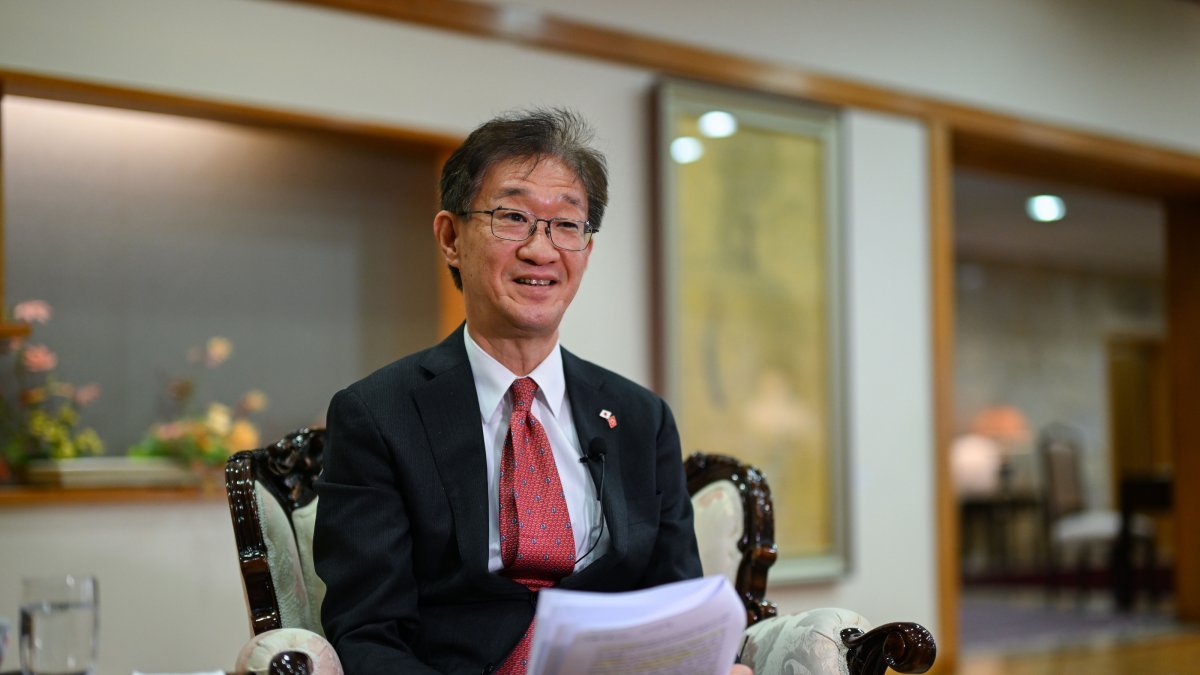
Japan sees Türkiye’s hosting of the COP31 climate summit as a notable venue to deepen bilateral cooperation in energy security, renewable energy and energy efficiency, said Japanese Ambassador to Ankara Tamura Masami.
Speaking to Anadolu Agency (AA) ahead of the summit, Tamura said COP31 could mark a new milestone in relations between the two countries, following the centenary of their diplomatic ties in 2024.
He said Japan appreciated Türkiye’s efforts to make COP31 an implementation-focused summit, emphasizing the need to turn climate commitments into concrete action.
“We completely resonate with the stance of the government of Türkiye to make COP31 an implementation phase of commitments,” Tamura said, adding that both countries shared the goal of tackling climate change despite having different economic and geographical conditions.
He stressed that there was no single pathway to achieving climate targets, pointing to the importance of countries pursuing approaches suited to their own circumstances.
Energy security as shared priority
Tamura said Japan and Türkiye faced similar challenges due to their high dependence on imported energy resources, making energy security and sustainable energy development key areas for cooperation.
He said both countries were seeking to improve efficiency in energy production, transmission and storage, while making greater use of renewable resources.
Highlighting Türkiye’s potential in hydropower, wind and solar energy, Tamura said Japanese and Turkish companies could expand cooperation across the energy value chain.
He cited Hitachi Energy’s operations in Kocaeli, where the company has been active since 1965, as an example of Japanese industrial involvement in Türkiye.
The company provides electricity transmission equipment that helps support the integration and stability of renewable energy into the grid, he said.
“All kinds of joint cooperation between Japanese and Turkish companies are really useful,” he added.
Energy Forum to support concrete projects
Tamura said the two countries had already taken steps to strengthen energy ties through the Türkiye-Japan Energy Forum, established following a memorandum of understanding (MoU) signed in 2024.
The framework aims to promote more concrete cooperation, particularly in energy efficiency and energy security.
He also pointed to an agreement involving a Japanese government-affiliated financial institution and its Turkish counterpart, saying financial mechanisms could help facilitate private-sector partnerships.
Japan is encouraging companies from both countries to work together, with institutions such as the Japan International Cooperation Agency (JICA), Japan Bank for International Cooperation (JBIC) and Eximbank among the potential tools for supporting cooperation, he said.
“At the end of the day, it is private companies that really make a difference in the results in this area,” Tamura said, adding that governments should help create the conditions for such partnerships.
Third-country cooperation, hydrogen potential
The ambassador also highlighted opportunities for Turkish and Japanese companies to cooperate in third countries, particularly in Central Asia, Africa, the Middle East and Europe.
He said Turkish companies’ regional experience, business networks and strategic position could complement Japanese companies’ technological capabilities.
Japanese companies are already working with Turkish groups, including Çalık Holding and Rönesans Holding, on energy-related projects in countries such as Turkmenistan and Senegal, he said.
Tamura also identified hydrogen as a promising area for future cooperation, alongside ammonia, nuclear energy and renewable sources.
He said Japan was investing significant resources in hydrogen technologies, which could play an important role in energy storage, transportation and utilization, although further development would take time.
Japanese to showcase technologies at COP31
Tamura said many Japanese companies were expected to participate in COP31, with a Japan Pavilion planned to showcase technologies addressing climate change and energy challenges.
He described the pavilion as an important platform for Turkish and Japanese stakeholders to exchange views and explore new cooperation opportunities.
On nuclear energy, Tamura said Japan remained cautious following the 2011 earthquake and tsunami, which triggered a major nuclear accident, but continued to regard nuclear power as important for its energy security.
He said Japan was open to nuclear cooperation with other countries, provided it was pursued carefully and step by step, taking into account the circumstances of both sides.