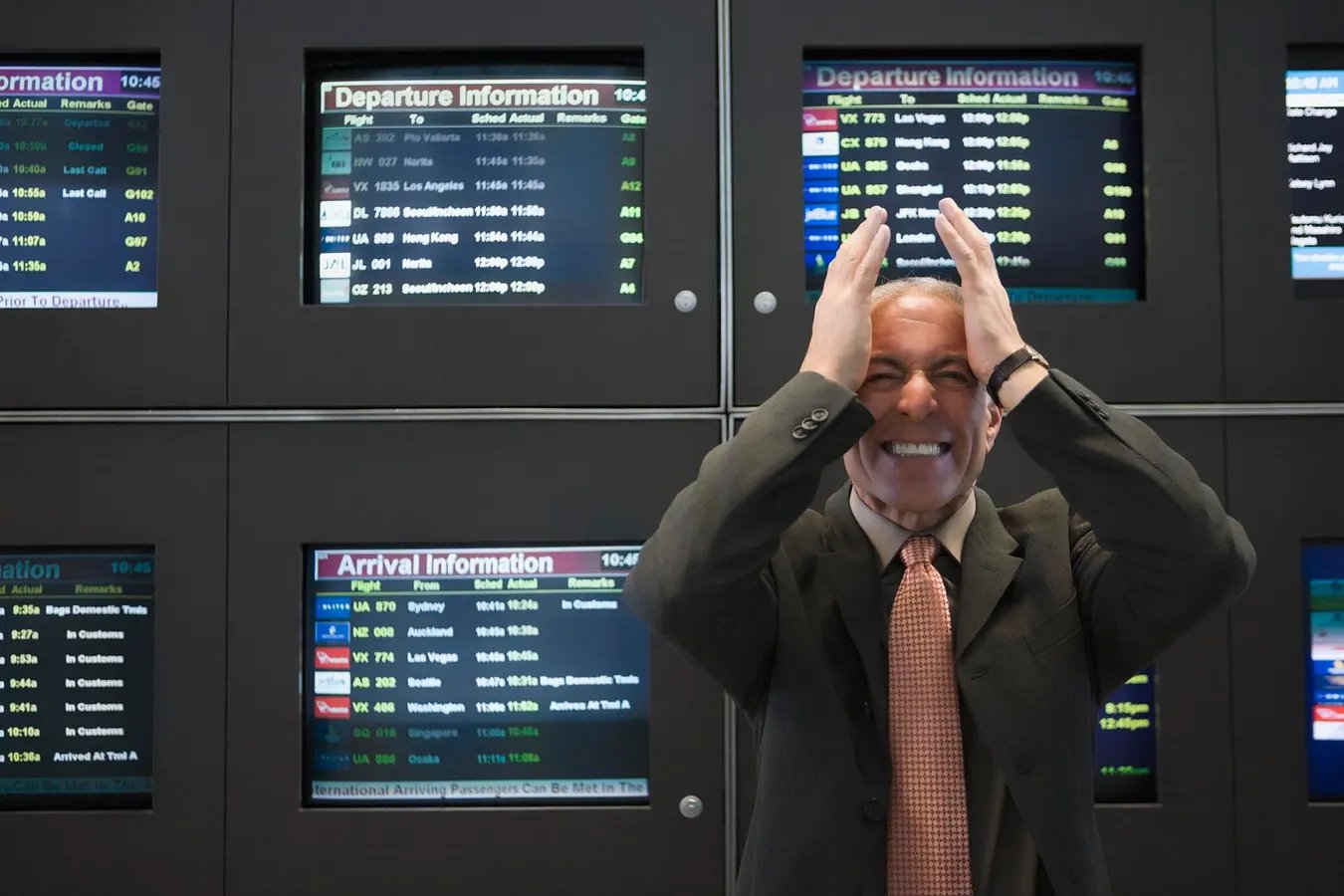
A frustrated passenger reacts to flight cancellations at an airport departure board. Buying comprehensive travel insurance early can protect your summer vacation from unexpected travel disruptions.
getty
It’s been a hard summer for travel, at least so far. Airlines have collapsed, and popular destinations continue to bake under record heat. The travel insurance policy you bought may not cover the disruption you encounter—and that’s becoming a problem for some travelers.
Take the heat, for example. Paris had its hottest day on record last month, forcing the Eiffel Tower and the Louvre to close early for days in a row. Britain, Germany, Austria and Switzerland issued red alerts for the extreme summer weather, and U.K. train operators canceled services to avoid buckled tracks.
Then there are the airlines. Spirit Airlines liquidated on May 2, and it was not alone. Small carriers on both sides of the Atlantic, including Mexico’s Magnicharters and Switzerland’s Air Mountain, have gone under since then, largely tied to a spike in jet fuel prices this year.
Travelers aren’t staying home despite the disruption. More than three-quarters of Americans (72 percent) plan to take at least one trip this summer, according to Redion’s 2026 Holiday Barometer survey. The likelihood they’ll buy travel protection also rose, from 41 percent in 2025 to 44 percent this year.
“American travelers are approaching summer 2026 with confidence, but also with intention,” says Paul-Adrien Maizener, CEO of Redion.
Travel insurance experts say travelers’ biggest mistake this summer is too much confidence—like assuming that any disruption is automatically covered by their policy. It isn’t. Timing, wording and the definition of a “known event” decide whether a claim gets paid.
Daniel Durazo, director of external communications at Allianz Partners USA, says the distinction usually comes down to what was already known when you bought the policy. If a natural disaster strikes and makes your destination uninhabitable after your policy is in place, your covered losses may be reimbursed, he says. But buy the policy after a storm is already forecast, and it’s a different story.
“That event is generally no longer considered unforeseen,” Durazo says.
When is the best time to buy travel insurance?
Most of the strongest protections have a short shelf life. “Cancel for any reason” coverage, “interruption for any reason” coverage, and waivers for pre-existing medical conditions are typically only available within 14 to 21 days of your first trip deposit, according to Jackie Mondelli, chief marketing officer at Squaremouth, a travel insurance comparison site.
“Wait longer than that,” she says, “and those options are off the table entirely.”
Squaremouth’s data shows sales of comprehensive coverage, which includes trip cancellation, hit a seven-year low in the first quarter of 2026 even as summer trip costs climbed past $9,000 for its shoppers.
“Travelers are instead choosing more limited plans that don’t include a key benefit: trip cancellation,” she adds. “Without it, one single disruption, such as illness, a family emergency, or job loss, could jeopardize your entire investment.”
Interest in “cancel for any reason” coverage rose sharply this spring as regional conflict spread, Mondelli says, though travelers who wait to buy it often find the window has already closed.
Julia Taliesin, an economic analyst and licensed insurance agent at the comparison site Insurify, says the same rule applies broadly across the industry, and that buying right after booking maximizes eligibility for time-sensitive add-ons.
Terry Boynton, president of Yonder Travel Insurance, makes a related point about embedded coverage.
“Waiting until a trip is fully paid for to purchase insurance doesn’t just result in the loss of critical, time-sensitive benefits,” he says. “If a crisis or storm develops before you secure a policy, it becomes a known event, making it impossible to get coverage for the very risks you’re concerned about.”
Boynton also warns against the insurance plan a hotel, cruise line or tour operator adds automatically at checkout. Those bundled policies, he says, can cost close to double a standalone plan while carrying lower medical evacuation limits and fewer accepted reasons for cancellation.
Does travel insurance cover extreme heat and weather?
Wanting to skip a trip because your destination is unbearably hot is not, by itself, a covered reason to cancel.
Scott Fleming, president of Aon Affinity Travel Practice, says some severe weather claims also require a storm to be officially named or to directly affect a destination during the traveler’s scheduled dates. Being in the general vicinity is not always enough.
If you have not booked yet and are worried about the heat, Mondelli suggests considering the shoulder season or a cooler destination. Squaremouth’s booking data suggest Ireland, Iceland, Switzerland, Norway and the Netherlands are among this year’s top cool-climate alternatives, The average trip cost ranges from about $9,200 to $14,100.
If you booked more than three weeks ago and heat is now a concern, “cancel for any reason” insurance may no longer be available. Mondelli recommends focusing instead on making the best of your vacation. In other words, stay hydrated, avoid alcohol and make sure you have at least emergency medical coverage, which she says can run as little as $5 a day.
Common travel insurance exclusions you need to know
Avantika Krishna, founder of Venture & Gain Travel, says some travelers may need separate coverage for high-risk activities this summer. Those include scuba diving, jet skiing and higher-altitude hiking, which can all fall under a policy’s “hazardous activity” exclusion.
Geopolitics is also a no-go zone for some travel insurance policies. So are strikes. And there’s some fine print to mind, too.
“An announced labor strike will likely be treated differently than an unforeseen strike, which is very common in Europe,” she says. “Coverage often depends on whether the event was already foreseeable when the policy was purchased.”
Many no-fee cards carry no travel insurance benefits at all, and the coverage from paid cards varies widely by issuer.
Steve Case, a financial and insurance consultant at Insurance Hero, says credit cards rarely protect against a carrier’s bankruptcy, which matters given how many airlines have gone under this year.
Another common mistake has nothing to do with timing or exclusions: incomplete coverage. Add a flight, tour or hotel after you’ve already bought your policy, and those new nonrefundable costs don’t automatically get covered, notes Raymond Yorke, a spokesman for Redpoint Travel Protection.
“If you add flights, tours or accommodations after purchasing your policy, make sure you understand whether you need to update your coverage to reflect them,” he says.
How medical evacuation insurance works
An insurance policy’s medical evacuation benefit typically gets you to the nearest adequate facility, not the hospital of your choice back home. John Gobbels, CEO at Medjet, a medical transport membership program for travelers, says that distinction catches people off guard mid-emergency.
“Also remember that most travel insurance reimburses you for hospital expenses, but only after you pay them out of pocket up front, then file a claim for reimbursement,” he adds. “That can amount to a significant sum, and many hospitals abroad will not take credit card payments. Know in advance where you’ll get ahold of cash like that in an emergency.”
Dan Richards, CEO of The Global Rescue Companies, also notes a related gap that only shows up once someone is hurt.
“If you’re injured while diving, hiking, mountain biking, rafting, climbing or exploring a remote destination, getting to medical care can be the hardest part,” he says. “Many travelers find out too late that most travel insurance begins only after you reach a hospital on your own.”
A field rescue benefit works differently. It sends help to wherever you actually are, coordinates the rescue itself and routes you to the facility best equipped to treat the injury, rather than defaulting to whichever hospital is closest.
Travel insurance mistakes to avoid before you go anywhere this summer
Perhaps the worst mistake you can make this summer, at least when it comes to travel insurance, is neglecting to purchase it, according to Susan Sherren, founder of Couture Trips.
“More hotels are luring clients with nonrefundable rates, which are quite appealing given the cost of travel these days,” she says. “Do not purchase a nonrefundable hotel, tour, or other travel products without a travel protection plan in place. You can’t predict how unforeseen circumstances may affect your travel plans.”
So what are the main errors should you avoid when you’re booking a summer trip?
- Buying insurance more than three weeks after your first deposit. You won’t be able to get “cancel for any reason,” “interruption for any reason” or a pre-existing condition waiver.
- Assuming a heat wave, strike or airline bankruptcy is automatically covered. It’s not. Once it’s already underway and widely known, insurance probably won’t cover it.
- Skipping activity-specific coverage for diving, hiking, jet skiing or other higher-risk excursions. Diving and high-altitude hikes often fall under a hazardous-activity exclusion. You may need extra insurance.
- Relying on a credit card for protection against a carrier’s bankruptcy. Your card probably won’t cover you.
- Assuming medical evacuation means a flight home. It won’t. It’ll probably just transport you to the nearest adequate facility
In other words: Buy your policy sooner rather than later, get coverage for any high-risk activities, don’t rely on your credit card for protection and consider a medical transport membership. When in doubt, call the provider and ask if you’re covered. This summer, you don’t want to make any assumptions.