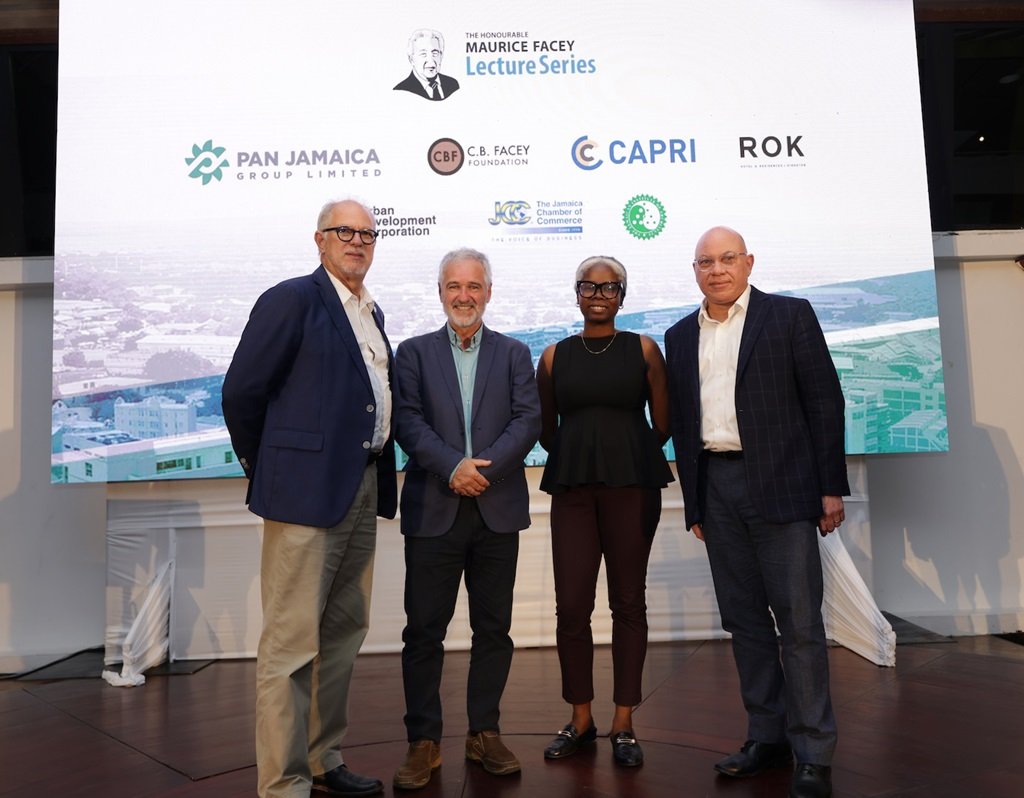
Former national director of energy in Uruguay , Dr Ramón Méndez Galain (second left) shares in a photo with members of the Pan Jamaica team following his presentation at this year’s staging of the Maurice Facey Lecture. From left are Stephen Facey, group chairman; Gayon Douglas, executive director of the CB Facey Foundation; and Jeffrey Hall, group vice-chairman and CEO.
AS Jamaica prepares for negotiations on a new electricity licence, internationally acclaimed energy strategist Dr Ramón Méndez Galain said the country has a unique opportunity to transform its energy sector, reduce electricity costs, and boost economic competitiveness — but only if it can pursue bold policy reforms, build political consensus and accelerate its transition to renewable energy.
Speaking at the sixth staging of the annual Maurice Facey Lecture hosted by the Pan Jamaica Group and the CB Facey Foundation, Galain drew on Uruguay’s experience in transforming its energy sector from one that was very dependent on imported fossil fuels to one that now generates more than 95 per cent of its electricity from renewable sources.
The lecture, held under the theme ‘Breaking the Grid: Charting Jamaica’s Path to Renewable Energy”, comes at a pivotal time for Jamaica as policymakers, regulators, and industry stakeholders debate the future structure of the country’s electricity sector ahead of the expiry of the Jamaica Public Service (JPS) licence next year.
Arguing that renewable energy can no longer be considered simply an environmental imperative, Galain said it must become an economic necessity.
“In Uruguay, we proved that energy transition is possible. We proved that renewables are not a contradiction between climate and economy — they are a combination of the two,” he told a large audience gathered at the Jamaica Conference Centre last Friday.
The former national director of energy in Uruguay shared that the South American country completed its renewable energy transformation in just five years, attracting billions of dollars in investment, creating nearly 50,000 jobs, and significantly improving energy security while reducing electricity generation costs.
Today, renewable sources account for more than 99 per cent of that country’s electricity generation and approximately 63 per cent of its overall energy consumption.
For Galain, Jamaica possesses many of the ingredients needed to replicate similar success.
He pointed to the country’s abundant solar and wind resources, declining global renewable energy costs, and rapid advances in battery storage technology as factors that make a faster transition increasingly achievable.
“Wind and solar plus battery storage is the perfect combination for Jamaica,” he said.
“The economics are now making the case. This is no longer simply about climate benefits. It is about lower costs, greater energy security, reduced dependence on imported fuel, more investment, more jobs and greater national resilience.”
He argued that Jamaica’s dependence on imported fossil fuels leaves the economy vulnerable to global energy price shocks, geopolitical conflicts and supply disruptions — all of which contribute to the country having some of the highest electricity costs in the Caribbean.
Galain, in cautioning that achieving a successful transition will require significant reforms to the country’s regulatory and institutional framework, urged policymakers to stop forcing renewable technologies to compete under rules designed for a fossil-fuel-based system.
“We have to stop asking renewables to play the game with rules that were not made for them,” he said.
Among his recommendations was the need for a strengthening of the country’s energy planning and regulatory institutions, revisiting contractual arrangements within the electricity sector, modernising market design, and improving long-term system planning.
The energy expert also called for broad political consensus around the country’s energy future, noting Uruguay’s transformation which he said was supported by agreements that transcended political administrations.
“My dream for Jamaica would be a national political agreement around energy. This is not a right versus left issue. It is about the future of the country,” Galain said.
In opening his remarks, Pan Jamaica Group Chairman Stephen Facey said Jamaica is now at a critical juncture in its energy transition and must move more aggressively to capitalise on its renewable energy potemtial.
He said that while the country has set a target of generating 50 per cent of its electricity from renewable sources by 2030, progress has continued to be relatively slow, with renewables accounting for only about 15 per cent of the energy mix before Hurricane Beryl in 2024.
“For a nation blessed with abundant sunshine, steady winds, and extraordinary natural resources, we must ask ourselves whether we are moving quickly enough,” Facey said.
Arguing that many of the technological barriers that once constrained renewable energy have now disappeared, Facey also said this has made the generation, storage and distribution of renewable energy more economically viable.
“Other countries are showing the way, and we think Jamaica should be at the cutting edge of that conversation,” he further stated.
Describing Jamaica as being at a crossroads in its energy journey, Facey warned that decisions taken in the coming months could shape the country’s economic future for decades.
He also highlighted the impact of high energy costs across the economy, noting that they affect almost every sector, from manufacturing and transportation to tourism, housing and food production.
With renewable technologies becoming cheaper, more efficient, and increasingly reliable, both men suggested that Jamaica now faces a defining choice whereby it can either continue to rely heavily on imported fossil fuels or accelerate a transition that could reshape the country’s economic future for generations.
“If we are serious about improving productivity, attracting investment, creating jobs, and raising living standards, then reducing the cost of energy must be a national priority,” Facey said.