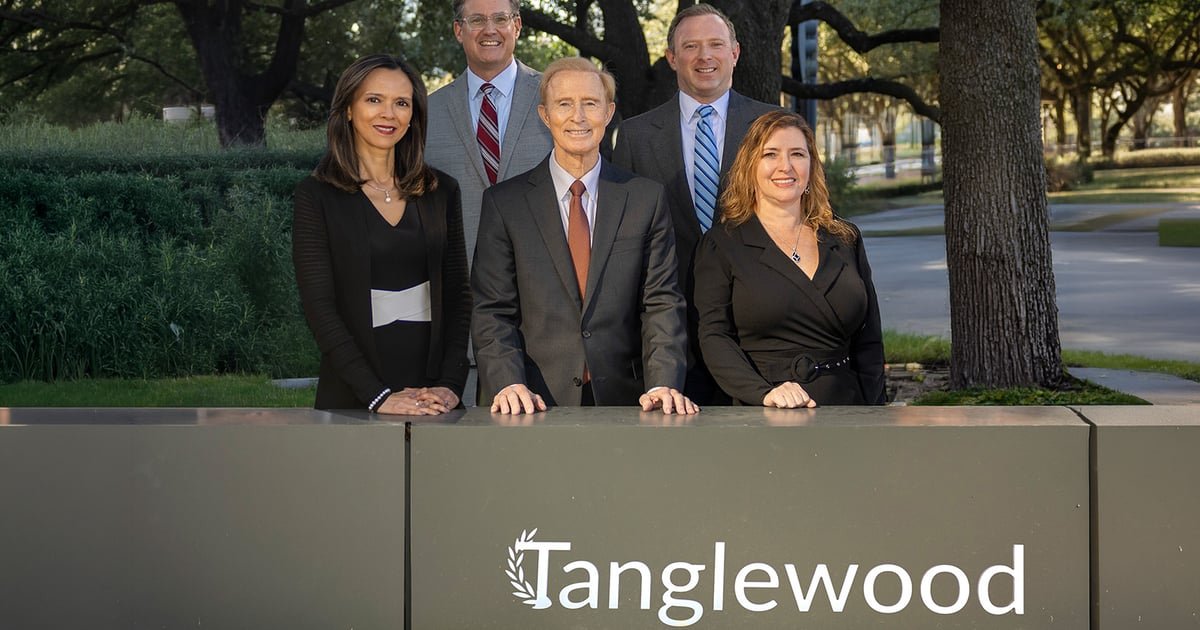
Tanglewood Total Wealth Management has a long and rich history. John F. Merrill, who’s now 78, founded the firm in 1979, and it was one of the first fee-only registered investment advisors. His goal was to remove the conflicts of interest that arise with commission-based compensation and not be tied to any one company.
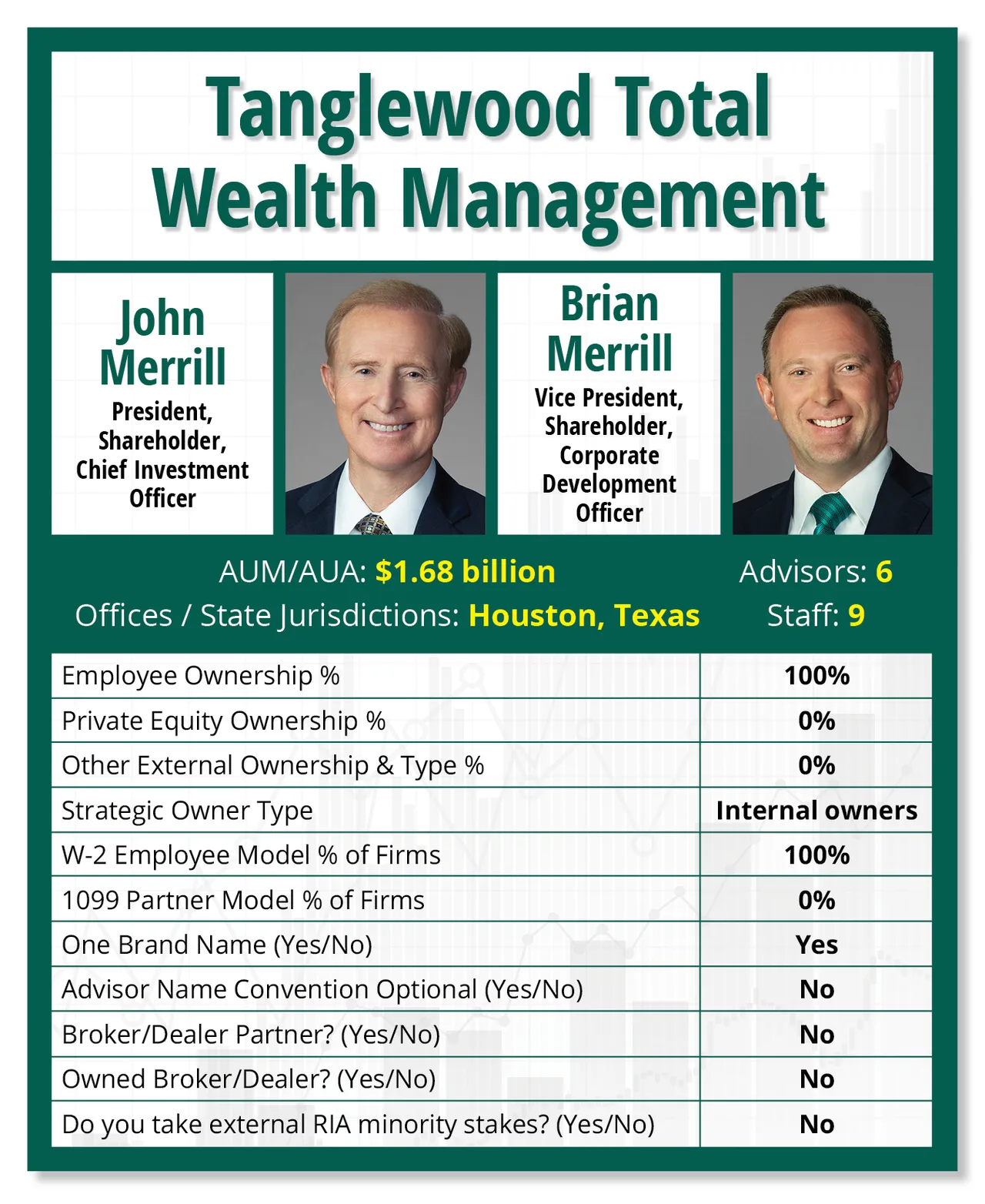
And the firm has remained independent in its ownership, too. Rather than pursuing a transaction, as many RIAs have, Tanglewood has doubled down on internal ownership as its path to growth and succession. The firm has grown to $1.68 billion today.
Merrill eventually brought his son, Brian Merrill, into the firm, who is working on a lot of the innovation and strategy for Tanglewood.
The Merrills recently sat down with Wealth Management to discuss their ownership structure, succession plan and decision not to take outside capital.
The following has been edited for length and clarity.
Wealth Management: Your firm has a long history. Would you tell me about how you got started?
John Merrill: I started the firm in October 1979. I’d been in a regional brokerage insurance outfit that was kind of a precursor of the wealth management firms of today, but it was all commission-based. I thought I loved what I did, but I didn’t like the way I was paid. So I wanted to find a way that I’d be on the same side of the table as my clients and wouldn’t be influenced by selling products. So I started out on the journey of being fee-only long before most in the industry even thought about that. In fact, the first NAPFA meeting wasn’t until 1982.
The first six, seven years were a struggle, but fortunately, most of the clients that I had developed at the previous firm came with me. But it was a new experience. They hadn’t seen the money that were paying me because it was part of a commission. Now they were writing a check. So it was a new experience for us both, but it worked out very well in the end.
And I was kind of doing more wealth planning as it would be called today. And I picked up investing mainly because a lot of the wealth planning we were doing back then was setting up defined benefit plans. They were very different than they are today, and they mostly benefited the owner. I started investing the money inside these defined benefit plans, then for them personally, and it just grew from there. The financial planning and the investment management became integrated.
I was primarily using mutual funds at that time. And then in 1986, an article by Gary Brinson came out on asset allocation. I was very much struck by that, and I spent the next two or three years trying to develop asset allocations that made sense to me. And in the 1990s, I got my first book published. And we’ve been doing the same kind of asset allocation with only modest changes since 1991, and it’s worked out really, really well for us.
And we’ve expanded how we use the investments, how we integrate them with financial planning. The things that we take for granted today, like RMDs, QCDs, Roth conversions, none of that existed in the ’90s. I mean, wealth planning has changed and morphed over time, and we’ve adapted those new strategies for the benefit of our clients. And that’s the beauty of being independent, that we feel we’re flexible, that we can make the changes needed to address what benefits our clients.
WM: What made you bring Brian into the firm? And is he part of your succession plan?
JM: Right out of college, Brian went to work for Enron. Enron folded. And so we just talked and said, “Well, why don’t we just for a year just see how things work at Tanglewood and see what we can do and see what you can learn? And you can use this as a jumping-off spot for wherever you want to go in life.” It wasn’t intentional in the beginning, but we just found more and more ways that Brian could learn, expand and grow. In 2014, we developed a formal succession plan that includes Brian and Keith Fenstad in our firm, and we now have six owners of the firm. So the succession plan is in full bloom. I only own about a third of the firm, although I retain voting control, but we’ve really come a long way in terms of internal succession.
WM: Brian, what has it been like working with your dad over the years?
Brian Merrill: After Enron went down, I was still working there. I was one of the last 10% there, but I was starting to have nothing to do. My father said, “Hey, if you help edit my most recent book, I’ll teach you how to trade.” So I learned how to trade and build portfolios over those first couple of years. After the book came out, we created what was called All Seasons Retirement Portfolios, which is now Tanglewood Portfolios, which grew from nothing to about 175 clients.
And then in 2014, when I became an owner of the firm, I transitioned that program to somebody else to instead focus on more of the business aspect of the firm. One of the reasons I have the corporate development officer title is not because of corporate development in the large company sense of acquisitions and external growth. It’s more internal, new products, new initiatives, innovation, strategy. And that keeps it exciting for me because I like to build new things, so there’s never been a time where we’ve been stagnant as a company. I think we’ve done some things that are unique in the industry because I was allowed the latitude to do some of those things here that I wouldn’t have had somewhere else.
WM: How is the succession plan structured? John, do you have an end date in mind or a plan for transitioning out?
JM: I’ve emulated Philip Carret, who managed the Pioneer Fund back in the 1920s. He worked at his desk till he was 103, and he died on his desk. And I liked that. That means he was productive until the day he died. It’s not that I don’t have my vacations and fun, but I enjoy what I do. Also, we still have clients that actually go back to my pre-Tanglewood days, with their kids and their grandkids, and I feel a huge responsibility to the original clients to see it through for them. We put a lot of plans in place. And through the estate settlement, through the estate distribution, through the setting up the heirs, many of which are clients, many of which are not, but we take it full board to see that through.
From a succession standpoint, we’ve got plans in place that my stock will be partially given to Brian, partially sold to the company. There’s a buy-sell in place where if it’s not given or sold to an existing shareholder, then it must be bought by the company. So it’s not going to get spread to relatives or anything like that. And that plan has been in place since 2014, although we have modified it twice as we brought in new owners and new aspects to the plan, but that’s still in place.
WM: The firm has made this decision to stay independent, not take outside capital. When did you come to that decision to stay independent, and why?
JM: The first firms that were being merged or bought happened probably 20 years ago, and I saw the results and how it changed things. With some firms, it changed things more than others, but on the other hand, you’ve got more mouths to feed, you’ve got different priorities, you’ve got different goalposts. It’s no coincidence that a lot of those are tied to Fidelity’s or Schwab’s referral plans. That’s 26 basis points, so they have to charge that to their clients. If we charge that added onto our fee, we’d have the same fee as everybody else, but we don’t do that. We have never taken a referral fee from any source. It’s been all organic growth, and that keeps us flexible from the standpoint that we’re not having to take those types of client relationships, nor do we have to pay those kinds of fees, nor do we have those kinds of obligations. But a lot of those firms do.
I go back to clients first. What’s in the client’s best interest versus what’s in your personal best interest? If it was all about money, we would’ve sold several years ago because the amount of money they were flashing was unbelievable. But I’ve invested well; I don’t need the money.
WM: How do you respond to capital providers that reach out to you? Or do you just not respond?
JM: I don’t respond to them, but they keep coming.
WM: Do you think you’ll ever reconsider taking capital?
JM: We don’t need it. We have talked periodically about buying another firm, but it would have to be a cultural fit. That’s the hardest part. I love our culture, and the people here are 100% on board with our culture. But you go to another firm, you’ve got a different culture. It may be similar, but it’s different. And integrating the two cultures would probably be much more than integrating the two businesses. And I’ve seen that also. A big firm two floors above us sold out to a bank, and then they went through a transition. Then, the owners were kicked out, and they started a new firm. It’s just kind of a mess, and where does that leave the clients?
WM: Last spring, you added a couple of shareholders. What was the significance of that to the firm?
BM: Ownership and succession aren’t something we’re thinking about or going to do; it’s something we’ve done. It’s already in place. Part of the process is also how do we retain the key employees who have been here a long time that we think are important to the continuity of the client experience going forward, and to the culture of the firm going forward? And one of the things we can do is decide who should be part of ownership because we believe they help with that continuity. They help maintain the consistency of the client experience through generations. From our perspective, we just want to broaden ownership and then basically let those know that we think are important to the future continuity of the firm, consistency of the firm, that we want them to be a part of the performance of the firm and to tie them to us, have an ownership mentality and feel like everything is rewarded for them, not just us, especially given the tenure and the value that they’ve brought to the firm over the years.
WM: What is the path to equity ownership at the firm?
BM: There is a 10-year component. We wanted to roll it out, and 10 years seemed to be a good starting point. But that said, if we were to bring in somebody who was at the leadership level or if we were to purchase a firm and their group came over, there are other ways to ownership. But the primary way to ownership is from working here a long time, delivering value for a long time, and then, even more importantly, feeling like you’re going to continue to be here a long time, so that we maintain the talent.
WM: What have you been doing to develop associate advisors?
BM: Up until about five years ago, we didn’t see the value of hiring young advisors because we intended to work with larger clients that those advisors wouldn’t resonate with. But then we started doing more and more work for each of our clients and adding to the services that we do, and we decided to develop an associate advisor program, which we had never had before and created a path. And then that path is associate advisor, senior associate advisor, wealth advisor, senior wealth advisor, and then potentially shareholder. We have somebody who started as an associate advisor, moved to senior associate and is now a wealth advisor. For every wealth management client, they now have a primary advisor, and then they have an associate advisor who is also assisting the primary advisor with that account.
That’s because of the extended services and deliverables that we’re doing, and it’s great because the associate advisors are in the meetings, talk with the clients, get experience. We’ve never really had a natural path for them to develop clients before being ready, but now we have more and more multi-generational families. We created what we would call a deliverable, which is our family financial consulting program, and it’s basically that if somebody signs up as a wealth management client, then their adult children will be able to have a junior advisor from our firm free of charge. And so they don’t have to go to Edward Jones; they don’t have to go do robo advisors, and they have somebody they can call.
The family financial consulting is specifically for those who may never become clients. That’s why we don’t view it as a profit center. It’s a service that we provide because we know that our clients care about their health and their kids more than anything. And so we wanted to make sure that their kids are taken care of, learn how to be good stewards of money and can carry through for the next generation. Our junior advisors can start there before having true client relationships where we have a client engagement, where we have an advisory agreement. And then also there’s the younger clients that are full clients of the firm that are the kids of gen one, maybe gen two, gen three. And so there is a path for them to develop their own clients.