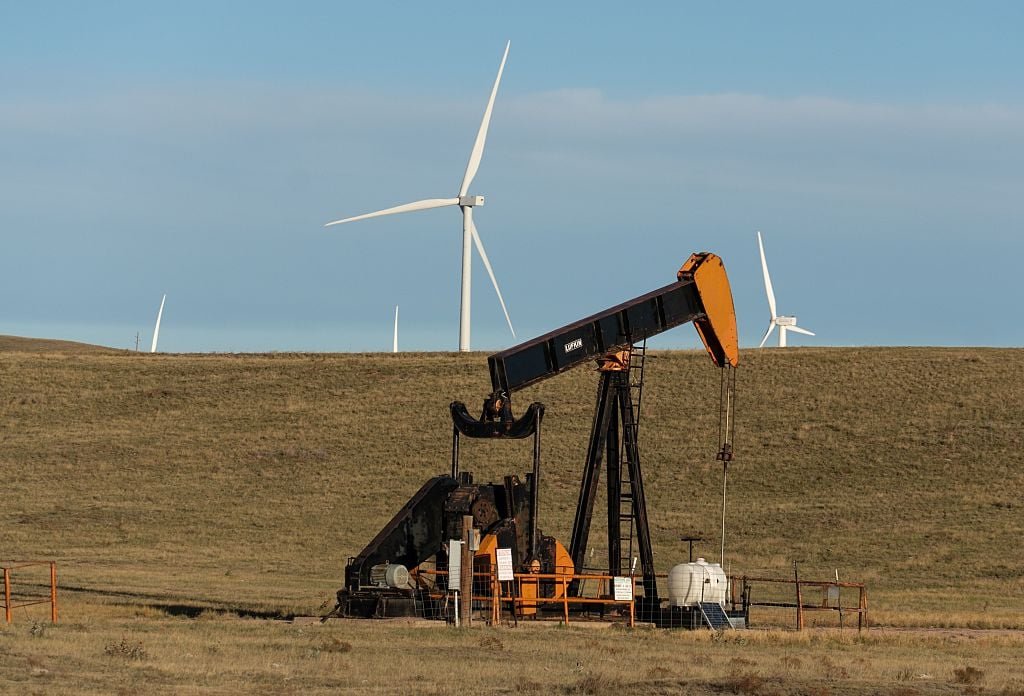
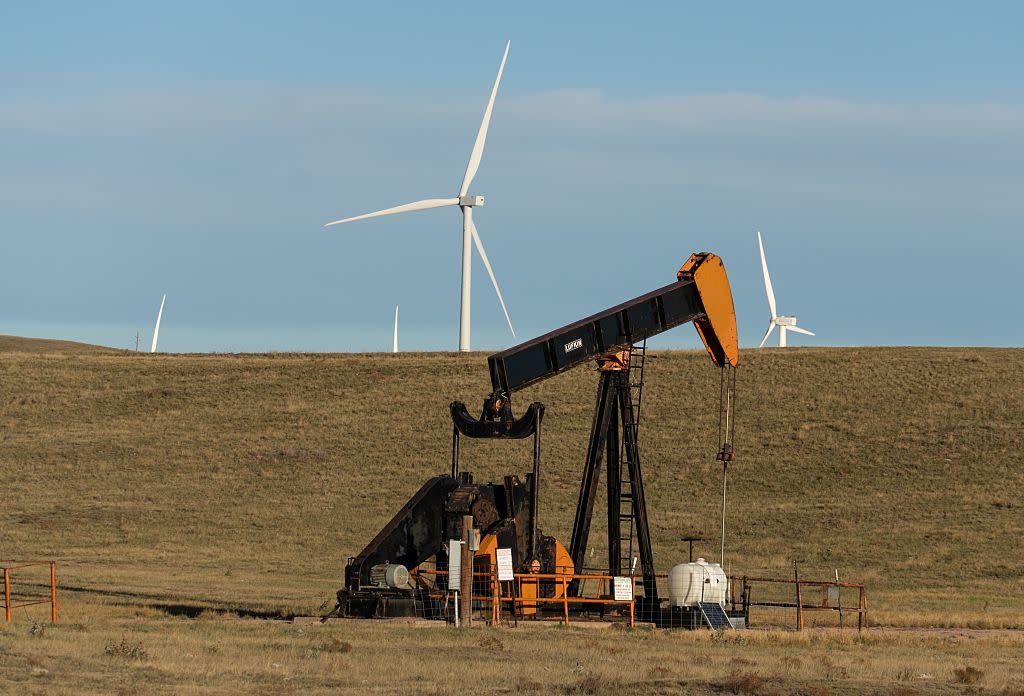
Oil pump jack and windmills, southern Wyoming —Marli Miller/UCG/Universal Images Group—Getty Images
At what point does an energy crisis change how businesses spend money and invest in clean energy technologies and more efficient ways of running their business? That question has gained importance in recent weeks as the war in Iran drags on with a neat resolution seeming increasingly unlikely.
As I’ve written in recent columns, the energy crisis has put the question on the agenda of some CEOs, but for the most part the overwhelming uncertainty has led companies to pull back spending rather than take visionary steps or make big bets.
This question has been top of mind in my conversations with executives and analysts in recent weeks, and I’ve explored the academic literature on the topic. The truth is there isn’t a clean answer—but some clues do emerge.
First, the longer the crisis persists—or is perceived as likely to persist—the more likely companies are to begin making different capital allocation decisions. Right now, there are mixed signals about how long the crisis will last. Energy experts see a prolonged crisis even in the best-case scenario just on the basis of the physical reality on the ground. Reserves have been depleted, tanker ships are out of place, and infrastructure has been damaged. And it could get worse. Yet, to the bafflement of many in the industry, markets don’t seem to be pricing in a prolonged crisis. The forward price of crude oil for contracts delivered over the summer remains under $100 barrel compared to $112 today.
Sign up to Future Proof here
To make big visionary bets, executives will often need to believe that high prices are here to stay. But, even in the worst case scenario where there is no geopolitical solution, high prices will eventually drive a recession and a decline in demand. That’s not a situation where executives want to make big investments. ”In order to have a real sustained capital reallocation to renewables and alternatives you need a sustained price spike,” says Bob McNally, president of Rapidan Energy Group, which conducts energy market analysis. “We may have new all-time highs… But then it’s going back down again.”
But, even without visionary bets, the crisis may still change behavior—and the academic literature provides some clues about what that might look like. A survey of the economics literature from the OECD finds that energy shocks tend to drive a decrease in productivity in the short-term as companies slow operations and conserve cash. In the medium-term, however, the results diverge.
Firms tend to emerge from small energy shocks more productive and energy efficient, after investing in new energy efficient technologies and processes. But large energy shocks drive different results: market conditions make it hard to find the resources to invest in new approaches. It’s a challenging paradox: the more dramatic the energy disruption, the harder it is to find the capital to address the challenge.
Indeed, the energy shock that hit Europe after the Russian invasion of Ukraine led to a similar dynamic. Policymakers incentivized renewables and energy efficiency with success. Companies signed more power purchase agreements to lock in the fixed price of renewables. But research from the European Central Bank found that many of the most energy intensive companies had to slow their investments in response to the crisis—including more efficient ones.
Nonetheless, study after study shows that energy shocks do change how companies allocate capital over the long-term. As facilities roll over, energy shocks remind companies of the value of efficiency for their new investments. In a study covering three decades of U.S. manufacturing, researchers found that a 10% increase in energy prices led new plants to use 1% less energy.
In the scheme of the global decarbonization conversation, 1% obviously isn’t anything transformational. But the technology suite available today is dramatically different than in past crises. Renewable energy can be deployed quickly at relatively low costs. Efficiency approaches—enabled by technology—can do more to cut energy use, more quickly than ever before. And years of research and development work have made some game-changing approaches commercial, from sustainable aviation fuel to next generation battery technologies, if not yet widely adopted.
The picture that emerges is a complicated one. To expect a rapid change of direction without policy intervention would be overly optimistic. But the cost and volatility of energy at this moment is yet another finger on the scale in favor of new approaches.
And yet, despite all the challenges, firms that take a forward-looking perspective can position themselves well. At IKEA nearly a decade ago, then-CEO Jesper Brodin launched what would become $5 billion in renewable energy investments. At the time it was a bold bet; today, it’s insulating the company from price fluctuations. “If you want all the answers,” he says, “you might actually miss the train.”
To get this story in your inbox, sign up to TIME’s Future Proof newsletter here.