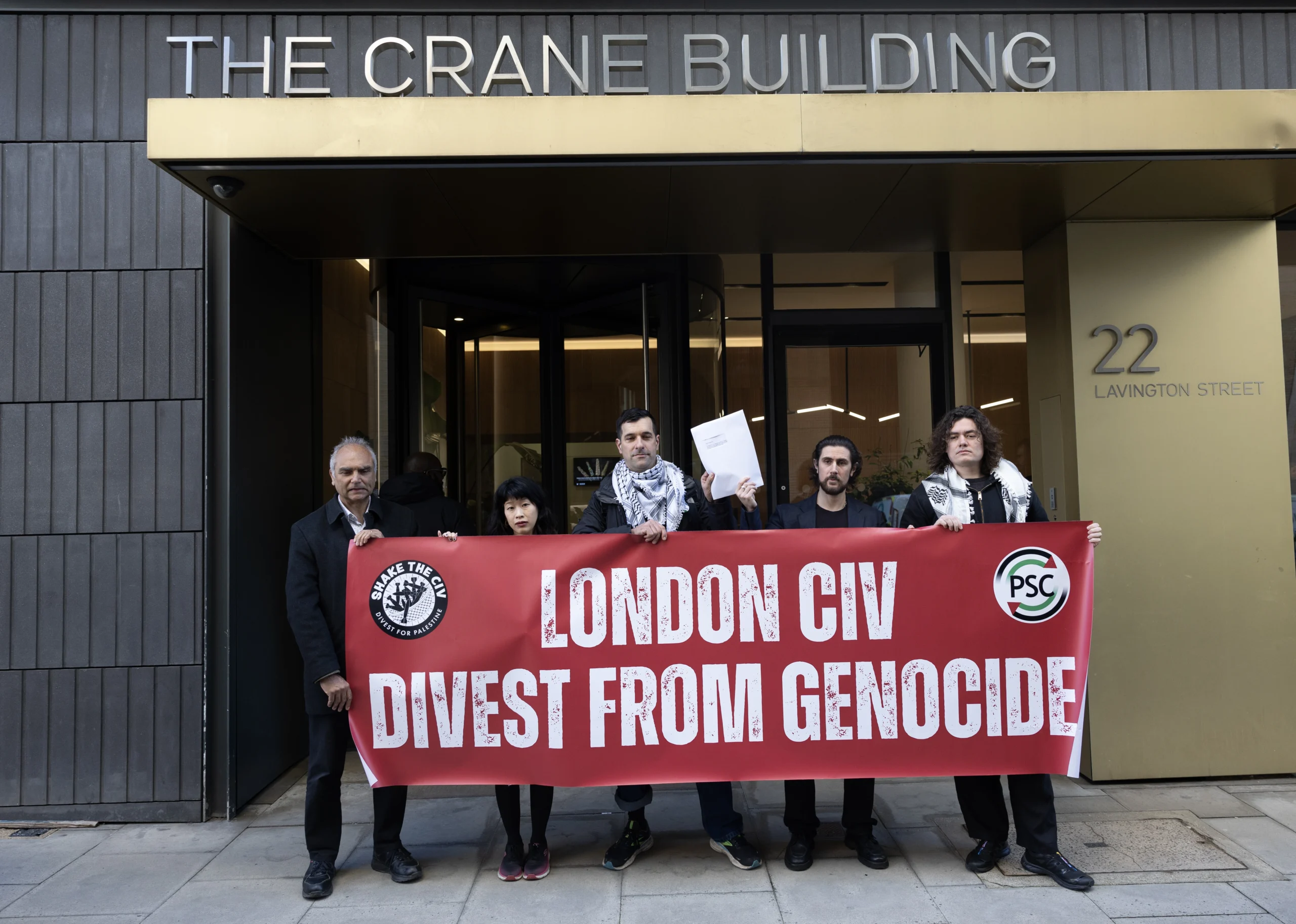
150 councillors have called for the divestment. Photograph: Facundo Arrizabalaga/MyLondon
London’s mega-pension fund must immediately divest from any firm “enabling Israel’s grave violations of international law”, a cross-party group of politicians has said.
150 councillors across London’s boroughs joined four London Assembly members in demanding the London Collective Investment Vehicle (LCIV), the pooled investment fund for the capital’s councils, exclude future investment options that help contribute to Israel’s alleged abuse of Palestinians and set a timeline for full divestment.
Shake the CIV, the campaign group which handed over a letter with the demands to LCIV’s office yesterday (Tuesday March 17) alongside the Palestinian Solidarity Campaign (PSC), said the pension fund currently invests £7billion of its £34billion portfolio in companies “complicit in Israel’s crimes”, including nearly £1billion in arms manufacturers.
Critics are concerned that more money could flow into such firms after all 32 boroughs and the City of London transfer their remaining pension assets to LCIV by the end of this month, with the new ‘megafund’ potentially worth over £55billion.
There is particular concern around Pillar 3 of LCIV’s new responsible investment policy, which the letter explains “excludes only a subset of companies that engage in Israel’s crimes”.
It adds: “Companies supplying Israel with weapons and military technology used in its genocide in Gaza fall outside of its scope. For example, Lockheed Martin, the primary producer of Israel’s F-16 and F-35 fighter jets, is not included.
“Given this, the exclusion criteria developed for LCIV’s Responsible Investment Matrix must include companies identified by research conducted by credible human rights organisations as contributing to Israel’s grave violations of international law, including the AFSC Investigate divestment list, and the WhoProfits Corporate database.
“LCIV has itself used these sources since 2021 to assess exposure to companies involved in violations of international law in Palestine, calling them “the most politically balanced and thorough sources of information that we can access” as recently as June 2025.
“Ensuring that London CIV’s investments are not contributing to Israel’s genocide, military occupation and apartheid must be an urgent priority, in line with Pension Funds’ responsibilities not to contribute to grave violations of international law”.
The signatories include dozens of Labour, Liberal Democrat, Green Party and Independent politicians, including high-profile figures such as Green Party leader Zack Polanski.
His party colleague on the London Assembly, Zoe Garbett, told the Local Democracy Reporting Service (LDRS): “This is simply doing what we can to make sure we are not complicit and that pension funds are instead used for the public good.
“People don’t want their money invested in firms like Elbit and Palantir – pension funds could be used to invest in housing, to help people locally instead.
“The London CIV should listen to the people it ultimately serves and move toward divestment from companies complicit in Israel’s crimes and human rights abuses globally”.
Milly Oldfield, spokesperson for Shake the CIV, added: “They follow the money, but it’s a myth that ethical investment isn’t profitable or that it’s difficult. Research shows that people would be happy to divert their pensions away from war crimes and away from crimes against humanity, if that’s saving lives.
“I think that especially London Council workers, 700,000 of them, don’t want their pension money covered in blood”.
Since July 2024, eight London councils, including Wandsworth, Islington, and Southwark, have passed a motion or issued a statement in support of divesting their pension funds from companies involved with Israel.
However, the pension reforms will make it much harder for individual councils to divest from any specific companies. While they can currently instruct their fund manager to sell off shares in any chosen firm, LCIV have stated that they will need a “critical mass” among member funds to trigger an exclusion.
Cllr Aydin Dikerdem, the Cabinet Member for Housing on Wandsworth council, explained: “Previously, councils were in control of their own funds – they were the investors. But as of April 1, all of the different pension funds from across London, are being pooled into one mega fund, and LCIV will have control of the day-to-day purchasing of the stocks and shares within those pooled funds.
“What we want is clear direction to managers, and it’s called Pillar 3, which is around ethics. What we’re asking for is that that pillar really offers a genuine choice for those who are concerned about the apartheid that’s taking place, the crimes against humanity, and the genocide in Gaza, to make sure that that fund really does meet the criteria that councils are asking for”.
LCIV were contacted for comment.
In a statement last year, the fund said that campaign groups had “wrongly” calculated the £7billion figure for investments “in companies alleged to be complicit in conflicts and human rights violations relating to Gaza”.
It added: “This is incorrect and appears to have arisen from a misunderstanding of data published on the London CIV website last year, following an FOI request. It is important to clarify… this data actually showed that London CIV’s exposure stood at £713 million, which equated to 4% of the pool’s total assets under management.
“The document also included Partner Fund exposures in their own passive strategies (often described as “deemed pooled”), which totalled £6.5bn. These passive strategies are managed by third-party fund managers, not under London CIV management and entirely outside the pool’s control in terms of any investment decisions.
“The data also showed that, of the £713m within London CIV’s own funds, 85% (£608m) was invested in either Alphabet, Meta or Microsoft. This observation is in no way a personal or institutional judgment on these named companies, but rather a view on their size. They are globally dominant tech firms, known for their scale, performance, and ubiquity across investment portfolios”.