Unlock the Editor’s Digest for free
Roula Khalaf, Editor of the FT, selects her favourite stories in this weekly newsletter.
Sport
by simon kuper

Dreams and Songs to Sing: A People’s History of Liverpool FC from Shankly to Klopp by Alan McDougall (Cambridge)
McDougall, a Liverpool supporter exiled to Canada and a sports historian, has written a personal and professional account of the club and its fans over the decades. He writes with joy and love, but is also critical of Liverpool on matters such as the club’s past tolerance of racism.
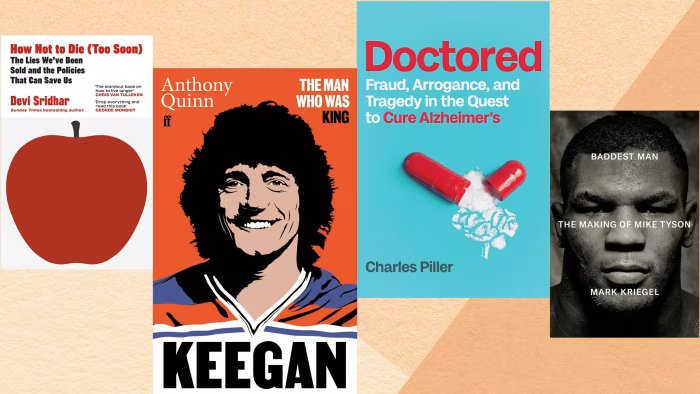
Baddest Man: The Making of Mike Tyson by Mark Kriegel (Ebury Spotlight/Penguin Press)
Tyson books are a genre, but this biography is well told by a skilled sportswriter. Kriegel takes the heavyweight champion from his frequent youthful arrests in extraordinarily violent 1980s Brooklyn to his swift apogee. The book also illuminates other legends of boxing, such as Tyson’s trainer and “white father” Cus D’Amato, and criminal promoter Don King.
Death of a Racehorse: An American Story by Katie Bo Lillis (Simon & Schuster)
Lillis, a CNN reporter, practically grew up on horseback and knows both the beautiful and awful sides of thoroughbred racing. In a personal work of investigative journalism, she exposes all that’s wrong with the sport, especially the drugs, overwork and dangerous breeding practices that have helped kill so many racehorses.
Keegan: The Man Who Was King by Anthony Quinn (Faber)
A short, entertaining and funny book about a short, entertaining and unintentionally funny footballer and manager. Quinn, a novelist, writes without either original research or any access to Kevin Keegan but doesn’t need them, because he’s such a good reader of the self-made star, his life and his various autobiographies.
Health and Wellness
by Anjana Ahuja

How Not to Die (Too Soon): The Lies We’ve Been Sold and the Policies That Can Save Us by Devi Sridhar (Viking)
“I am living longer because of political choices made more than half a century ago,” observes Sridhar, professor and chair of global public health at Edinburgh university, who argues forcefully that the focus in health must now shift beyond the individual and on to societies and governments. She shows how better health and longevity is attainable today — but needs the right policies and enough political willpower.
Music as Medicine: How We Can Harness Its Therapeutic Power by Daniel Levitin (Cornerstone Press)
Whether it’s mooching around to break-up ballads or gyrating to dance-floor fillers, we all know that music affects mood. Now Levitin, a neuroscientist and musician, drums up a back catalogue of evidence suggesting it reduces stress, slows neurodegeneration and strengthens immunity. Shortlisted for the Royal Society Science Book Prize.
Doctored: Fraud, Arrogance and Tragedy in the Quest to Cure Alzheimer’s by Charles Piller (Icon Books)
A challenging but powerful deep dive into how the billion-dollar quest to cure Alzheimer’s went off the rails. Piller, an award-winning investigative journalist for Science magazine, wades into a tangled web that involves alleged scientific misconduct, whistleblowing, corporate greed, questionable lobbying and amateur sleuths. A bit like Wirecard, but for pharma wonks.

All this week, FT writers and critics share their favourites. Some highlights are:
Monday: Business by Andrew Hill
Tuesday: Environment by Pilita Clark
Wednesday: Economics by Martin Wolf
Thursday: Fiction by Maria Crawford
Friday: Politics by Gideon Rachman
Saturday: Critics’ choice
The Age of Diagnosis: Sickness, Health and Why Medicine Has Gone Too Far by Suzanne O’Sullivan (Hodder/Thesis)
Medicine has become accomplished at diagnosis but to what end? The neurologist and author of It’s All in Your Head takes a stethoscope to her own profession, questioning the value of pathologising ever milder aspects of the human condition (think ADHD) and precautionary screening that pre-emptively turns us into patients without making us better. Brave, provocative and humane.
Proof: The Uncertain Science of Certainty by Adam Kucharski (Profile Books)
As misinformation and disinformation run riot, including in health and wellness, the concepts of truth and certainty have never felt more slippery. Kucharski, a maths-trained professor at the London School of Hygiene & Tropical Medicine who penned The Rules of Contagion, explains how we know things and to what level of certainty, and how to hone our own decision-making. Engaging and uncondescending.
Tell us what you think
What are your favourites from this list — and what books have we missed? Tell us in the comments below
Join our online book group on Facebook at FT Books Café