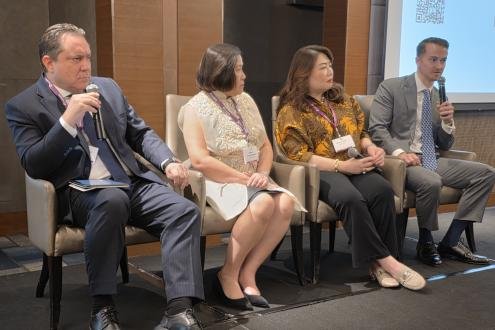
At the Hubbis Philippines Wealth Management Forum 2026, industry practitioners examined how Filipino business families are navigating succession, globalisation, and wealth structuring in an increasingly complex regulatory and cross-border environment. The discussion explored the evolving dynamics between generations, the growing role of offshore structuring, and the implications of rising transparency and mobility on long-term wealth preservation.
Panellists highlighted how traditional family-business models are being reshaped by shifting next-generation priorities, international lifestyles, and the need for more sophisticated structuring frameworks. As Filipino families become more globally dispersed, wealth planning is becoming inherently cross-border, requiring coordination across jurisdictions, advisers, and regulatory regimes.
Chair: Zac Lucas, Partner – International Private Wealth, Spencer West LLP
Speakers
- Stella L. Cabalatungan, Board Advisor and Consultant, BDO Private Bank
- Sharon Yam, Managing Director and Regional Head of Asia, Equiom Group
- Scott Moore, IMCM, Head of Private Clients Asia, Henley & Partners
Key Takeaways
- Filipino business families are facing increasing complexity in succession planning due to forced heirship rules, global asset bases, and evolving next-generation preferences
- Professionalisation of family businesses is emerging as a key solution where next-generation involvement is limited
- Offshore structuring and international advisory collaboration are becoming central to effective wealth preservation
- Trust structures and private trust companies are gaining traction, particularly for managing global assets and governance
- Migration, education pathways, and citizenship planning are becoming integral components of wealth structuring discussions
- Regulatory developments, including beneficial ownership transparency and future CRS alignment, are creating urgency around proactive planning
Structural Challenges in Succession Planning
Panellists described succession planning for Filipino families as inherently complex, shaped by a combination of legal constraints and practical realities. Forced heirship rules, estate taxes, and often lengthy probate processes create structural friction in transferring wealth efficiently across generations.
At the same time, many families face unresolved legacy issues, including assets that have not been formally regularised across generations. This adds an additional layer of complexity when attempting to implement modern structuring solutions.
“The interplay between legal requirements and family dynamics creates a highly fragmented succession landscape,” a panellist said.
Compounding this challenge is the increasingly global footprint of Filipino families, with assets, beneficiaries, and business interests spread across multiple jurisdictions.
The Next Generation Is Reshaping the Equation
A defining theme of the discussion was the changing mindset of next-generation family members. Increasingly educated abroad and exposed to global opportunities, many are choosing not to participate in traditional family businesses.
This shift is forcing families to reconsider long-standing assumptions around succession and continuity.
“There is a clear divergence between legacy business models and next-generation aspirations,” a panellist observed.
Rather than attempting to compel participation, families are increasingly accepting alternative approaches – including allowing professional managers to run operating businesses while focusing on preserving and growing financial wealth separately.
This transition reflects a broader evolution from business-centric wealth to more diversified, portfolio-based wealth structures.
From Business Families to Financial Families
Panellists highlighted a gradual but important shift towards diversification and institutionalisation of family wealth. As families progress through generations, reliance on operating businesses is typically reduced in favour of financial assets and more structured investment portfolios.
This transition is increasingly being supported by the development of family office frameworks and global structuring solutions.
“The long-term objective is to de-risk the family by moving from concentrated business exposure to diversified financial wealth,” a panellist said.
However, the pace of this transition varies, and many families are still in the early stages of adopting more formalised wealth governance structures.
The Role of Offshore Structuring and Advisory Ecosystems
As Filipino families expand globally, offshore structuring has become a central component of wealth planning. Panellists noted that local advisory capabilities are often insufficient to address the full complexity of cross-border assets and multi-jurisdictional families.
This has led to a growing reliance on international advisers and fiduciary service providers.
“You cannot solve global wealth challenges with purely domestic solutions,” a panellist noted.
Collaboration between onshore relationship managers and offshore specialists is therefore critical, particularly in areas such as trust structuring, tax planning, and cross-border asset management.
Selecting reputable and experienced partners was highlighted as a key determinant of successful outcomes.
Trust Structures and Governance Evolution
Trust structures continue to play an important role in enabling wealth preservation and governance, particularly in navigating legal frameworks such as forced heirship. Panellists discussed the increasing use of both discretionary trusts with reserved powers and private trust company (PTC) structures.
While reserved powers trusts are commonly used for financial assets, PTCs are more frequently employed in managing family businesses and governance structures.
“Governance is becoming as important as structuring – families are thinking more carefully about who makes decisions and how,” a panellist said.
There is also a growing trend towards more professionalised governance within PTCs, with independent advisers and specialists increasingly included alongside family members.
Migration, Education, and Citizenship Planning
Mobility is becoming a critical dimension of wealth structuring. Education pathways, residency options, and citizenship planning are now closely linked to long-term wealth outcomes.
Australia, the United States, and Canada were highlighted as key destinations for Filipino students, with each jurisdiction presenting different implications in terms of taxation, residency, and future wealth transfer.
“Education decisions are no longer just about schooling – they are strategic decisions with long-term structuring implications,” a panellist observed.
Panellists noted that while international exposure can create opportunities, it also introduces risks, particularly in high-tax jurisdictions. Without careful planning, these risks can have significant implications for intergenerational wealth transfer.
Rising Transparency and Regulatory Pressure
The introduction of beneficial ownership requirements in the Philippines marks a significant shift towards greater transparency. Panellists noted that many families remain underprepared for these changes, particularly in relation to offshore structures.
“There is still a degree of complacency, but the direction of travel is clear,” a panellist said.
Looking ahead, further developments such as the potential implementation of the Crypto-Asset Reporting Framework (CARF) and broader alignment with global reporting standards are expected to increase scrutiny.
This reinforces the need for proactive planning, particularly as regulatory frameworks increasingly take a retrospective view of historical structures and transactions.
A Shift Towards Proactive, Integrated Planning
In conclusion, panellists emphasised that wealth structuring for Filipino families is entering a new phase – one defined by globalisation, regulatory transparency, and generational change.
Success will depend on the ability to integrate multiple dimensions – legal, tax, governance, and family dynamics – into a coherent and forward-looking strategy.
“The key is not reacting to change, but anticipating it and structuring ahead of time,” a panellist concluded.
As Filipino families continue to expand globally, the ability to align succession planning with international mobility, regulatory developments, and evolving family priorities will be critical in preserving wealth across generations.