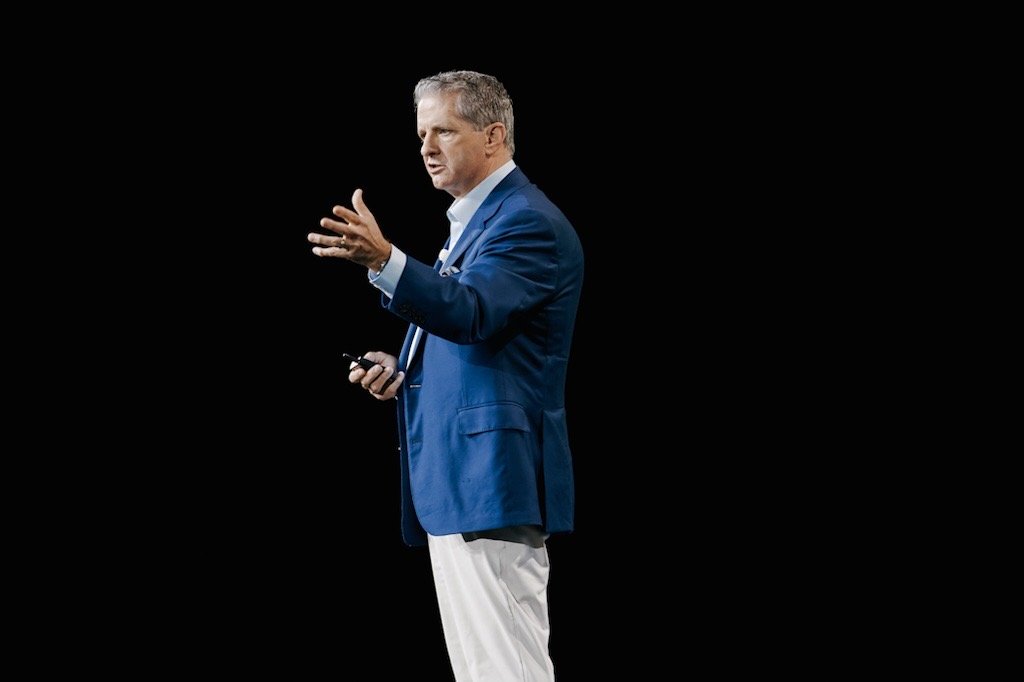
“The fourth Industrial Revolution, driven by artificial intelligence, cloud computing, and digital platforms,” is what will transform wealth management, Price said.
Osaic CEO Jamie Price has a clear message to deliver to financial advisors: the rapid evolution of technology will reshape their work, but ultimately give them more time to do what matters most — serve clients.
Price frames these changes within what he called the Fourth Industrial Revolution, driven by artificial intelligence, cloud computing, and digital platforms. Even as things accelerate, however, he asserts wealth management is still very early in the process. “We’re at maybe the very, very bottom of the first inning,” he told InvestmentNews during Osaic’s annual ConnectED conference earlier this week. “These things are all crashing together — social, digital, cloud computing, the ability for unlimited storage capacity, and iterative AI, generative AI, now iterative AI — and it’s producing stuff that we just can’t fathom.”
Tackling the advisor shortage
A key concern for advisors is how to serve a growing pool of wealthy clients while the number of advisors shrinks. This advisor shortage, reportedly in the vicinity of anywhere between 70,000 to 100,000 over the next five years, could be crippling to the industry. “There’s gonna be 100,000 less advisors, and wealth continues to grow,” Price said. “How are we gonna power productivity for our advisors and the way our staffs work in advisor offices today?”
According to Price, the answer lies in technology that eliminates wasted time on low-value tasks. He pointed to an internal survey showing advisors and their staff spend 35% to 50% of their time on “administrivia” — tasks tied to client work but not directly advisory.
“Our view is this [technology] is what’s going to disrupt that side,” Price said. “These people that were doing administrative work we’re going to replace with machines are going to actually pick up the capacity of the amount of clients available to fewer advisors — if we can do this right.”
Changing roles within the office
Price highlighted one example already in action. Patti Brennan, CEO of Key Financial, piloted Osaic’s “Jump” tool for financial planning, and the impact was immediate.
“It has completely changed the way she runs her financial planning units,” Price said. “Every client has to do a financial plan, and her first and second meetings are totally different. The person sitting in a meeting does not take notes any longer. They have a totally different job.”
Instead of losing staff, advisors may find their team members taking on new, more meaningful roles — sometimes even becoming registered to directly participate in client conversations.
Plugging in tools, fast
For advisors, the speed of change is just as important as the technology itself. Price said Osaic has built a flexible, open digital architecture that allows new tools to be integrated quickly — sometimes in less than 90 days.
“We couldn’t have gotten a tool through cybersecurity tech review or even through compliance in 90 days,” Price admitted. “We put Jump and Zocks on our platform in less than 90 days, and architecturally put it into our system.” As Price also noted in his opening conference keynote, speed has become the table stakes for the company’s growth.
Because technology changes so quickly, he stressed that Osaic’s focus is not on building proprietary tools but on making sure advisors can seamlessly transition as new solutions become available. “The tools will iterate so fast that we could never keep up,” Price said. “We want a very flexible, open digital architecture so we can plug and play tools and move data really fast.”
Advisors at the center of it all
For Price, the bottom line is that technology should expand — not replace — the role of the advisor. By taking repetitive, back-office tasks off their plate, he said, Osaic’s strategy is to free advisors to spend more time with clients.
“The future state, I think I’m probably going to be right,” Price said. “The question is, does it happen in two years or five?”