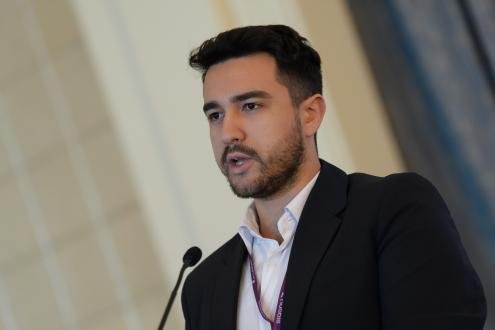
At the Hubbis Independent Wealth Management Forum – Dubai 2026, Alexander Kearns, CEO and Co-Founder of DataDasher, examined how high-performing wealth teams are redesigning post-meeting workflows and operational infrastructure using advisor-focused AI. His presentation positioned workflow automation not simply as efficiency technology, but as a strategic competitive differentiator capable of improving client service, governance oversight and measurable operational returns.
As client expectations accelerate and technology becomes embedded in competitive positioning, Kearns argued that artificial intelligence is rapidly transitioning from optional enhancement to core operational infrastructure.
Key Takeaways
- AI as Competitive Infrastructure: Technology quality increasingly determines client acquisition and retention, redefining operational standards across wealth management.
- Meeting Workflows Are the Productivity Bottleneck: Preparation, documentation and follow-up processes represent one of the largest inefficiencies in advisory practices.
- Verticalised AI Outperforms Generic Tools: Industry-specific platforms designed for regulated environments deliver greater integration, compliance alignment and contextual awareness.
- Workflow Design Drives Adoption Success: Operational improvements require structured change management and leadership clarity on governance and accountability.
- ROI Must Be Operationally Measured: Early metrics should focus on time saved, reduced errors, improved responsiveness and compliance consistency within the first 30–90 days.
Technology as Competitive Advantage – or Strategic Risk
Kearns began by highlighting the accelerating role of technology in shaping competitive dynamics across wealth management. Increasingly, clients expect rapid response times, personalised engagement and seamless service delivery supported by modern infrastructure.
“Technology is becoming one of the greatest competitive advantages firms have,” he suggested. “But outdated workflows and manual processes can just as easily become an Achilles heel.”
Industry research underscores this shift. According to surveys referenced during the session, firms with state-of-the-art technology stacks are significantly more likely to attract clients from competitors operating with outdated systems. As expectations evolve, operational inefficiencies increasingly translate into lost opportunities rather than merely internal inconvenience. His presentation highlighted that 85% of advisors using modern technology believe they have gained clients due to competitors’ outdated tech environments.
The Hidden Cost of Meeting Workflows
A central theme of the presentation was the disproportionate operational burden associated with client meetings. While advisors often focus on portfolio strategy or relationship development, much of their time is absorbed by preparation, documentation and follow-up tasks.
Kearns described meeting workflows as the “largest invisible productivity drain” within wealth management organisations. From gathering client information and drafting notes to updating CRM systems and ensuring compliance-ready records, advisors frequently spend significant portions of their week on administrative work rather than client engagement.
Industry research cited during the session suggests advisors lose more than 15 hours per week to administrative tasks alone – a structural misallocation of precious adviser time that creates both productivity challenges and compliance risks.
Manual processes introduce additional vulnerabilities. Inconsistent note-taking, delayed CRM updates and fragmented follow-ups can undermine governance oversight and create “Friday scramble” scenarios where teams rush to complete compliance documentation retrospectively.
“What a strong workflow looks like,” Kearns explained, “is structured notes, clearly assigned next steps, approval layers and compliance-ready records – without requiring advisors to manually piece everything together after the fact.”
Horizontal AI vs Verticalised Financial AI
A significant portion of the discussion focused on the distinction between general-purpose AI tools and industry-specific solutions.
Generic models such as ChatGPT or Microsoft Copilot provide broad capabilities but lack integration into financial advisory workflows. According to Kearns, these horizontal tools often require extensive manual input, limited system integration and additional compliance oversight.
“Horizontal AI is powerful, but it doesn’t understand financial advisory context,” he noted. “Purpose-built systems embed the language, workflows and regulatory awareness that wealth firms actually need.”
He stated that verticalised solutions integrate directly with CRM systems, communication platforms and portfolio tools while embedding compliance guardrails and data security frameworks designed for regulated industries.
This distinction reflects a broader shift across financial services, where enterprise AI adoption increasingly prioritises contextual integration rather than standalone productivity tools.
From Reactive Advisors to Proactive Relationship Management
Beyond efficiency gains, Kearns highlighted how workflow automation changes the operating model of advisory teams. Traditional workflows often leave advisors operating reactively – responding to client inquiries, searching manually for information and managing follow-ups inconsistently.
Advisor-centric AI platforms, by contrast, enable proactive engagement by surfacing insights across historical communications, CRM data and meeting records. Automated task generation, engagement monitoring and personalised follow-ups allow teams to maintain consistent contact across broader client books.
“The goal is operational alpha,” he suggested. “Better notes are only valuable if they translate into better action.”
DataDasher’s analytics dashboards track engagement across both emails and meetings, allowing firms to see metrics like unique clients contacted, identify at-risk relationships, and ask natural language questions across communication data surfacing answers in seconds. This enables firms to deliver high-touch service at scale without increasing headcount. The shift from reactive to proactive engagement was highlighted as a core transformation enabled by workflow redesign.
Designing for Adoption and Change Management
Kearns cautioned that technology implementation alone does not guarantee success. Firms frequently encounter challenges when introducing new operational tools if leadership fails to define workflows clearly or align incentives around adoption.
High-performing teams prioritise governance frameworks, accountability structures and user-centric design. Advisors must retain approval authority and control over outputs, ensuring that automation supports rather than replaces professional judgement.
“AI should feel like an extension of the advisor,” he explained. “If it disrupts existing workflows instead of integrating into them, adoption stalls quickly.”
Kearns cautioned against firms attempting to build AI capabilities internally, noting that purpose-built vendors iterate faster than most financial services organisations can keep pace with, especially amid the current AI revolution. Beyond initial development costs, firms often underestimate the ongoing burden of platform maintenance and continuous redevelopment required to keep pace with rapidly evolving AI capabilities.
“Wealth managers should focus on what they do best – serving clients,” he suggested. “Let specialised platforms handle specific tasks and workflows. The firms trying to reinvent the wheel internally are losing time they don’t have – and often discover the true cost only after they’ve already committed significant resources.”
Measuring ROI: The First 30–90 Days
Leadership teams often struggle to quantify the value of operational technology investments. Kearns suggested shifting evaluation away from abstract innovation narratives towards measurable operational outcomes.
Key early metrics include:
- Reduction in meeting preparation time
- Faster client response turnaround
- Decreased compliance errors or documentation gaps
- Increased consistency in follow-up actions
- Improved engagement coverage across client segments
Reported efficiency gains from AI-driven meeting workflows range from approximately 10–15 hours saved per advisor each week, alongside measurable productivity improvements and enhanced retention outcomes.
Building the Future Operational Stack
Kearns concluded by reinforcing that AI adoption in wealth management is entering a new phase. Rather than experimental pilots or isolated productivity tools, firms are increasingly deploying advisor-centric systems designed to integrate across the entire client lifecycle.
As client expectations evolve and regulatory complexity grows, operational infrastructure will play a defining role in competitive positioning.
“AI is not about replacing advisors,” he said. “It’s about giving them operational leverage – turning time saved into deeper relationships and better client outcomes.”