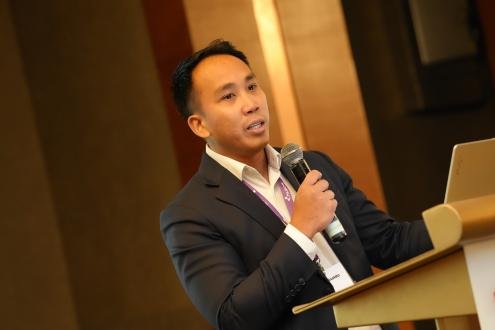
At the Hubbis Thailand Wealth Management Forum 2026, Alex Aguinaldo, Sales Director for Southeast Asia at Avaloq, explored how wealth managers can transition from periods of rapid growth to sustainable, scalable operating models. Drawing on Avaloq’s experience supporting private banks and wealth management institutions across multiple markets, Aguinaldo outlined the structural pressures facing the industry and the strategic steps required to build resilience in an increasingly complex environment.
With more than 170 financial institutions across 35 countries using the Avaloq platform – collectively managing around USD 5 trillion in assets – Aguinaldo emphasised that the next phase of development for wealth managers will depend less on expansion alone and more on operational efficiency, advisory differentiation and intelligent use of technology.
Key Takeaways
- Market Uncertainty Is Driving Higher Client Expectations: Geopolitical risk and market volatility are increasing client engagement demands, requiring faster responses and deeper advisory capabilities.
- The Great Wealth Transfer Is Reshaping Client Relationships: Approximately USD 20 trillion is expected to pass to the next generation globally over the next two decades, including roughly USD 2.5 trillion in Asia.
- Relationship Managers Are Burdened by Operational Complexity: Many RMs continue to spend most their time on non-client-facing activities due to fragmented systems and manual processes.
- Operational Integration Is Critical for Scale: Streamlined platforms and open architectures allow wealth managers to integrate products, services and workflows across the entire value chain.
- AI and Digital Tools Are Accelerating Productivity: AI-driven insights, automation and digital client engagement tools are becoming essential to scaling personalised advisory services.
Structural Pressures Reshaping Wealth Management
Aguinaldo began by highlighting several structural trends that are reshaping the wealth management industry globally and within Asia. Heightened geopolitical tensions and market volatility have intensified client concerns, driving more frequent engagement between advisers and investors.
Survey data suggests that a significant majority of advisers now face increasing pressure to communicate with clients more regularly during periods of uncertainty. At the same time, clients are demanding faster responses and more personalised guidance.
“Market volatility is forcing advisers to engage with their clients more frequently and with greater clarity,” he noted. “Speed and responsiveness are becoming central to maintaining trust.”
Another major force is the ongoing intergenerational transfer of wealth. Globally, approximately USD 20 trillion is expected to change hands over the next two decades, with Asian families accounting for roughly USD 2.5 trillion of that shift. Crucially, many next-generation investors are reassessing their existing wealth relationships.
According to recent data, as many as 66% of APAC investors may reconsider their wealth manager during this transition. For financial institutions, this presents both a retention challenge and a growth opportunity.
“The next generation will not automatically remain with their parents’ adviser,” Aguinaldo explained. “Wealth managers must actively demonstrate value if they want to retain those relationships.”
The Productivity Challenge Facing Relationship Managers
Despite rising expectations placed on advisers, operational realities often prevent relationship managers from spending sufficient time with clients.
Industry surveys indicate that relationship managers still spend most of their working hours to non-client-facing tasks such as administrative processing, internal coordination and navigating multiple technology systems. Aguinaldo noted that many relationship managers are highly skilled professionals, yet they continue to lose significant time to operational friction, limiting their ability to focus on prospecting, financial planning and portfolio discussions.
Training gaps further compound the problem. Nearly half of relationship managers report that they lack sufficient education or support to keep pace with increasingly complex client requirements. At the same time, fragmented technology environments remain a major operational barrier.
While most institutions have invested heavily in digital systems, many of those tools remain underutilised or poorly integrated. In fact, navigating multiple platforms has become one of the most widely cited productivity challenges among wealth professionals. Aguinaldo highlighted that technology should empower advisers, yet in many organisations, the lack of system integration ends up adding complexity instead of reducing it.
Strengthening the Core Operating Model
To address these structural challenges, Aguinaldo outlined three strategic pillars for building a resilient wealth management model.
The first is strengthening the operational core by streamlining systems, processes and data. In many institutions, legacy technology stacks still require manual workflows across front, middle and back-office functions.
In an era increasingly defined by automation and artificial intelligence, such inefficiencies are becoming increasingly difficult to justify.
Aguinaldo noted that manual processes across the value chain are no longer acceptable in modern wealth management and stressed that institutions need platforms capable of orchestrating workflows seamlessly across the entire organisation.
Integrated platform architectures allow wealth managers to connect data, automate processes and provide relationship managers with unified dashboards that consolidate operational and client information.
Such integration can also accelerate product development. When systems are already connected across the organisation, launching new products or services becomes significantly faster and less operationally complex.
“Once the infrastructure is integrated, time to market improves dramatically,” he explained. “Institutions can introduce new solutions without rebuilding processes each time.”
Turning Advisory Differentiation Into Competitive Advantage
While operational efficiency is essential, Aguinaldo emphasised that technology alone does not define competitive success. Wealth managers must also rethink how they structure and deliver advisory services.
The traditional product-driven model is increasingly giving way to client-centric advisory frameworks, particularly as younger investors enter the market.
“Product pushing is no longer sufficient,” Aguinaldo said. “Clients expect advice that reflects their individual goals, preferences and life circumstances.”
Achieving this level of personalisation requires more sophisticated client segmentation. Many wealth managers already divide their client base into broad categories such as mass affluent, affluent and high net worth.
However, Aguinaldo argued that those classifications are no longer granular enough to support truly differentiated advisory services.
Institutions must instead use detailed data to develop richer client personas that incorporate behavioural preferences, investment sophistication and digital engagement habits.
“With more granular client profiles, advisers can deliver services that feel genuinely tailored,” he noted. “That is what ultimately builds long-term trust.”
Such segmentation also enables wealth managers to democratise access to more sophisticated investment solutions. Technology can allow advanced strategies traditionally reserved for high-net-worth clients to be delivered efficiently to a wider range of clients.
Scaling Personalised Advice Through Technology
The final pillar of Aguinaldo’s framework focuses on scaling advisory capabilities through technology. Digital tools now allow wealth managers to extend personalised engagement across both client-facing and adviser-facing channels.
From the client perspective, digital wealth platforms can offer goal-based financial planning tools that guide investors through structured planning processes. By answering a series of targeted questions, clients can receive tailored portfolio recommendations aligned with their objectives.
Engagement can be further enhanced through digital banking features such as behavioural nudges and gamified interactions, techniques that have already proven effective in retail financial services.
Meanwhile, communication habits across Asia continue to evolve. Many investors prefer to interact with advisers via messaging platforms, creating new compliance and data management challenges. Aguinaldo noted that clients increasingly expect to interact with their advisers via these channels, meaning institutions must provide secure, compliant environments that still feel natural and intuitive for such interactions.
Empowering Relationship Managers With Digital Workplaces
On the adviser side, new digital workplace tools are transforming how relationship managers interact with client information.
Advanced analytics platforms can now provide contextual insights into client portfolios, identify potential opportunities and suggest next-best actions based on market conditions and individual client profiles. Aguinaldo noted that this changes how advisers work with information, turning portfolio and market data into timely, client‑specific insights that support more focused client discussions.
Equally important is the ability to execute tasks directly within a unified interface. While many firms have already consolidated data views, execution capabilities often remain fragmented across multiple systems.
Providing advisers with a single operational workspace allows them not only to see client information but also to act on it – whether initiating transactions, updating portfolios or triggering workflow processes.
Artificial Intelligence Across the Wealth Value Chain
Artificial intelligence is rapidly becoming another critical component of the modern wealth management infrastructure.
Aguinaldo highlighted several emerging AI applications across the entire value chain. In the front office, AI-powered assistants can analyse client portfolios, summarise information and recommend specific actions tailored to each client.
Conversational AI interfaces also allow advisers to query internal systems in a manner similar to generative AI tools, enabling faster access to research, documentation and client data.
Operational teams are also benefiting from automation. AI agents can process service tickets, retrieve internal knowledge resources and streamline client servicing functions.
Meanwhile, in banking operations, automation tools are increasingly capable of handling corporate actions and other routine processing tasks that historically required manual intervention.
Even technology development itself is evolving. AI-assisted coding tools are enabling financial institutions to translate business requirements into working software more rapidly. Aguinaldo noted that AI has moved well beyond experimentation and is increasingly embedded across both operational and advisory workflows in wealth management.
Building the Foundation for the Next Phase of Growth
As Aguinaldo concluded, the transition from growth to scale requires more than incremental improvements. Wealth managers must rethink their operational foundations, advisory models and technology strategies simultaneously.
Operational efficiency provides the foundation for scale, freeing advisers to focus on higher-value activities and client engagement. At the same time, differentiated advisory capabilities are essential to retaining clients in an era of generational wealth transition.
Technology – particularly AI – ultimately acts as the enabling layer that connects these elements.
“If institutions want to remain competitive, they must combine efficient operations, differentiated advice and intelligent technology,” Aguinaldo concluded. “Those three elements together define a resilient wealth management model.”